

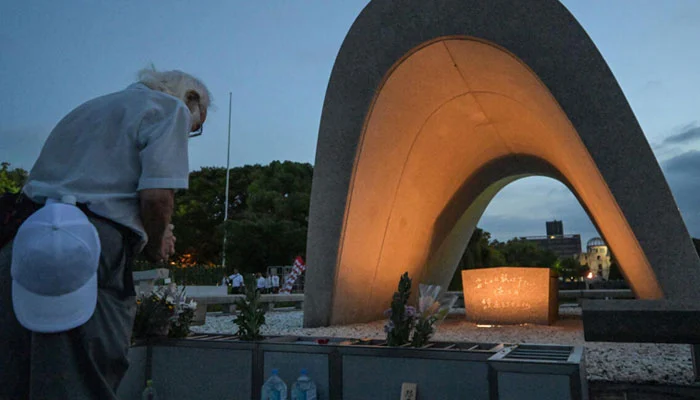
Japan commemorated the 80th anniversary of the atomic bombing of Hiroshima on Wednesday with a ceremony that served as a stark reminder of the devastating power of nuclear weapons, even as global tensions push the nuclear “Doomsday Clock” closer to midnight. A silent prayer was observed at 8:15 am, the precise moment the US aircraft Enola Gay dropped the “Little Boy” atomic bomb on the city on August 6, 1945.
In a somber atmosphere, hundreds of officials, students, and survivors, dressed in black, placed flowers at the memorial cenotaph. The backdrop featured the skeletal remains of a domed building, a powerful symbol of the destruction that unfolded. Hiroshima’s mayor, Kazumi Matsui, used his speech to warn against “an accelerating trend toward military buildup around the world,” citing Russia’s invasion of Ukraine and the ongoing conflicts in the Middle East as prime examples. He stated that these actions “flagrantly disregard the lessons the international community should have learned from the tragedies of history.”
Prime Minister Shigeru Ishiba emphasized that it is Japan’s mission “to take the lead… toward a world without nuclear weapons.” The final death toll from the Hiroshima attack reached approximately 140,000 people, who died not only from the initial blast and fire but also from the long-term effects of radiation. Three days later, on August 9, a second atomic bomb killed 74,000 people in Nagasaki, and Imperial Japan surrendered on August 15, ending World War II.
Today, Hiroshima is a bustling city of 1.2 million, but the memories of the attack remain vivid for many. The night before the ceremony, people began gathering to pay their respects, and before dawn on Wednesday, families who lost loved ones came to pray. Yoshie Yokoyama, a 96-year-old survivor, shared that her parents and grandparents were victims of the bombing. “My grandfather died soon after the bombing, while my father and mother both died after developing cancer,” she said, adding that “People are still suffering.”
The ceremony included representatives from a record 120 countries and regions, with Taiwanese and Palestinian representatives attending for the first time. The United States, which has never formally apologized for the bombings, was represented by its ambassador to Japan, while Russia and China were absent.
The grassroots organization Nihon Hidankyo, which won the Nobel Peace Prize last year, represents the survivors, known as hibakusha. According to the Japanese health ministry, as of March, there were 99,130 hibakusha with an average age of 86. Toshiyuki Mimaki, the group’s co-chair, urged foreign envoys to visit the peace memorial museum to “understand what happened.”
In a statement, Pope Leo XIV said that in “our time of mounting global tensions and conflicts,” Hiroshima and Nagasaki remain “living reminders of the profound horrors wrought by nuclear weapons.” UN Secretary-General Antonio Guterres also warned that “the very weapons that brought such devastation to Hiroshima and Nagasaki are once again being treated as tools of coercion.”
These attacks remain the only use of atomic bombs in wartime. Kunihiko Sakuma, an 80-year-old survivor, expressed hope for a nuclear-free world, noting that “the younger generation is working hard for that end.” However, in January, the Bulletin of the Atomic Scientists’ “Doomsday Clock” was set to 89 seconds to midnight, the closest it has ever been in its 78-year history. This symbolic clock, which represents humanity’s proximity to destruction, was last moved to 90 seconds to midnight in 2022 following Russia’s invasion of Ukraine.
According to the Stockholm International Peace Research Institute (SIPRI), Russia and the United States together possess approximately 90% of the world’s over 12,000 nuclear warheads. SIPRI warned in June that “a dangerous new nuclear arms race is emerging at a time when arms control regimes are severely weakened,” with nearly all nine nuclear-armed states modernizing their arsenals. Earlier this month, US President Donald Trump ordered the deployment of two nuclear submarines after a public exchange with former Russian president Dmitry Medvedev.
