

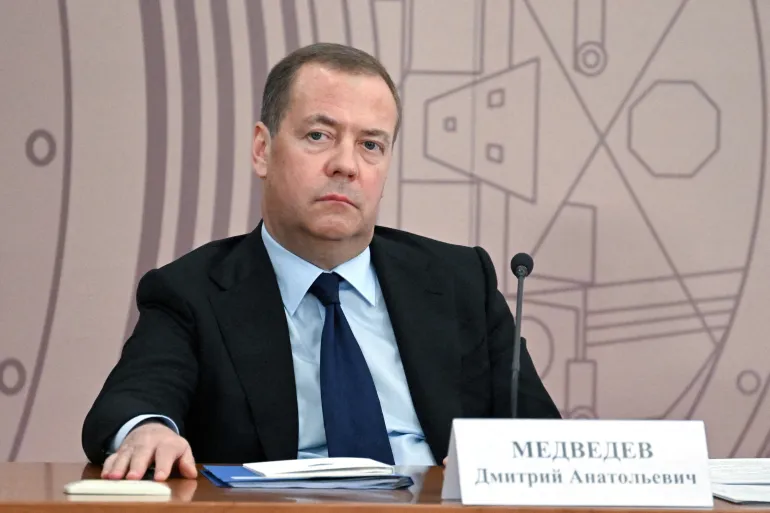
Former Russian President and current Deputy Head of the Security Council, Dmitry Medvedev, has announced that Russia is withdrawing its moratorium on the deployment of medium- and short-range missiles. In a post on X, he stated that this decision is a direct result of the “anti-Russian policy” pursued by NATO countries. Medvedev described this as a “new reality” that Russia’s opponents must accept, adding that they should “expect further steps.”
This announcement follows recent comments from US President Donald Trump, who last week said he had ordered two US nuclear submarines to be repositioned in response to Medvedev’s remarks about the risk of a war between Washington and Moscow.
In its official statement, the Russian Foreign Ministry said its reassessment was prompted by the developing situation in Europe and the Asia-Pacific. The ministry explained that since the US is moving toward deploying its own land-based medium- and short-range missiles in these regions, the conditions for Russia to maintain its unilateral moratorium on similar weapons have disappeared.
This sentiment echoes previous warnings from Russian President Vladimir Putin and Foreign Minister Sergey Lavrov. Last year, they both indicated that Moscow might have to lift its restrictions on missile deployment in response to what they called provocations from the US and NATO. Lavrov had specifically criticized the US for “arrogantly” ignoring warnings from Russia and China by proceeding with the deployment of these weapons.
The backdrop to this entire situation is the 2019 withdrawal of the US from the Intermediate-Range Nuclear Forces (INF) treaty, which had been signed in 1987 by Soviet leader Mikhail Gorbachev and US President Ronald Reagan. The treaty had eliminated an entire class of ground-launched nuclear missiles. The US withdrew from the agreement under the first Trump administration, citing Russian non-compliance, while Moscow had insisted it would not deploy such weapons as long as Washington didn’t.
On Monday, the Kremlin played down Trump’s recent comments about repositioning submarines. Kremlin spokesman Dmitry Peskov told reporters that American submarines are already on “combat duty” and that the Kremlin did not want to engage in a public controversy over the matter. He added that everyone should be “very, very careful with nuclear rhetoric.”
The episode unfolds at a particularly sensitive moment. Trump is currently threatening to impose new sanctions on Russia—and on countries that buy its oil, such as India and China—if President Vladimir Putin does not agree to a ceasefire in Ukraine by Friday. Putin, however, has recently stated that Russia has the momentum in the war, signaling no shift in his position despite the looming deadline.
