

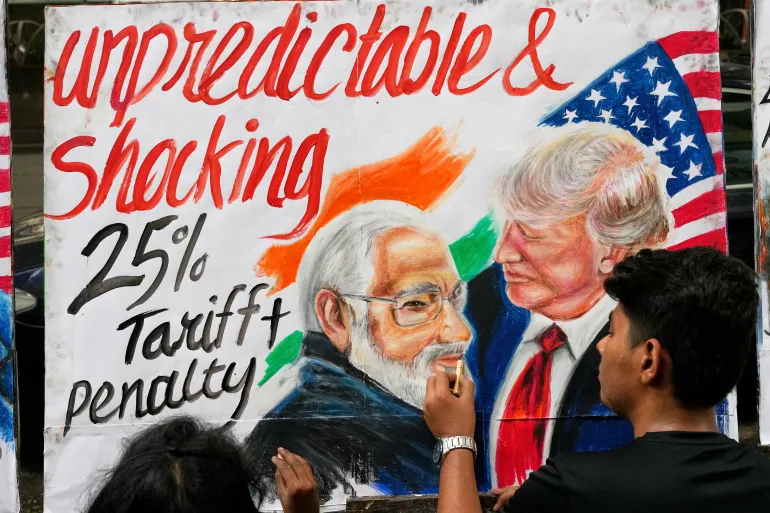
In a strong pushback against increasing pressure from Washington and Brussels on its trade and ties with Russia, India has broken its silence. This aggressive stance came just hours after US President Donald Trump threatened to significantly increase the tariffs he had previously announced on Indian goods.
Trump had initially imposed a 25% tariff on Indian imports, set to take effect on August 7. However, in a social media post, he declared he would “substantially” raise the tariff, citing India’s continued imports of Russian crude oil. This followed a similar move by the European Union, which had also recently sanctioned Nayara, a Russian-owned Indian oil refiner, and banned imports of refined products made from Russian crude, further impacting India’s refining sector.
Previously, India’s response had been subdued, but that has now changed. Just two hours after Trump’s announcement, New Delhi issued a statement accusing the US and EU of using double standards. India claimed that these Western nations had, in fact, quietly encouraged India to buy Russian crude earlier. This has led to a noticeable strain in India’s otherwise growing relations with the West.
On August 4, Indian Prime Minister Narendra Modi’s government issued a terse statement, calling the targeting of India “unjustified and unreasonable.” Ministry of External Affairs spokesperson Randhir Jaiswal stated that India would take all necessary measures to protect its national interests, making it clear that New Delhi is not backing down.
Jaiswal pushed back directly against the notion that India’s actions were out of step with Western behavior. He asserted that India began importing from Russia only after traditional supplies were diverted to Europe following the invasion of Ukraine. He further claimed that the US had actively encouraged these imports to stabilize global energy markets. Jaiswal concluded that it was “revealing that the very nations criticising India are themselves indulging in trade with Russia,” citing data that shows the EU’s total trade with Russia in 2024 was higher than India’s.
Trade economist Biswajit Dhar noted that India’s response was unsurprising. “The aggressiveness that the Trump administration has shown – there had to be some reaction from India,” he said, adding that such threats from another country are “unacceptable” for a sovereign nation.
The US is India’s largest export market, and Trump’s higher tariffs could significantly disrupt this trade, bleeding India’s export revenue. The EU’s ban on refined petroleum from Russian crude could also batter the profits of Indian refiners, who had been benefiting from buying subsidized Russian oil.
Some experts believe Trump’s threats are a trade negotiating tactic to secure a deal favorable to the US. However, a key sticking point remains agriculture, as India is unwilling to open its markets to US agribusiness, a move that would negatively impact its large farming population.
Amid this, the debate continues over who is more responsible for enabling Russia’s war. The facts show that while India’s trade with Russia has surged, the EU’s total trade with Russia in 2024 was still higher. Furthermore, a former US ambassador to India, Eric Garcetti, has acknowledged that India’s purchase of Russian oil was part of a Western policy design to keep global oil prices from skyrocketing.
