

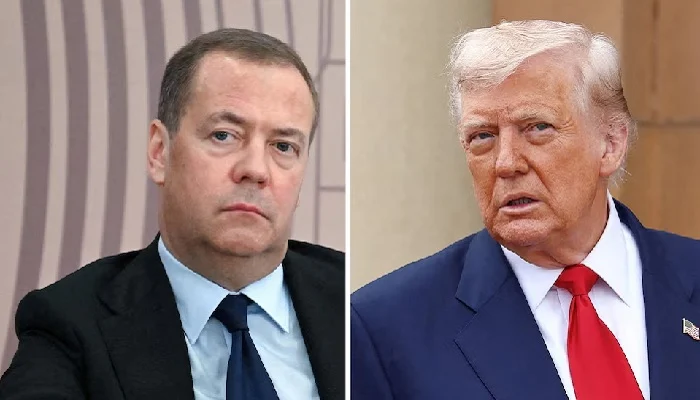
In response to threats from former Russian President Dmitry Medvedev, U.S. President Donald Trump announced on Friday that he has ordered two nuclear submarines to be moved to “appropriate regions.” Security analysts have described Trump’s action as a rhetorical escalation, not necessarily a military one, noting that the U.S. already has nuclear-powered submarines deployed that are capable of striking Russia.
The public exchange began after Trump told Medvedev to “watch his words,” to which Medvedev responded on Thursday by saying that Trump should remember Moscow possesses Soviet-era nuclear strike capabilities as a last resort. In a social media post on Friday, Trump stated, “Based on the highly provocative statements of the Former President of Russia, Dmitry Medvedev… I have ordered two Nuclear Submarines to be positioned in the appropriate regions, just in case these foolish and inflammatory statements are more than just that.” He added, “Words are very important, and can often lead to unintended consequences. I hope this will not be one of those instances.”
When later asked by reporters why he issued the order, Trump replied, “A threat was made by a former president of Russia, and we’re going to protect our people.” The U.S. Navy and the Pentagon declined to comment, as discussing the deployment and location of submarines is extremely rare due to their sensitive mission in nuclear deterrence.
Trump’s comments come amid rising tensions between Washington and Moscow, as Trump has expressed growing frustration with what he perceives as President Vladimir Putin’s failure to negotiate an end to the ongoing invasion of Ukraine. While Trump did not specify whether the submarines were nuclear-armed or just nuclear-powered, security experts voiced concern over any U.S. president’s talk of potential nuclear military capabilities. They noted that the United States has historically avoided matching Russia’s nuclear saber-rattling.
Daryl Kimball, executive director of the Arms Control Association, called Trump’s move “irresponsible and inadvisable,” stating, “No leader or deputy leader should be threatening nuclear war, let alone in a juvenile manner on social media.” Hans Kristensen of the Federation of American Scientists pointed out that U.S. nuclear submarines are always positioned to launch nuclear-armed missiles at targets in Russia and “don’t need to be moved into position.” He added that Trump’s actions give Medvedev a response to his “crazy statements.”
Medvedev, who serves as the deputy chairman of Russia’s Security Council, has become one of the Kremlin’s most outspoken anti-Western figures since the 2022 invasion of Ukraine. While some Western diplomats see his statements as an indication of senior Kremlin thinking, others dismiss him as an irresponsible figure. U.S. officials had told Reuters before Trump’s latest remarks that they did not consider Medvedev’s comments a serious threat.
This latest public clash follows a recent back-and-forth where Trump set a 10-day deadline for Russia to agree to a ceasefire in Ukraine or face new tariffs. Kristensen described Trump’s actions as creating a “commitment trap” by raising expectations that he might use nuclear weapons if tensions with Russia escalate. However, Evelyn Farkas, executive director of the McCain Institute, played down the risk of nuclear conflict, calling Trump’s move a form of “signaling” rather than the start of a confrontation. She added that his actions are unlikely to persuade Russia to change its course in Ukraine.
