

Just after midnight on May 7, the Pakistan Air Force’s operations room was a flurry of red as dozens of Indian aircraft appeared on their screens. Anticipating an Indian strike, Air Chief Marshal Zaheer Sidhu had been staying on a mattress in an adjoining room. The previous month, an attack in Indian Kashmir had killed 26 civilians, and while Islamabad had denied any involvement, India had blamed Pakistan for backing the militants and vowed a response. That response came in the form of pre-dawn air strikes on May 7.
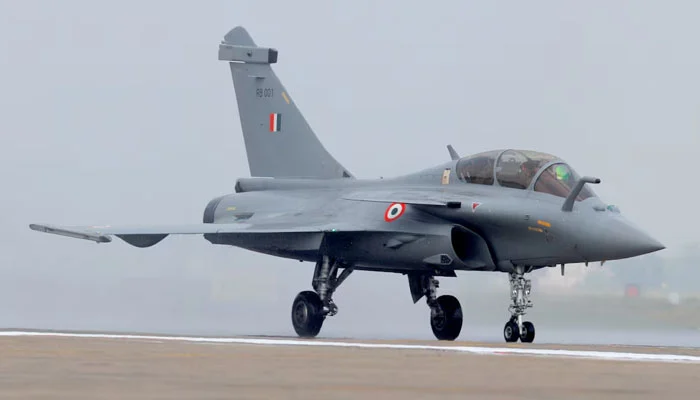
Air Chief Marshal Sidhu immediately ordered Pakistan’s prized Chinese-made J-10C jets to scramble. A senior Pakistan Air Force (PAF) official, who was present in the operations room, recalled the air chief’s instructions to target the French-made Rafales—the crown jewel of India’s fleet, which had never been shot down in battle. “He wanted Rafales,” the official said.
The hour-long aerial battle, which took place in darkness, involved an estimated 110 aircraft, making it the largest air skirmish in decades. According to a Reuters report in May, citing US officials, the J-10s successfully shot down at least one Rafale. The downing of the Rafale surprised many in the military world and raised questions about the effectiveness of Western military hardware against untested Chinese alternatives.
Following these reports, shares of Dassault, the maker of the Rafale, declined. Indonesia, which has outstanding Rafale orders, has since indicated it is considering purchasing J-10s, providing a significant boost to China’s efforts to sell the aircraft internationally. However, interviews conducted by Reuters with two Indian and three Pakistani officials revealed that the Rafale’s performance wasn’t the main issue. The key to its downing was an Indian intelligence failure regarding the range of the Chinese-made PL-15 missile fired by the J-10. Pakistan and China are the only two countries that operate both J-10s, also known as Vigorous Dragons, and PL-15s.
Indian officials stated that the faulty intelligence created a false sense of security for the Rafale pilots, who believed they were out of Pakistani firing range, estimated to be around 150 km—the widely cited range of the PL-15’s export variant. “We ambushed them,” the PAF official said, adding that Islamabad also conducted an electronic warfare assault to confuse the Indian pilots. Indian officials, however, disputed the effectiveness of this electronic attack.
Justin Bronk, an air warfare expert at London’s Royal United Services Institute (RUSI) think tank, noted, “The Indians were not expecting to be shot at. And the PL-15 is clearly very capable at long range.” Pakistani officials claimed the PL-15 that hit the Rafale was fired from approximately 200 km away, while Indian officials estimated the distance to be even greater. This would make it one of the longest-range air-to-air strikes ever recorded.
India’s defense and foreign ministries did not respond to requests for comment about the intelligence failures. While Delhi has not acknowledged the loss of a Rafale, France’s air chief told reporters in June that he had seen evidence of the downing of that fighter and two other Indian aircraft, including a Russian-made Sukhoi. A top Dassault executive also informed French lawmakers that month that India had lost a Rafale during operations.
Pakistan’s military referred to past statements from a spokesperson who emphasized that their professional readiness and resolve were more critical than the specific weapons deployed. China’s defense ministry did not reply to Reuters’ questions. Dassault and UAC, the manufacturer of the Sukhoi, also did not provide comments.
‘Situational Awareness’
Reuters spoke with eight Pakistani and two Indian officials to reconstruct the events of the aerial battle, which triggered four days of fighting between the two nuclear-armed nations and caused concern in Washington. All officials spoke on the condition of anonymity to discuss national security matters.
Not only did Islamabad have the element of surprise with the missile’s range, but Pakistani and Indian officials also said that Pakistan was more effective at connecting its military hardware to its ground and air surveillance. This provided a clearer picture of the battlefield. These networks, known as “kill chains,” are now a critical component of modern warfare.
Four Pakistani officials said they created a “kill chain,” or a multi-domain operation, by linking air, land, and space sensors. According to two Pakistani officials, the network included a Pakistani-developed system, Data Link 17, which connected Chinese military hardware with other equipment, including a Swedish-made surveillance plane. Experts explained that this system allowed the J-10s flying closer to India to receive radar feeds from the surveillance plane, which was cruising farther away. This enabled the Chinese-made fighters to turn off their own radars and fly undetected.
Indian officials noted that Delhi is trying to create a similar network but acknowledged that their process is more complicated because the country acquires aircraft from a wide range of international suppliers. Retired UK Air Marshal Greg Bagwell, now a fellow at RUSI, said the incident did not definitively prove the superiority of either Chinese or Western air assets, but it highlighted the importance of having accurate information and using it effectively. “The winner in this was the side that had the best situational awareness,” Bagwell stated.
Shift in Tactics
After India struck targets in Pakistan that it described as terrorist infrastructure in the early hours of May 7, Sidhu ordered his squadrons to shift from a defensive to an offensive posture. Five PAF officials said India had deployed around 70 planes, more than they had anticipated, which presented a target-rich environment for Islamabad’s PL-15s. India has not disclosed the number of planes used.
Bagwell noted that the May 7 battle was the first major modern air conflict where weaponry was used to strike targets beyond visual range. He added that both Indian and Pakistani planes remained within their respective airspaces throughout the engagement.
Five Pakistani officials stated that an electronic assault on Indian sensors and communication systems degraded the situational awareness of the Rafale pilots. However, the two Indian officials denied that the Rafales were blinded or that Indian satellites were jammed. They did, however, acknowledge that Pakistan appeared to have disrupted the Sukhoi’s systems, which Delhi is now in the process of upgrading.
Other Indian security officials have deflected questions away from the Rafale, a centerpiece of India’s military modernization, and instead pointed to the orders given to the air force. India’s defense attaché in Jakarta told a university seminar that Delhi had lost some aircraft “only because of the constraint given by the political leadership to not attack [Pakistan’s] military establishments and their air defenses.” India’s chief of defense staff, General Anil Chauhan, previously told Reuters that Delhi had quickly “rectified tactics” after the initial losses.
‘Live Inputs’
In the aftermath of the event, India’s deputy army chief, Lt. Gen. Rahul Singh, accused Pakistan of receiving “live inputs” from China during the battles, implying radar and satellite feeds. He did not provide evidence, and Islamabad has denied the allegation. When asked at a July briefing about Beijing’s military partnership with Pakistan, Chinese Foreign Ministry spokesperson Mao Ning told reporters that the work was “part of the normal cooperation between the two countries and does not target any third party.”
China did not respond to questions about this interaction. In a July statement, the Pakistani military said that Wang had expressed “keen interest in learning from PAF’s battle-proven experience in Multi Domain Operations.”
