

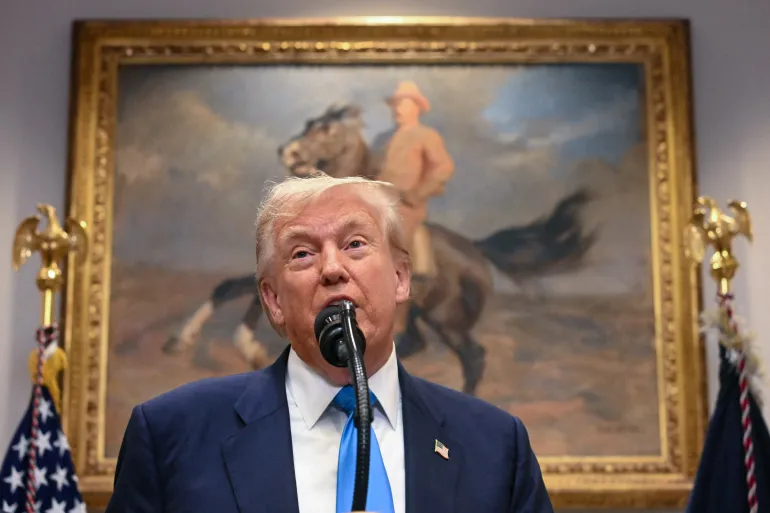
President Trump’s reaction follows by a day Prime Minister Carney’s announcement that Canada intends to recognize the State of Palestine at the 80th session of the United Nations General Assembly in September, provided certain conditions are met, mirroring recent declarations by France and the UK.
Canada and the US are actively negotiating a trade deal, with a deadline of August 1. Trump has threatened to impose a 35 percent tariff on all Canadian goods not covered by the US-Mexico-Canada (USMCA) trade agreement if an agreement is not reached by this date. Carney stated on Wednesday that tariff negotiations with the Trump administration have been constructive, but acknowledged that talks might not conclude by the looming deadline.
Carney emphasized that recognizing Palestinian statehood is crucial for preserving the hope of a two-state solution to the Israeli-Palestinian conflict, a long-standing Canadian objective that he described as “being eroded before our eyes.” The Prime Minister asserted that the escalating suffering of civilians in Gaza leaves “no room for delay in coordinated international action to support peace.”
However, Carney’s decision is contingent upon specific commitments from the Palestinian Authority (PA), the body led by President Mahmoud Abbas that exercises civil authority in parts of the Israeli-occupied West Bank. Carney stipulated that for Canada to proceed with recognition, the PA must demonstrate “commitment to much-needed reforms,” including Abbas’s pledge to “hold general elections in 2026 in which Hamas can play no part, and to demilitarize the Palestinian state.”
Canada Aligns with UK and France
The US has rejected moves to recognize a Palestinian state, arguing that such a policy would reward Hamas. The Trump administration has maintained unwavering support for Israel, despite accusations by UN experts and human rights organizations that the US ally is committing genocide against Palestinians.
The Israeli military has caused the deaths of over 60,000 Palestinians in Gaza and devastated most of the territory since the war began in 2023. The rising number of Palestinians dying from starvation—now at least 154 people, including 89 children—and the hundreds killed at US- and Israeli-backed aid distribution sites have intensified global condemnation of Israel.
Even Trump himself has acknowledged that starvation is clearly occurring in Gaza, despite Israeli denials. His Middle East envoy, Steve Witkoff, is expected to arrive in Israel on Thursday for ceasefire and aid negotiations.
With Wednesday’s announcement, Carney has positioned Canada alongside France, following President Emmanuel Macron’s statement that his country would formally recognize a Palestinian state during the same UN meeting.
The Israeli embassy in Ottawa responded by stating that “recognizing a Palestinian state in the absence of accountable government, functioning institutions, or benevolent leadership, rewards and legitimizes the monstrous barbarity of Hamas on October 7, 2023.”
PA President Abbas, however, welcomed the announcement as a “historic” decision, while France indicated that the countries would collaborate “to revive the prospect of peace in the region.” Canada’s plan goes a step further than the British Prime Minister Keir Starmer’s announcement this week. Starmer had stated that the UK would formally recognize the State of Palestine in September unless Israel takes various “substantive steps,” including agreeing to a ceasefire in Gaza.
Carney underscored Canada’s long-standing commitment as a member of the nations that had hoped a two-state solution “would be achieved as part of a peace process built around a negotiated settlement between the Israeli government and the Palestinian Authority.”
“Regrettably, this approach is no longer tenable,” Carney stated, citing “Hamas terrorism” and the group’s “longstanding violent rejection of Israel’s right to exist,” thereby attempting to balance his criticism of Israel’s actions with condemnation of Hamas. Carney also pointed out that the peace process has been undermined by the expansion of Israeli settlements across the occupied West Bank and East Jerusalem.
The Prime Minister concluded that a two-state solution is becoming increasingly distant, referencing a vote in Israel’s parliament “calling for the annexation of the West Bank,” as well as Israel’s “ongoing failure” to prevent a humanitarian catastrophe in Gaza. He framed his decision as one aimed at safeguarding Israel’s future, asserting that “any path to lasting peace for Israel also requires a viable and stable Palestinian state, and one that recognizes Israel’s inalienable right to security and peace.”
