

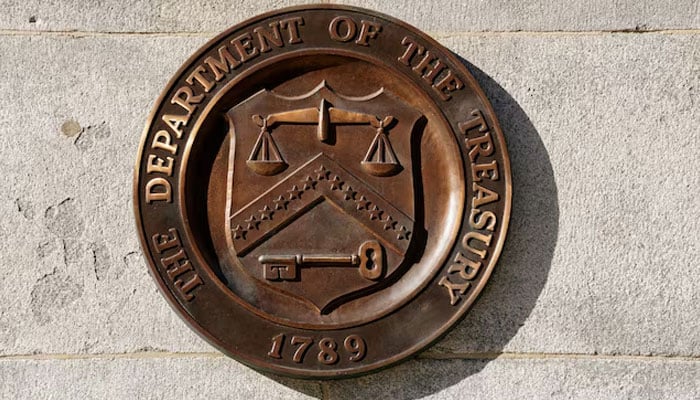
The United States has announced a fresh wave of sanctions, extensively targeting Iran’s shipping industry, encompassing over 100 individuals, companies, and vessels linked to the country. This action is part of President Donald Trump’s intensified campaign to exert pressure on Tehran, particularly following airstrikes on its nuclear sites in June.
US officials stated that the primary objective of these sanctions is to impede Iran’s oil sales and to cut off financial flows believed to sustain the current regime. The sanctions broadly focus on the shipping interests associated with Mohammad Hossein Shamkhani, the son of Ali Shamkhani, who serves as an adviser to Supreme Leader Ayatollah Ali Khamenei.
The US Treasury Department characterized this move as the most significant Iran-related sanctions action since 2018, during President Donald Trump’s initial administration. According to the Treasury, Mohammad Hossein Shamkhani controls a vast network of container ships and tankers through a complex web of intermediaries, facilitating the global sale of Iranian and Russian oil and other commodities.
The Treasury accused Shamkhani of leveraging personal connections and corruption within Tehran to generate tens of billions of dollars in profits, a substantial portion of which is allegedly used to bolster the Iranian regime. In total, the new sanctions target 15 shipping firms, 52 vessels, 12 individuals, and 53 entities involved in sanctions evasion across 17 countries, spanning from Panama to Italy to Hong Kong.
A US official indicated that these sanctions would make it “much more difficult” for Iran to sell its oil, though the administration does not foresee any prolonged disruption to global oil markets. The official added that Iran’s oil exports had already declined to approximately 1.2 million barrels per day, down from 1.8 million at the start of the year, following previous rounds of sanctions aimed at Iran’s oil sector.
“We’re still pursuing further action to bring that number down even more,” the official stated, recalling that sanctions during Trump’s first term had reduced Iranian oil exports to only a few hundred thousand barrels per day.
An Iranian foreign ministry spokesperson, Esmaeil Baghaei, denounced the sanctions as “a clear example of America’s hostility towards the Iranian nation,” according to the country’s Student News Network. Baghaei further asserted that the sanctions were “an evil act aimed at harming Iran’s economic development and the welfare of its people.”
China remains the largest purchaser of Iranian oil. Earlier in July, the European Union also imposed sanctions on Mohammad Hossein Shamkhani due to his alleged involvement in the Russian oil trade. A US official confirmed that Wednesday’s actions would impact both Russia and Iran but underscored that the primary focus remains on Iran.
“From our perspective, given where this individual fits, given his connection to the Supreme Leader and his father’s previous sanctions activity, and under the Iran-related authorities, this is an Iran action — meaningful and impactful,” the official declared. Ali Shamkhani, Mohammad Hossein Shamkhani’s father, was previously sanctioned by the United States in 2020.
This latest round of sanctions emerges amid diminished hopes for renewed US-Iran diplomacy, following last month’s US bombing of Iranian nuclear sites. Trump issued a warning on Monday that additional US attacks would follow if Tehran attempts to reactivate the nuclear sites previously targeted. He also claimed Iran had been sending out “nasty signals” and cautioned that any effort to resume its nuclear program would be immediately suppressed.
Prior to the June airstrikes, the United States had conducted five rounds of talks with Iran. Trump asserted that these strikes had “obliterated” a program that Washington and its ally Israel contend is aimed at developing a nuclear bomb. Some experts, however, have expressed doubts about the full extent of the damage. Iran consistently denies seeking nuclear weaponry.
A senior White House official indicated last week that Washington remains open to direct negotiations with Iran. However, European and Iranian diplomats suggest there is little likelihood of Tehran returning to talks with the US in the near future.
