

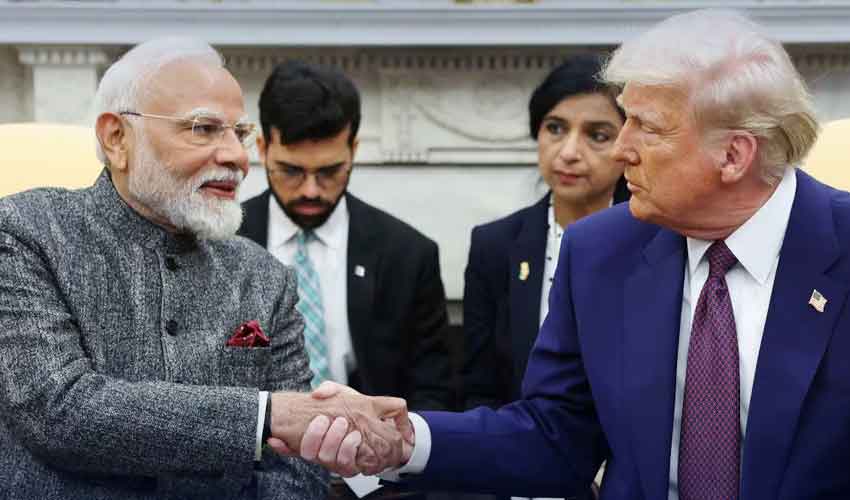
U.S. President Donald Trump has stated that a trade agreement with India has not yet been finalized, issuing a warning of potentially higher tariffs ahead of the August 1 deadline for securing a deal.
These comments follow a Reuters report indicating that India was preparing to accept increased tariffs of 20%-25% on its exports to the U.S. if a trade deal isn’t reached, as it refrains from offering new concessions before Friday’s deadline.
Speaking to reporters aboard Air Force One on Tuesday, Trump remarked, “India has been a good friend, but India has charged basically more tariffs, almost more than any other country,” adding that this situation would cease.
When questioned about the Reuters report, Trump reiterated that a trade deal had not been finalized and that India could face more significant tariffs.
Indian officials stated that India intends to resume broader trade discussions with the U.S. in mid-August, coinciding with an anticipated visit by a U.S. delegation, with aspirations to conclude a comprehensive bilateral trade agreement by October.
“Talks are progressing well,” an official commented, further noting that in a “worst-case scenario,” Trump might issue a tariff order. The official requested anonymity due to not being authorized to speak to the media.
“But, we assume it would be a temporary measure, considering the five rounds of trade talks that have taken place. A deal will soon be worked out,” the official added.
Trump also reiterated his assertion that he facilitated a ceasefire in a conflict between India and Pakistan earlier this year, claiming both nations accepted his request.
Describing his friendship with Prime Minister Narendra Modi, he stated, “That was great.” However, India disputes Trump’s claims of having brokered the ceasefire.
Analysts suggest that Trump’s remarks concerning the India-Pakistan conflict have cast a shadow over the ongoing trade negotiations.
On Monday, Trump had indicated that most partners who do not negotiate separate trade deals would soon face tariffs ranging from 15% to 20% on their exports to the United States, a considerable increase from the general 10% tariff he imposed in April. His administration plans to notify approximately 200 countries of their new “world tariff” rate shortly.
U.S. Trade Representative Jamieson Greer informed CNBC that discussions with India require more time, emphasizing that Trump desires favorable deals, not quick ones.
Greer observed that India has demonstrated “strong interest in opening portions of its market,” despite its trade policy historically prioritizing the protection of domestic interests.
Piyush Goyal, India’s trade minister, told Reuters last week that India was making “fantastic” progress in U.S. trade negotiations.
Indian officials revealed that New Delhi had proposed tariff reductions on a wide array of goods and was actively working to alleviate non-tariff barriers.
Nonetheless, agriculture and dairy sectors remain “no-go” areas, with India unwilling to permit U.S. imports of genetically modified soybean or corn, or to open its dairy industry.
Total bilateral goods trade amounted to approximately $129 billion in 2024, with India reporting a trade surplus of nearly $46 billion.
Officials conveyed that India is adjusting its strategy amidst broader U.S. tariff threats targeting BRICS nations, including India, over matters such as de-dollarization and purchases of Russian oil.
A second Indian government official, who chose to remain anonymous, stated, “We remain hopeful of securing a deal that gives Indian exporters preferential access compared to our peers.”
