

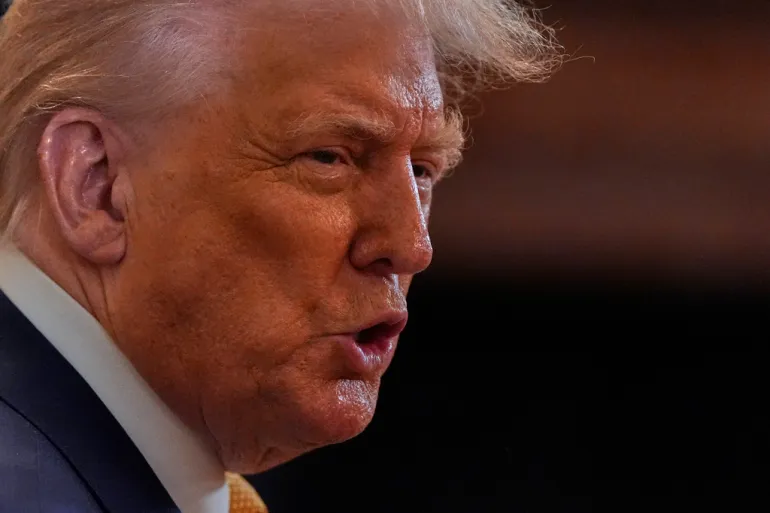
As United States President Donald Trump continues his aggressive push of tariff announcements, one thing is becoming increasingly evident, according to experts: some level of import duties are here to stay. In recent weeks, Trump has unveiled a series of agreements with the European Union, Japan, Indonesia, Vietnam, and the Philippines, featuring tariffs ranging from 15 percent to 20 percent.
He has also issued a threat of a 50 percent tariff on Brazil, introduced duties of 30 percent and 35 percent for key trading partners Mexico and Canada, and indicated that deals with China and India are close to completion. The exact final rates of Trump’s tariffs remain uncertain, but Vina Nadjibulla, vice president of research and strategy at the Asia Pacific Foundation of Canada, emphasizes a clear trend: “No one is getting zero tariffs. There’s no going back.”
Trump’s frequent announcements have caused months of chaos for industries, leaving businesses in a state of limbo and compelling them to pause investment and hiring decisions. The World Bank has consequently slashed its growth forecasts for nearly 70 percent of economies, including the US, China, and Europe, and six emerging market regions. It also reduced its global growth estimate to 2.3 percent, a drop from 2.7 percent in January. Oxford Economics has forecasted a mild recession in capital spending across the Group of Seven (G7) nations—Canada, France, Germany, Italy, Japan, the United Kingdom, and the US—expected to last from the second to the third quarter of this year.
“What we’re seeing is the Donald Trump business style: There’s lots of commotion, lots of claim, lots of activity and lots of b*******,” Robert Rogowsky, professor of international trade at the Middlebury Institute of International Studies, told Al Jazeera. He elaborated, “That’s his business model, and that’s how he operates. That’s why he’s driven so many of his businesses into bankruptcy. It’s not strategic or tactical. It’s instinctive.”
Rogowsky anticipates that Trump will once again postpone his tariff deadline, having already delayed it from April to July, and then to August 1. “It’s going to be a series of TACO tariffs,” Rogowsky stated, referencing the acronym for “Trump Always Chickens Out“—a term coined by Financial Times columnist Robert Armstrong in early May to describe the US president’s frequent reversals on tariffs in response to stock market volatility. “He will bump them again,” Rogowsky added. “He’s just exerting the image of power.”
Trump’s inconsistent policy shifts have characterized his dealings with some of the US’s largest trade partners, including China and the EU. China’s tariff rate has fluctuated wildly, moving from 20 percent to 54 percent, then 104 percent, 145 percent, and finally settling at 30 percent, with implementation deadlines repeatedly shifted. Proposed tariff rates for the EU have followed a similar volatile pattern, escalating from 20 percent to 50 percent, then 30 percent, and finally settling at 15 percent after the latest trade deal. The EU’s current tariff rate applies only to 70 percent of goods, with a zero rate for a limited range of exports, including semiconductor equipment and some chemicals. European steel exports will continue to be taxed at 50 percent, and Trump has signaled that new tariffs on pharmaceutical products could be forthcoming. Despite the numerous trade agreements, many operational details of Trump’s tariffs remain ambiguous.
Regardless of whether Trump announces further changes, analysts agree that the world has entered a new phase where countries are actively seeking to reduce their reliance on the US. “Now that the initial shock and anger [at Trump policies] has subsided, there is a quiet determination to build resilience and become less reliant on the US,” Nadjibulla observed, suggesting that Trump’s actions are compelling countries to address longstanding, previously intractable issues.
For example, Canada is addressing inter-provincial trade barriers, a historically sensitive political issue, even as it seeks to diversify its export markets, noted Tony Stillo, director of Canada Economics at Oxford Economics. “It would be foolhardy not to provide to the US, seeing as it’s our largest market, but it also makes us more resilient to provide to other markets as well,” Stillo told Al Jazeera. Canadian Prime Minister Mark Carney has reached out to the EU and Mexico and expressed his desire to improve his country’s strained relations with China and India. This month, Canada expanded its liquified natural gas exports beyond the US market, with its first shipments to Asia. To mitigate the impact of Trump’s tariffs, Ottawa has offered relief to Canadian businesses, including automakers, and has imposed a six-month pause on tariffs for certain imports from the US to allow firms time to adjust their supply chains.
There is also “some relief” in the fact that other countries “don’t seem to be imitating the Trump show [by levying their own tariffs]. They’re witnessing this attempt to strong-arm the rest of the world, but it doesn’t seem to be working,” Mary Lovely, the Anthony M. Solomon senior fellow at the Peterson Institute for International Economics (PIIE), told Al Jazeera. However, the world is closely observing the impact of these tariffs on the US economy, as “that will also be instructive to other countries,” Lovely added. “If we see a slowdown, as we expect, it becomes a cautionary tale for others.” Although the US stock market is near an all-time high, it is heavily skewed towards the “magnificent seven,” referring to the largest tech companies, which reflects only a segment of the broader economy.
Trump’s tariffs exacerbate other growing challenges for global exporters, including China’s subsidy-heavy industrial policy that enables its businesses to undercut competitors. “We’ve entered a period of global economic alignment with the reintroduction of industrial policies,” Nadjibulla stated, explaining that more governments are likely to provide support for their domestic industries. “Each country will have to navigate these and find ways to de-risk and reduce overreliance on the US and China.”
Nonetheless, countries seeking to support their homegrown industries will need to do so while navigating the complexities of the World Trade Organization and rules-based trade agreements like the Comprehensive and Progressive Agreement for Trans-Pacific Partnership, Nadjibulla highlighted. “It will take some tremendous leadership around the world to corral this wild mustang [Trump] before he breaks up the world order,” Rogowsky asserted. “But it will break because I do think Donald Trump will drive us into a recession.”
