

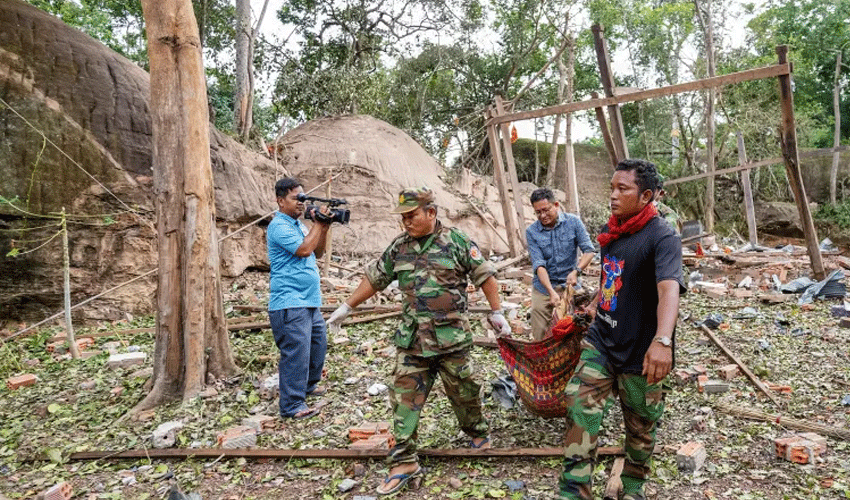
US President Donald Trump claimed on Saturday that he successfully mediated a ceasefire agreement between Cambodia and Thailand amid ongoing border clashes that have resulted in at least 33 deaths and displaced thousands. However, reports of continued shelling along the frontier overnight have cast doubt on the effectiveness of his intervention.
In a post on his social media platform, Truth Social, Trump stated he had spoken separately with Cambodian Prime Minister Hun Manet and Thailand’s Acting Prime Minister Phumtham Wechayachai, urging them to end hostilities. “Both nations have agreed to immediately meet and quickly work out a Ceasefire and, ultimately, PEACE!” Trump wrote from his luxury golf resort in Turnberry, Scotland.
While both Southeast Asian countries expressed appreciation for Trump’s engagement, neither has formally altered its position on the conflict. Cambodia reiterated its proposal for an immediate and unconditional ceasefire, whereas Thailand maintained that any cessation of hostilities must be preceded by sincere dialogue between the two sides.
Cambodia Calls for Immediate Truce
Following his call with Trump, Cambodian Prime Minister Hun Manet affirmed his country’s stance. “I made it clear to [Trump] that Cambodia agreed with the proposal for an immediate and unconditional ceasefire between the two armed forces,” Manet said. “President Trump’s mediation will truly help protect the lives of many soldiers and civilians.”
Cambodia, whose military is believed to be at a disadvantage against Thailand’s more advanced artillery and air power, has been steadily losing ground in recent days. The Cambodian leadership appears increasingly eager to de-escalate the situation.
Thailand Urges Dialogue Before Ceasefire
Thailand, however, remained cautious. According to a statement from the Thai foreign ministry, Acting Prime Minister Phumtham Wechayachai thanked Trump for his concern but stressed that any ceasefire must be preceded by dialogue and trust-building measures. The statement read, “Thailand agrees in principle to a ceasefire,” but “would like to see sincere intention from the Cambodian side.”
Tensions between the two countries flared on July 24, reportedly sparked by a surveillance drone operation by Cambodian forces near the Thai border, followed by Thai military advances toward a disputed Khmer-Hindu temple. Each side has accused the other of initiating hostilities.
Trade Talks on Hold
Trump’s unexpected involvement comes just days before new US tariffs are set to take effect on imports from both Cambodia and Thailand. From August 1, American companies importing goods from either country will face a 36% tax unless a resolution is reached.
While Trump expressed optimism about resuming trade negotiations, he made it clear that discussions would not move forward until the violence ceased. “I look forward to concluding our Trading Agreements with both,” Trump said in his Truth Social post. “But this can only happen when the fighting STOPS.”
It remains unclear how Trump, currently on a private visit to Scotland, became involved in the situation. As recently as Friday, Thai Foreign Minister Maris Sangiampongsa said, “I don’t think we need any mediation from a third country yet.”
Earlier this week, Malaysian Prime Minister Anwar Ibrahim had offered to mediate between the two nations, but there was no indication that talks under his facilitation had advanced.
Background to the Conflict
The ongoing dispute between Cambodia and Thailand stems from a long-standing territorial disagreement, exacerbated by differing interpretations of border demarcations made following the end of French colonial rule in Cambodia more than a century ago.
The latest violence has resulted in at least 33 deaths—both civilian and military—and forced thousands to flee their homes on both sides of the border. Despite expressions of gratitude towards Trump, the continuation of shelling overnight has raised questions over the immediate prospects for peace.
