

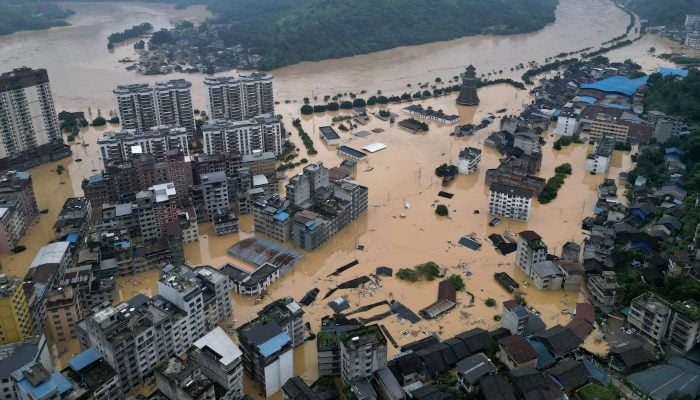
Heavy storms in northern China have unleashed nearly a year’s worth of rainfall on Baoding, an industrial city bordering the capital, Beijing. This deluge has forced over 19,000 residents from their homes as streets submerged and roads became impassable. In Yi, located in western Baoding, a staggering 447.4 mm (17.6 inches) of rain fell within 24 hours leading up to early Friday morning, setting new records at several weather stations across Hebei province, where Baoding is situated.
Official data indicates that Baoding typically receives an average annual rainfall exceeding 500 mm. The China Meteorological Administration (CMA) reported via social media that a total of 19,453 people from 6,171 households were evacuated. While the forecaster did not specify where these residents were relocated, a brief video clip showed two police officers, clad in neon rain jackets, standing boot-deep on a waterlogged street amidst heavy night-time downpours.
The forecaster drew parallels between the current precipitation levels and the exceptional rainfall brought by a powerful typhoon in 2023, which submerged Beijing with rains not seen in 140 years. Baoding’s Zhuozhou, an area devastated by floods two years ago during those very rains, experienced cut-off access to several bridges and roads after the recent storms delivered over 190 mm of rain by Friday morning.
Northern China has faced record-breaking rainfall in recent years, leaving densely populated cities, including Beijing, highly vulnerable to flood risks. Some scientists attribute the increased rainfall in China’s typically arid northern regions to global warming. According to CMA’s 2024 climate bulletin for Hebei province, the region recorded 640.3 mm in annual rainfall last year, marking a 26.6% increase over its decades-long average. The report further noted that Hebei has consistently experienced above-average annual precipitation since 2020.
Last summer, Baoding, along with neighboring cities Zhangjiakou, Langfang, Xiongan, and Cangzhou, saw 40% more than their usual seasonal precipitation, with some localized areas within Baoding recording an 80% increase in rainfall. This intensifying rainfall is part of a broader pattern of extreme weather across China, driven by the East Asian monsoon, which has caused significant disruptions to the world’s second-largest economy.
Chinese authorities are closely monitoring extreme rainfall and severe flooding, as these pose significant challenges to China’s aging flood defenses, threaten to displace millions, and wreak havoc on its $2.8 trillion agricultural sector. Baoding maintained a red alert for heavy rains on Friday morning, while Hebei upgraded its emergency response preparedness.
Approximately 160 km (100 miles) from Baoding, Beijing has also been affected. State broadcaster CCTV reported forecasts for intensifying rains, with potential accumulations exceeding 50 mm over a six-hour period from Friday afternoon through Saturday morning in several districts. The capital is bracing for its heaviest rainfall since the current flooding season began, which could potentially trigger flash floods, debris flows down mountainsides, landslides, and other secondary disasters, as per CCTV. Elsewhere in northern China, heavy rains disrupted railway service in Inner Mongolia, prompting authorities to suspend several passenger trains passing through high-risk areas from Friday until Tuesday.
