

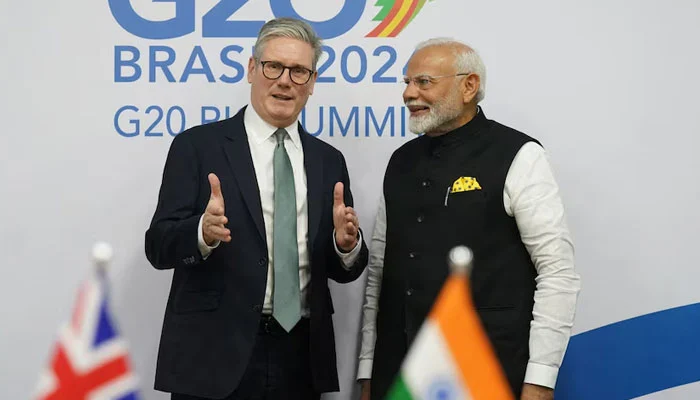
Britain and India are set to sign a landmark free trade agreement (FTA) on Thursday, coinciding with a visit by Indian Prime Minister Narendra Modi. This pivotal deal aims to reduce tariffs on a wide range of goods, from textiles to whisky and cars, while also expanding market access for businesses in both nations.
After three years of intermittent negotiations, the two countries concluded talks on this highly anticipated trade pact in May. Both sides expedited efforts to finalize the deal amidst the tariff uncertainties triggered by President Donald Trump.
This agreement between the world’s fifth and sixth largest economies is projected to boost bilateral trade by an additional £25.5 billion ($34 billion) by 2040. The pact will come into effect following approval by the British Parliament and India’s federal cabinet, a process expected to be completed within a year.
“Our landmark trade deal with India is a major win for Britain. It will create thousands of British jobs across the UK, unlock new opportunities for businesses and drive growth,” stated British Prime Minister Keir Starmer.
The agreement will be formally signed during Modi’s fourth visit to the UK since he assumed office in 2014. Beyond trade, the leaders are also set to sign a strategic partnership encompassing areas such as defense and climate, and will strengthen cooperation on tackling crime.
Under the terms of the trade agreement, tariffs on Scotch whisky will immediately drop from 150% to 75%, further decreasing to 40% over the next decade, according to the British government. For cars, India will reduce duties from over 100% to 10% under a quota system that will be gradually liberalized.
In reciprocity, Indian manufacturers are expected to gain access to the UK market for electric and hybrid vehicles, also under a quota system, as confirmed by Indian commerce ministry officials. The ministry has indicated that 99% of Indian exports to Britain, including textiles, will benefit from zero duties under the deal, while Britain will see reductions on 90% of its tariff lines.
This agreement represents Britain’s most significant trade deal since its departure from the EU in 2020. However, the projected annual boost to British economic output of £4.8 billion by 2040 is relatively small when compared to the country’s gross domestic product of £2.6 trillion in 2024.
The deal will also facilitate easier access for temporary business visitors, though visa provisions are not covered. Additionally, Britain and India have agreed to ensure that workers are no longer required to make social security contributions in both countries during temporary postings.
Furthermore, the trade deal will grant British firms access to India’s procurement market for projects in sectors like clean energy, and it also covers services sectors such as insurance.
India’s efforts to secure an exemption from Britain’s Carbon Border Adjustment Mechanism (CBAM), which could impose higher taxes on polluters from 2027, were not successful as part of this deal.
Finally, talks concerning a separate bilateral investment treaty, which were held parallel to the trade negotiations, have not yet been concluded and are still ongoing.
