

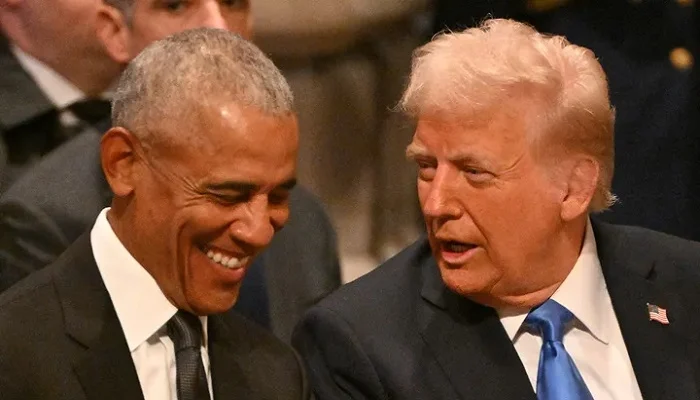
On Tuesday, U.S. President Donald Trump leveled accusations of “treason” against former President Barack Obama, contending, without presenting supporting evidence, that Obama spearheaded an endeavor to falsely link him to Russia and undermine his 2016 presidential campaign. A spokesperson for Obama swiftly rejected Trump’s assertions, labeling them “bizarre allegations [that] are ridiculous and a weak attempt at distraction.”
While President Trump has frequently targeted Obama by name, his recent remarks mark a significant escalation, as he has not, since resuming office in January, previously gone to such lengths in accusing his Democratic predecessor of criminal conduct. During statements made in the Oval Office, Trump seized upon comments delivered by his intelligence chief, Tulsi Gabbard, on Friday. Gabbard had threatened to refer Obama administration officials to the Justice Department for prosecution concerning an intelligence assessment of Russian interference in the 2016 election. She subsequently declassified documents, claiming the information revealed a “treasonous conspiracy” in 2016 orchestrated by top Obama administration officials to undermine Trump – allegations that Democrats have vociferously refuted as false and politically motivated.
“It’s there, he’s guilty. This was treason,” Trump declared on Tuesday, though he provided no substantiation for his claims. “They tried to steal the election, they tried to obfuscate the election. They did things that nobody’s ever imagined, even in other countries.”
A January 2017 assessment by the U.S. intelligence community concluded that Russia, through social media disinformation, hacking, and the deployment of Russian bot farms, aimed to harm Democrat Hillary Clinton’s campaign and bolster Trump’s. The assessment, however, also determined that the actual impact was likely limited and found no evidence that Moscow’s efforts altered voting outcomes. A bipartisan report from 2020 by the Senate intelligence committee had found that Russia utilized Republican political operative Paul Manafort, the WikiLeaks website, and other entities in an attempt to influence the 2016 election to aid Trump’s campaign. Patrick Rodenbush, a spokesperson for Obama, stated, “Nothing in the document issued last week (by Gabbard) undercuts the widely accepted conclusion that Russia worked to influence the 2016 presidential election but did not successfully manipulate any votes.”
Trump Under Scrutiny: President Trump, known for frequently promoting unverified conspiracy theories, has consistently dismissed these intelligence assessments as a “hoax.” In recent days, Trump reposted a fabricated video on his Truth Social account depicting Obama being arrested in handcuffs within the Oval Office.
Trump’s recent accusations appear amidst pressure from his conservative base to disclose further information regarding Jeffrey Epstein, who died by suicide in 2019 while awaiting trial on sex trafficking charges. Adherents of various conspiracy theories surrounding Epstein have urged Trump, who associated with the disgraced financier during the 1990s and early 2000s, to release investigative files pertaining to the case.
When questioned about Epstein in the Oval Office, Trump promptly shifted his focus to an attack on Obama and Clinton. “The witch hunt that you should be talking about is they caught President Obama absolutely cold,” Trump asserted. Trump hinted at potential action against Obama and his former officials, denouncing the Russia investigation as a treasonous act and declaring the former president guilty of “trying to lead a coup.” “It’s time to start, after what they did to me, and whether it’s right or wrong, it’s time to go after people. Obama has been caught directly,” he remarked.
Democratic Representative Jim Himes responded via X (formerly Twitter), stating: “This is a lie. And if he’s confused, the President should ask @SecRubio, who helped lead the bipartisan Senate investigation that unanimously concluded that there was no evidence of politicisation in the intelligence community’s behaviour around the 2016 election.” Notably, former Republican Senator Marco Rubio now serves as Trump’s Secretary of State.
Since his return to office, Trump has vehemently criticized his political adversaries, alleging that they weaponized the federal government against him and his allies in relation to the January 6, 2021, attack on the U.S. Capitol by his supporters, and his handling of classified materials after his departure from office in 2021.
Persistent Attacks on Predecessors: Obama has consistently been a target of Trump’s criticism. In 2011, Trump publicly accused then-President Obama of not being born in the United States, prompting Obama to release a copy of his birth certificate. In recent months, Trump has maintained a relentless barrage of rhetorical broadsides against his two Democratic predecessors, a pattern largely unprecedented in modern presidential discourse.
He initiated an investigation after accusing former President Joe Biden and his staff, without evidence, of a “conspiracy” involving the use of an autopen—an automated device that replicates a person’s signature—to sign sensitive documents on the president’s behalf. Biden has dismissed this claim as false and “ridiculous.”
Gabbard’s assertion that Obama conspired to subvert Trump’s 2016 election by fabricating intelligence on Russia’s interference stands in contradiction to a CIA review ordered by Director John Ratcliffe and released on July 2, a 2018 bipartisan Senate report, and even declassified documents that Gabbard herself released last week. These documents indicate that Gabbard conflated two distinct U.S. intelligence findings in alleging that Obama and his national security aides altered an assessment suggesting Russia was likely not attempting to influence the election through cyber means.
One finding concluded that Russia was not trying to hack US election infrastructure to change vote counts, while the second indicated that Moscow was likely employing cyber means to influence the US political environment through information and propaganda operations, including the theft and leakage of data from Democratic Party servers. The January 2017 U.S. intelligence assessment, commissioned by Obama, was built upon this second finding: that Russian President Vladimir Putin authorized influence operations to sway the 2016 vote in favor of Trump. The review ordered by Ratcliffe did identify flaws in the production of that assessment. However, it did not dispute its core conclusion and upheld “the quality and credibility” of a highly classified CIA report upon which the assessment’s authors relied.
