

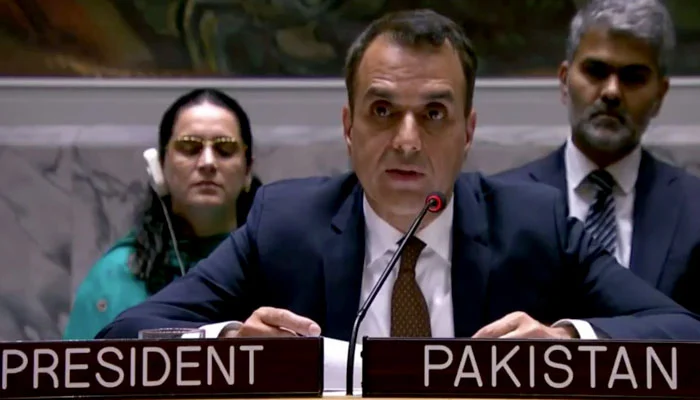
Pakistan has vehemently refuted India’s accusations of cross-border terrorism, urging New Delhi to critically examine its own conduct rather than deflecting blame. During a United Nations Security Council (UNSC) debate on “Promoting International Peace and Security through Multilateralism and Peaceful Settlement of Disputes,” Pakistan’s Deputy Permanent Representative to the UN, Ambassador Usman Jadoon, dismissed the Indian allegations. He advised New Delhi to alter its approach instead of relying on its “tired narrative of victimhood and blame-shifting.”
“It is India which actively sponsors, aids and abets terrorism in my country and beyond,” Ambassador Usman Jadoon told the 15-member body on Tuesday evening, in direct response to the allegations put forth by India’s UN Ambassador Parvathaneni Harish.
Ambassador Jadoon expressed regret that the Indian ambassador targeted Pakistan on Tuesday, particularly as earlier that day, the Council had unanimously reaffirmed the principles of the UN Charter, the imperative of peaceful dispute settlement, respect for international law, and the effective implementation of Security Council resolutions.
The Indian envoy’s remarks were a reaction to Pakistani Deputy Prime Minister and Foreign Minister Ishaq Dar, who, speaking in his national capacity after the adoption of a Pakistan-sponsored resolution advocating for the peaceful settlement of disputes, had emphasized the necessity of resolving the Kashmir dispute.
“First of all,” the Pakistani envoy asserted, India is in illegal occupation of the disputed territory of Jammu and Kashmir. He added, “While claiming to abide by the UN Charter and purportedly the principle of peaceful settlement of disputes, India has been in violation of Security Council resolutions on the Jammu & Kashmir dispute, and has refused to implement those resolutions, thereby denying the Kashmiri people the exercise of their inalienable right to self-determination.”
Jadoon further pointed out, “India’s egregious violations of human rights, which extend beyond the occupied territory of Jammu and Kashmir and encompass its appalling treatment of minorities, have been widely reported by international human rights organisations.”
He also stated that India has reached a new low by unilaterally and illegally holding in abeyance the 1960 Indus Waters Treaty – with the declared aim of depriving the people of Pakistan of water from the Indus river system.
“In gross violation of international law, India resorted to blatant aggression against my country between May 7-10, targeting civilians, including women and children,” the Pakistani envoy highlighted. He emphasized Pakistan’s “befitting but measured response by its right to self-defense,” which exclusively targeted military objectives, resulting in the downing of six Indian aircraft involved in the act of aggression, among other significant military losses.
“The hostilities came to an end owing to Pakistan’s position of strength and responsible approach, and facilitation of the United States, as also highlighted in the statement of the US [this morning],” Ambassador Jadoon informed delegates.
“It is ironic that India, which itself brought the Jammu and Kashmir dispute to the UNSC, refuses to implement the resolutions adopted by the Council to peacefully resolve this dispute,” the Pakistani envoy remarked.
Stung by the success of Pakistan’s signature event at the Council, the Indian envoy had alleged that Pakistan was “steeped in fanaticism and terrorism, and a serial borrower from the IMF.”
The debate is scheduled to resume on July 24 to hear from the remaining speakers after numerous high-level representatives have already presented. Earlier, the UN Security Council unanimously adopted a Pakistan-sponsored resolution urging member-states to take measures for the effective implementation of the 15-member body’s resolutions for the peaceful settlement of disputes—such as Kashmir and Palestine.
The UNSC took action on the resolution at a meeting organized under the “Maintenance of international peace and security” agenda item. This meeting underscored concerning trends of protracted and unresolved disputes threatening international peace and security and called for reinforced collective efforts to address them. This was one of the two signature events proposed by Pakistan under its presidency of the world body’s power center.
DPM Dar, who traveled to New York specifically to preside over this high-level event, put the resolution to a vote and then confirmed its adoption with a gavel strike. UN Secretary-General Antonio Guterres, who opened the debate, commended DPM Dar for convening the debate and for utilizing the UNSC’s presidency to put forward a resolution urging all member states to make full use of available tools in the collective pursuit of global peace, stating: “This is needed now more than ever.”
