

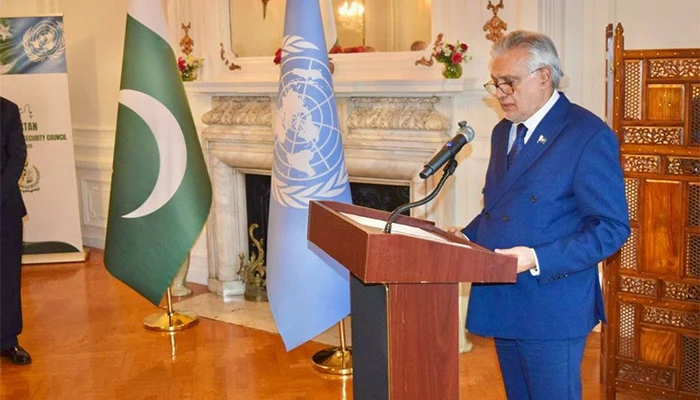
On Wednesday, Deputy Prime Minister and Foreign Minister Senator Ishaq Dar emphasized Pakistan’s vigorous diplomatic engagement, affirming the nation’s unwavering commitment to collaborate with global partners in advancing the shared objectives of peace, development, and human rights. Speaking at a reception hosted by Pakistan’s Mission in New York to mark Pakistan’s Presidency of the UN Security Council, Dar noted, “Our engagement transcends the Security Council and is reflected across the UN system — from the General Assembly to the UN Economic and Social Council (ECOSOC) and beyond.”
Amidst increasing global instability, Dar advocated for inclusive dialogue and cooperative diplomacy over confrontation, asserting that “the cost of unresolved disputes, long-running conflicts, unilateral actions, and disregard for international law is being felt in every region.” He underscored Pakistan’s steadfast dedication to multilateralism, peaceful resolution of disputes, and the fundamental principles enshrined in the UN Charter.
Addressing diplomats, UN officials, and representatives from member states, Dar highlighted that a core tenet of Pakistan’s foreign policy is a firm belief in multilateralism and the rule of international law. He stated, “The purposes and principles enshrined in the UN Charter, especially the peaceful settlement of disputes and the non-use or threat of force, are foundational to the United Nations and indispensable for a just international order.”
Dar’s remarks came as Pakistan currently holds the presidency of the UN Security Council this month. He noted that Pakistan’s leadership throughout its tenure has been consistently guided by these principles in both its deliberations and concrete actions. Under Pakistan’s presidency, the Security Council adopted Resolution 2788 earlier today, following a high-level open debate on the peaceful settlement of disputes—the first of three key priorities outlined by Dar. He described this core principle of the UN Charter as “too often sidelined” and stressed the importance of bringing it back to the forefront of the Council’s work.
Dar also emphasized the critical importance of revitalizing multilateralism, describing it not merely as a slogan but as an absolute necessity. He asserted, “The Security Council must be seen not only as a chamber of reaction but as a forum of prevention, problem-solving, and principled leadership.”
A third central focus of Pakistan’s presidency is to enhance cooperation between the United Nations and regional organizations, particularly the Organisation of Islamic Cooperation (OIC). Dar announced that a Council briefing with the OIC was scheduled for July 24, underscoring the vital role of the 57-member body in fostering global peace.
Reiterating Pakistan’s active diplomatic involvement, the Deputy Prime Minister reaffirmed the country’s dedication to working with partners worldwide to advance common goals of peace, development, and human rights. He reiterated that “Our engagement transcends the Security Council and is reflected across the UN system — from the General Assembly to the UN Economic and Social Council (ECOSOC) and beyond.”
Dar highlighted Pakistan’s leading role in global climate and development discussions and reiterated its support for strengthening the UN’s three foundational pillars: peace and security, development, and human rights. He also announced Pakistan’s candidacy for the Human Rights Council for the 2026–2028 term, a candidacy endorsed by the Asia-Pacific Group. He expressed hope for broad international support, stating, “Our engagement with the Human Rights Council is guided by the values of truth, tolerance, mutual respect, consensus-building, and engagement.”
Concluding his address, Dar urged the global community to transcend divisions. He affirmed, “In a world facing deepening divides and mounting challenges, we must choose cooperation over confrontation, and diplomacy over force. Pakistan stands ready to work with all of you to advance these common goals.”
