

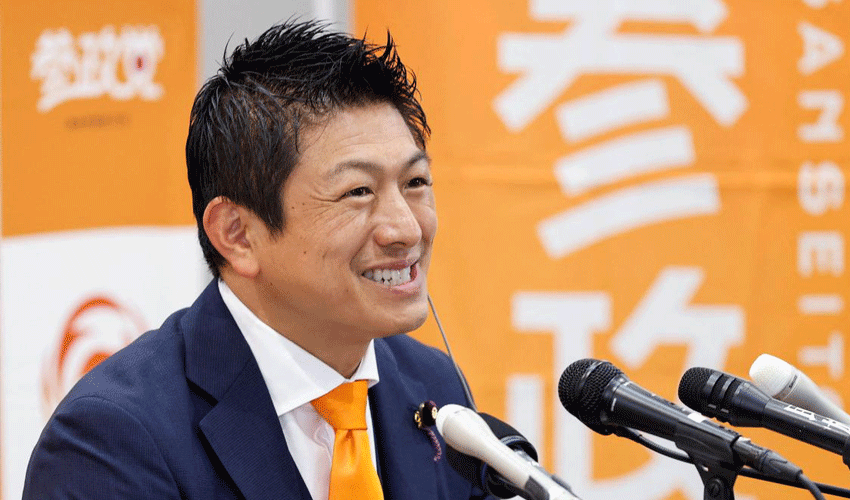
Japan’s nascent far-right party, Sanseito, emerged as a surprising force in the country’s upper house elections on Sunday, securing 14 seats amidst burgeoning populist sentiment and public dissatisfaction with the incumbent ruling coalition. The party, which campaigned on a “Japanese First” platform, gained considerable traction with its stringent stance on immigration, commitments to tax reductions, and pledges to enhance social welfare programs. Sanseito now commands 15 seats in the 248-member upper house, a significant leap from the singular seat it held since 2022. In the more influential lower house, the party maintains its three seats.
Under the leadership of 47-year-old Sohei Kamiya, a former supermarket manager and English teacher, Sanseito has largely cultivated its presence through social media. The party’s official YouTube channel boasts over 400,000 subscribers—the most extensive following of any political group in Japan, more than tripling that of the ruling Liberal Democratic Party (LDP).
Sanseito’s ascent coincides with Prime Minister Shigeru Ishiba’s LDP and its coalition partner Komeito losing their majority in the upper house. The governing bloc had already experienced a notable setback in the lower house elections last October, making it increasingly dependent on opposition support.
“The phrase ‘Japanese First’ was intended to convey the rebuilding of Japanese people’s livelihoods by resisting globalism,” Kamiya stated in a post-election interview with Nippon Television. He clarified, “I am not saying that we should completely ban foreigners or that every foreigner should get out of Japan.” However, the party’s campaign rhetoric—including warnings of a “silent invasion” by immigrants—has drawn criticism for being xenophobic and discriminatory. Japan’s foreign-born population reached a record 3.8 million last year, constituting merely 3 percent of the total population—a figure considerably lower than levels observed in Europe and the United States.
Despite these statistics, the issue of immigration has regained political momentum. Days before the vote, Ishiba’s administration inaugurated a new task force aimed at curbing crimes purportedly committed by foreign nationals. The LDP also pledged to achieve “zero illegal foreigners,” a move analysts interpret as an effort to neutralize Sanseito’s expanding influence.
Political observers suggest that Sanseito has tapped into escalating public discontent over economic stagnation, escalating prices, and a weakening yen—factors that have rendered Japan more attractive to foreign tourists but increased the cost of living for its citizens. Joshua Walker, president of the Japan Society in New York, commented, “Sanseito has become the talk of the town, and particularly here in America, because of the whole populist and anti-foreign sentiment.” He added, “It’s more of a reflection of the LDP’s weakness than the strength of Sanseito.”
In pre-election polls conducted by NHK, immigration was ranked joint fifth among voter concerns, cited by only 7 percent. Social security and the nation’s declining birthrate topped the list, cited by 29 percent of respondents, closely followed by anxiety over surging rice prices, which have doubled over the past year.
Notwithstanding his party’s hardline stances, Kamiya has attempted to moderate its public image. During the campaign, he fielded several female candidates in an endeavor to broaden Sanseito’s appeal beyond its core demographic of young men. Among the successful candidates was a Tokyo-based pop singer known as Saya.
Nevertheless, Kamiya remains a polarizing figure. In 2022, he garnered notoriety for suggesting that the Japanese emperor should take concubines—a comment from which he later distanced himself. More recently, he faced criticism for asserting that gender equality policies were misguided and discouraged women from having children.
In an earlier interview with Reuters, Kamiya acknowledged drawing inspiration from President Donald Trump’s “bold political style.” Sanseito has also been likened to Europe’s far-right movements, including Germany’s Alternative for Germany (AfD) and the UK’s Reform Party.
Following the election, Kamiya ruled out any alliance with the LDP and instead articulated plans to coordinate with other minor opposition parties to consolidate the populist right. He stated, “We are gradually increasing our numbers and living up to people’s expectations.” He concluded, “By building a solid organization and securing 50 or 60 seats, I believe our policies will finally become reality.”
Sanseito’s success underscores the evolving political landscape in Japan, where economic anxiety and dissatisfaction with mainstream parties have created new opportunities for fringe political actors. While the party’s breakthrough remains limited in scale, analysts caution that it could push national policy further to the right.
