

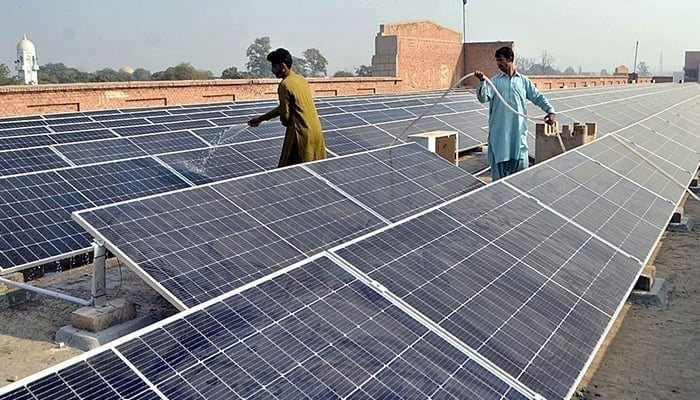
Power generation in the fiscal year 2024-25 remained largely flat, primarily due to increased solar power adoption and reduced industrial activity, which continued to suppress demand for on-grid electricity. This information was reported by The News on Sunday.
Official data indicates that total power generation reached 127,160 GWh (Gigawatt-hours) during FY25, showing almost no change from the 127,165 GWh recorded in the previous fiscal year.
In June, power generation saw a 2% increase compared to the same month last year and an 8% rise on a month-on-month basis. The average fuel cost for power generation decreased by 2% over the year. In June alone, it dropped by 9% year-on-year (YoY) but was slightly higher, by 1%, compared to May.
Farhan Mahmood, Head of Research at Sherman Securities, explained that “solarisation has reduced the on-grid electricity demand in the country, as it has seen substantial growth.” He added that industrial users have increasingly shifted to self-generation due to lower coal and oil prices, further reducing their reliance on the main grid. However, Mahmood noted that electricity consumers continued to shoulder the burden of low demand through capacity payments, which ranged between Rs12 and Rs15 per unit during FY25.
Generation Mix and Cost Dynamics: Hydropower generation remained steady throughout the fiscal year. Generation from regasified liquefied natural gas (RLNG) decreased by 6.0%, while power from local coal increased by 2%.
Generation from imported coal rose sharply by 80%, but nuclear power declined by 3%. Both gas- and wind-based generation dropped by 2% each, while solar power increased by 15%. Electricity generation from furnace oil plunged by a significant 79%.
In terms of cost, nuclear power became 35% more expensive, and the cost of local coal-based generation rose by 10%. Conversely, electricity from furnace oil became 12% cheaper, the cost of electricity from imported coal declined by 5%, and RLNG power generation cost dropped by 1%.
Hydropower maintained its position as the largest contributor to the national energy mix, accounting for 31.4% of total power generation. It was followed by nuclear at 17.7% and RLNG at 17.5%. Over the course of the year, local coal contributed 12.2%, natural gas 8.8%, and imported coal 7.1%.
