

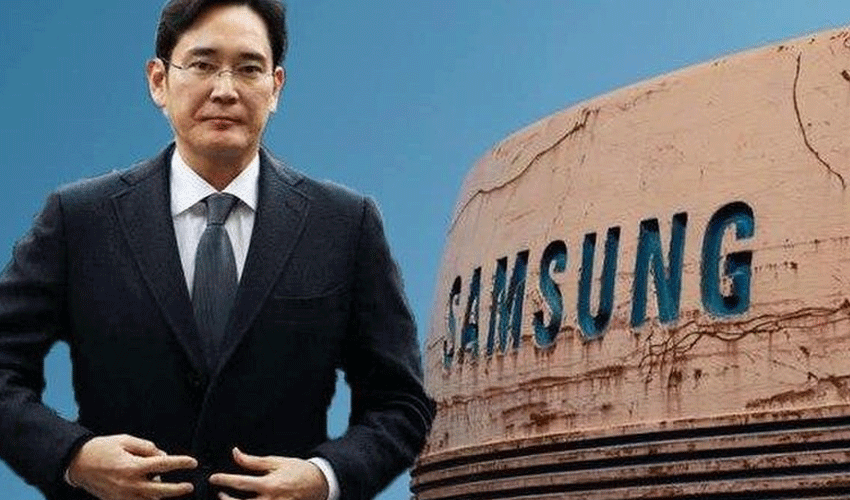
South Korea’s Supreme Court on Thursday upheld a lower court’s verdict that acquitted Samsung Electronics Chairman Jay Y. Lee of accounting fraud and stock manipulation charges. These charges were linked to a contentious 2015 merger between two Samsung affiliates.
The top court’s decision brings to a close a protracted legal battle that has spanned nearly a decade. It also removes a significant hurdle for the de facto head of South Korea’s largest conglomerate. The $8 billion merger involved Samsung C&T Corp and Cheil Industries. It was widely perceived as a strategic maneuver to consolidate Lee’s control over the sprawling tech empire after his father, Lee Kun-hee, suffered an incapacitating heart attack in 2014.
In its ruling, the Supreme Court affirmed the judgments of two lower courts. Both previous rulings had found Lee not guilty of the charges brought by prosecutors, who had argued that the merger unfairly benefited Lee and negatively impacted shareholder interests.
“The Supreme Court ruling clears a layer of legal uncertainty, which could be a long-term positive for Samsung,” stated Ryu Young-ho, senior analyst at NH Investment & Securities. “It remains to be seen how directly and proactively he will engage going forward, but if the owner takes a more active role, it could allow management to focus more on long-term initiatives rather than short-term results.”
Shares in Samsung Electronics saw a modest rise following the verdict, closing up 1.7% on the day.
Samsung’s legal team expressed gratitude for the ruling. In a brief statement, the company affirmed that the verdict validates the legality of the 2015 merger, which had long been a focal point for critics alleging corporate governance irregularities within the family-run chaebol.
Business lobby groups welcomed the decision, characterizing it as a stabilizing development for the national economy. This comes at a time of increasing global competition in fields such as artificial intelligence and semiconductors, alongside ongoing trade tensions among major economies.
“The ruling removes a major legal burden for Samsung and comes at a critical juncture as the company faces mounting pressure in key high-tech sectors,” the Korea Enterprises Federation said in a statement. “Samsung’s role as a leading South Korean company is more critical than ever.”
The group voiced hope that under Lee’s unencumbered leadership, Samsung would boost investment in innovation, contribute to job creation, and aid South Korea’s post-pandemic economic recovery.
Lee, 56, has navigated a series of legal challenges over the past decade. In a separate case, he served 18 months of a 30-month sentence related to a bribery scandal involving former president Park Geun-hye, before receiving a presidential pardon in 2022. Despite these legal entanglements, Lee formally became chairman of Samsung Electronics in 2022, inheriting the role previously held by his late father.
Park Ju-gun, head of corporate analysis firm Leaders Index, observed that Lee must now balance strengthening his control of the conglomerate with positioning Samsung as a global leader in future growth sectors.
“He must both defend Samsung’s core businesses and find new growth engines, all while consolidating his control,” Park concluded.
