

On Wednesday, Israel conducted powerful airstrikes in Damascus, destroying a portion of the defense ministry and striking near the presidential palace. These attacks came as Israel vowed to eliminate government forces assaulting Druze in southern Syria and demanded their withdrawal. These actions represent a significant escalation by Israel against the administration of interim President Ahmed al-Sharaa, occurring despite his improving relations with the United States and his administration’s developing security contacts with Israel.
Describing Syria’s new leadership as thinly veiled extremists, Israel has declared it will prevent their forces from entering southern Syria and pledged to safeguard the region’s Druze community from assault, encouraged by appeals from Israel’s own Druze minority. U.S. Secretary of State Marco Rubio characterized the situation as “complicated” but suggested it appeared to be a “misunderstanding.” He expressed optimism that progress towards de-escalation would materialize within hours.
Scores of individuals have been killed this week in the violence in and around the predominantly Druze city of Sweida, where fighters from the Druze minority have clashed with government security forces and members of Bedouin tribes. Reuters reporters heard warplanes flying low over the capital, unleashing a series of massive strikes in the mid-afternoon. Columns of smoke billowed from the vicinity of the defense ministry. A section of the building was obliterated, with debris scattered across the ground.
A Syrian medical source reported that the strikes on the defense ministry resulted in the deaths of five security force members. An Israeli military official stated that the Israeli military targeted the entrance to the military headquarters in Damascus and a military objective near the presidential palace. The Israeli official asserted that Syrian forces were not actively preventing attacks on the Druze and were contributing to the problem. Defense Minister Israel Katz affirmed that the Israeli military would “continue to operate vigorously in Sweida to destroy the forces that attacked the Druze until they withdraw completely.”
Sharaa faces substantial challenges in reunifying Syria amidst profound apprehension from groups wary of Islamist rule – a distrust compounded by the mass killings of Alawite minority members in March. Syrian government troops were deployed to the Sweida region on Monday to quell fighting between Druze fighters and Bedouin armed groups but ultimately engaged in clashes with Druze militias.
Late Wednesday, the Syrian interior ministry and a Druze leader, Sheikh Yousef Jarbou, announced that a ceasefire had been reached. However, Sheikh Hikmat al-Hajari, another Druze leader, insisted that fighting should persist until Sweida is “entirely liberated.” A ceasefire declared on Tuesday had previously collapsed. Residents of Sweida reported being confined indoors. “We are surrounded and we hear the fighters screaming… we’re so scared,” a Sweida resident reached by phone conveyed.
The sound of gunfire interspersed with explosions could be heard in the background. “We’re trying to keep the children quiet so that no one can hear us,” the man added, requesting anonymity due to fear of reprisals. The Syrian Network for Human Rights reported 169 fatalities in this week’s violence. Security sources placed the toll at 300. Reuters was unable to independently verify these figures.
The Minority Community
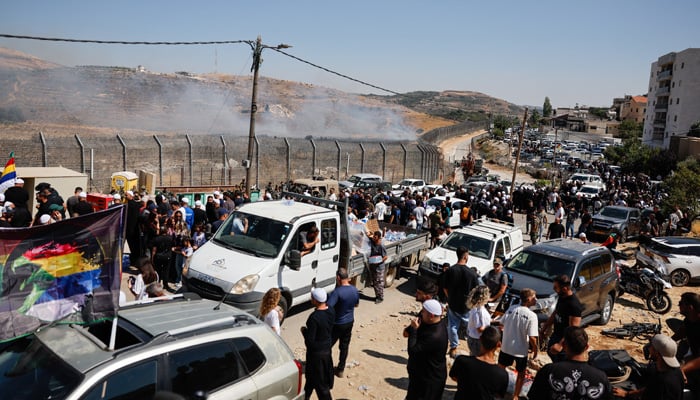
The Druze community is dispersed across Syria, Lebanon, and Israel. Following calls in Israel to aid Druze in Syria, scores of Israeli Druze breached the border fence on Wednesday, connecting with Druze on the Syrian side, a Reuters witness observed. Israeli Prime Minister Benjamin Netanyahu stated that the Israeli military was working to protect the Druze and urged Israeli Druze citizens not to cross the border. The Israeli military confirmed it was working to safely return civilians who had crossed.
U.S. Syria envoy Tom Barrack, who has previously commended Syria’s new rulers and declared in May that peace between Syria and Israel was achievable, condemned violence against civilians in Sweida. “All parties must step back and engage in meaningful dialogue that leads to a lasting ceasefire. Perpetrators need to be held accountable,” he asserted.
Israeli Druze man Faez Shkeir expressed his helplessness while witnessing the violence in Syria. “My family is in Syria – my wife is in Syria, my uncles are from Syria, and my family is in Syria, in Sweida, I don’t like to see them being killed. They kicked them out of their homes, they robbed and burned their houses, but I can’t do anything,” he lamented.
The defense ministry urged city residents to remain indoors. On Tuesday, a Reuters reporter reported observing government forces looting and burning homes and stealing cars and furniture in Sweida. One man showed the reporter the body of his brother, who had been shot in the head inside their home.
A Syrian government statement on Wednesday declared that those responsible for lawlessness in Sweida would be held accountable. It affirmed the government’s commitment to protecting the rights of the people in Sweida. Sharaa has repeatedly pledged to protect minorities. News outlet Sweida24 reported that Sweida and nearby villages were experiencing heavy artillery and mortar fire early on Wednesday.
