

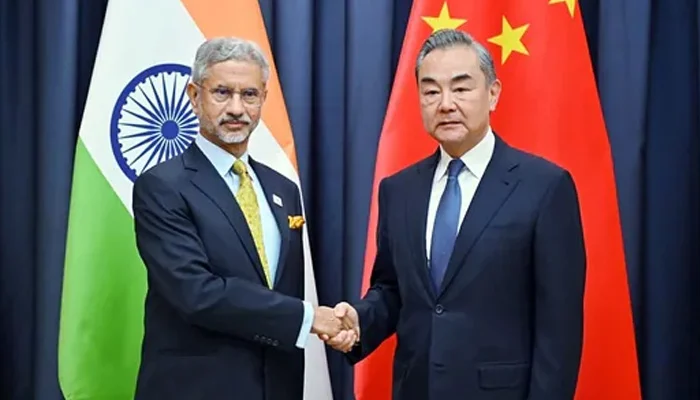
In Beijing on Monday, India’s Foreign Minister Subrahmanyam Jaishankar urged his Chinese counterpart, Wang Yi, to resolve friction along their shared border, pull back troops, and avoid “restrictive trade measures” to normalize their relationship.
This meeting marked Jaishankar’s first trip to China since 2020, a year when a deadly border clash between their troops led to a four-year military standoff. Relations were significantly strained until a thaw began in October when both sides agreed to step back from the border.
Jaishankar told Wang that the “good progress” made by the countries over the past nine months towards normalizing relations is a direct result of resolving friction along their border.
India and China share a 3,800 km (2,400 miles) border that is poorly demarcated and has been disputed since the 1950s. They fought a brief but brutal border war in 1962, and decades of talks to settle the dispute have made slow progress.
Last month, Indian Defence Minister Rajnath Singh informed his Chinese counterpart that the two countries should seek a “permanent solution” to the border dispute, signaling a renewed push from New Delhi for a conclusive outcome.
“It is now incumbent on us to address other aspects related to the border, including de-escalation,” Jaishankar stated. He further emphasized the critical importance of avoiding restrictive trade measures and roadblocks to foster mutually beneficial cooperation. The minister’s remarks come as Beijing has imposed restrictions in recent months on supplies of critical minerals such as rare earth magnets and machinery essential for manufacturing high-tech goods. India holds the world’s fifth-largest rare earth reserves, but its domestic output remains underdeveloped.
Jaishankar, who is in China to attend the meeting of foreign ministers of the Shanghai Cooperation Organisation (SCO), also met Chinese Vice President Han Zheng earlier in the day, as reported by the official Chinese news agency Xinhua. Xinhua stated that Han told Jaishankar that India and China should steadily advance practical cooperation and respect each other’s concerns.
