

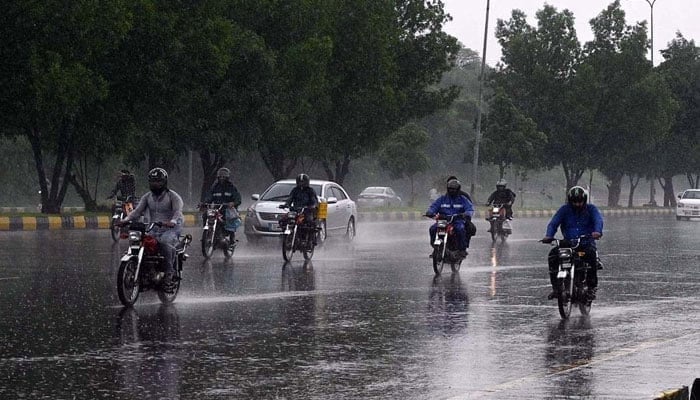
Since late June, monsoon rains in Pakistan have resulted in over 110 fatalities, including dozens of children, according to government figures released on Monday. Data from the National Disaster Management Authority (NDMA) from June 26 to July 14 indicates that electrocution was the primary cause of deaths, followed by flash floods.
In late June, a tragic incident saw at least 13 tourists swept away and killed while seeking shelter from sudden flash floods on a raised river bank. The disaster agency’s latest report confirms 111 deaths, including 53 children, with the highest number of casualties recorded in Punjab, the most populous province.
The Pakistan Meteorological Department (PMD) has issued a forecast for heavy rains from July 15 to 17. This is due to a low-pressure area currently located over northwest Madhya Pradesh, India, which is expected to influence Pakistan over the next 24 to 72 hours. The PMD stated that this weather system will lead to strong monsoon currents penetrating the central and upper parts of the country from July 15 to 17. Additionally, a “westerly wave is also present over the upper parts of the country.” These meteorological conditions are expected to bring:
The weather department predicts very heavy rainfall, along with rain-wind and thundershowers, in parts of Kashmir from July 14 to 17, with occasional breaks. Isolated heavy falls are also expected in Gilgit-Baltistan during this period. Furthermore, “very heavy to extremely heavy” rains are anticipated in parts of Khyber Pakhtunkhwa from the night of July 14 until July 17.
Azad Kashmir: Rain-wind/thundershowers with scattered heavy falls (at times very heavy) are expected in Kashmir (Neelum valley, Muzaffarabad, Rawalakot, Poonch, Hattian, Bagh, Haveli, Sudhanoti, Kotli, Bhimber, Mirpur) from the night of July 14 to 17.
Gilgit-Baltistan: Rain-wind/thunderstorms (with isolated heavy falls) are expected in Gilgit-Baltistan (Diamir, Astore, Ghizer, Skardu, Hunza, Gilgit, Ghanche, Shigar) from the night of July 14 to July 17 with occasional breaks.
Khyber-Pakhtunkhwa: Rain-wind and thundershowers with scattered heavy falls (at times very heavy/extremely heavy) are expected in Dir, Chitral, Swat, Kohistan, Malakand, Shangla, Battagram, Buner, Kohat, Karak, Bannu, Tank, Lakki Marwat, Dera Ismail Khan, Bajaur, Mohmand, Khyber, Waziristan, Orakzai, Mansehra, Abbottabad, Haripur, Peshawar, Charsadda, Nowshera, Mardan, Swabi, Hangu and Kurram from the night of July 14 to 17 with occasional breaks.
Punjab/Islamabad: Rain-wind/thundershowers with scattered heavy falls (at times very heavy/extremely heavy) are expected in Islamabad/Rawalpindi, Murree, Galliyat, Attock, Chakwal, Jhelum, Mandi Bahauddin, Gujrat, Gujranwala, Hafizabad, Wazirabad, Lahore, Sheikhupura, Sialkot, Narowal, Sahiwal, Jhang, Toba Tek Singh, Nankana Sahib, Chiniot, Faisalabad, Okara, Kasur, Khushab, Sargodha, Bhakkar, Mianwali, Bahawalpur, Bahawalnagar, D.G. Khan, Multan, Khanewal, Lohdran, Muzaffargarh, Rajanpur, Rahimyar Khan, Kot Addu and Layyah from the evening of July 14 to 17 with occasional breaks.
Balochistan: Rain-wind/thundershowers with scattered heavy falls (at times very heavy) are expected in northeastern and southern parts (Quetta, Zhob, Qilla Saifullah, Qilla Abdullah, Ziarat, Sherani, Musakhel, Loralai, Sibbi, Bolan, Barkhan, Naseerabad, Kalat, Lasbella, Khuzdar, Awaran, Jaffarabad, Dera Bugti and Kohlu) from July 14 to 16.
Sindh: Rain-wind/thundershowers are expected in Tharparkar, Mirpur Khas, Sanghar, Sukkur, Larkana, Dadu, Jacobabad, Khairpur and Shaheed Benazirabad from July 14 to 16 with occasional breaks. Light rain is also expected in Karachi.
The PMD has advised concerned authorities to remain on high alert, warning that the torrential rains could trigger flash floods in local nullahs and streams, as well as hill torrents. The downpours also pose a risk of urban flooding in low-lying areas and road closures in vulnerable hilly regions due to landslides and mudslides. The public, travelers, and tourists are advised to avoid unnecessary exposure in vulnerable areas to prevent any untoward incidents and to stay updated on weather conditions.
Understanding the Monsoon Season: The monsoon season contributes 70 to 80% of South Asia’s annual rainfall, typically arriving in early June in India and late June in Pakistan, and lasting until September. These yearly rains are crucial for agriculture, food security, and the livelihoods of millions of farmers. However, they also bring destructive flooding, landslides, and cause building collapses.
South Asia is experiencing a warming trend and has seen shifting weather patterns in recent years, though scientists are still studying the exact impact of a warming planet on the highly complex monsoon system. Pakistan is among the countries most susceptible to the effects of climate change, and its 240 million residents are increasingly facing extreme weather events. In 2022, unprecedented monsoon floods submerged a third of Pakistan, claiming 1,700 lives, with some areas still recovering from the devastation. More recently, in May, severe storms, including powerful hailstorms, resulted in at least 32 fatalities.
