

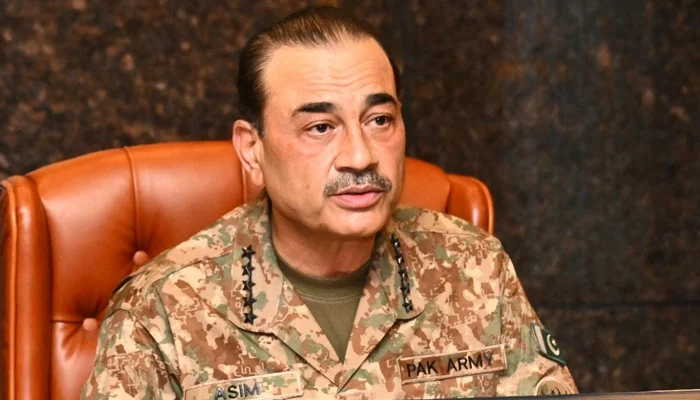
Pakistan’s top military leadership has reaffirmed its commitment to taking decisive and comprehensive actions at all levels against proxies supported and sponsored by India, as announced by the Inter-Services Public Relations (ISPR) on Thursday. The 271st Corps Commanders’ Conference (CCC), chaired by Field Marshal Syed Asim Munir, Chief of Army Staff, in Rawalpindi, observed that India is intensifying its hostile actions against Pakistan following its recent defeat in a conflict.
Pakistan and India engaged in a military conflict in May after New Delhi launched attacks on Islamabad, alleging its involvement in an attack on tourists in Indian Illegally Occupied Jammu and Kashmir’s Pahalgam — an accusation the Pakistani government has vehemently denied. Although the hostilities ceased within 90 hours due to Pakistan’s decisive response, the Pakistani government has stated that India has since conducted numerous terrorist activities within Pakistan through its proxies.
During the high-level meeting, the CCC offered prayers for the martyrs of recent terrorist attacks perpetrated by Indian-sponsored proxies, vowing that their sacrifices would not be in vain. “Taking stock of recent successes against terrorist proxies, the forum resolved that the blood of our Shuhada will not go to waste and the safety and security of people of Pakistan remain top-most priority for the Armed Forces of Pakistan,” the ISPR statement read.
The CCC noted that, following its clear defeat in direct aggression against Pakistan after the Pahalgam incident, India is now redoubling its efforts to advance its sinister agenda through proxies of “Fitna al-Khawarij” and “Fitna al-Hindustan.” Addressing the Indian Army’s baseless insinuations aimed at offsetting its comprehensive defeat, the COAS stated that the region is visibly growing disillusioned with India’s hegemonic ambitions and Hindutva-driven extremism. He emphasized, “Invoking third parties in what is unmistakably a bilateral military confrontation reflects a disingenuous attempt at bloc politics aimed at falsely projecting India’s self-assigned role as a net security provider to accrue benefits in a region that is visibly growing disillusioned with Indian hegemonic ambitions and Hindutva-driven extremism.”
Successful Diplomatic Maneuvers
During the conference, the COAS shared details of Pakistan’s proactive and successful diplomatic initiatives, including recent visits to Iran, Türkiye, Azerbaijan, Saudi Arabia, and the UAE, where Field Marshal Munir accompanied Prime Minister Shehbaz Sharif. “[The] forum was also briefed on the historic and unique visit of the COAS to the US, where meetings with top-tier leadership afforded an opportunity to share, firsthand, Pakistan’s objective perspective on bilateral, regional, and extra-regional developments.”
The army’s top brass conducted a holistic review of the prevailing internal and external security dynamics, the ISPR reported, with particular emphasis on recent developments in the Middle East and Iran and the growing tendency for “use of force” as a preferred policy tool. This, they noted, necessitates the persistent development of self-reliant capabilities, along with national unity and resolve. The forum was also briefed on the Pakistan Army’s ongoing drive towards quick adaptation to the evolving threat spectrum and the changing character of warfare. “The COAS also appreciated the leadership of Pakistan Navy and Pakistan Air Force for further strengthening tri-services synergy,” the ISPR added.
In his concluding remarks, the army chief expressed full confidence in the operational readiness of the Pakistan Army across the complete threat spectrum.
