

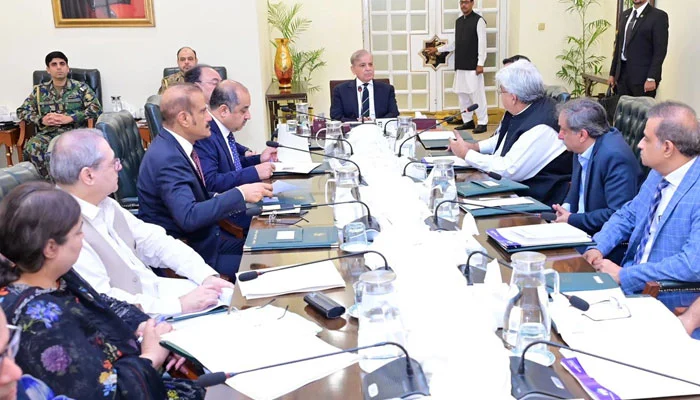
Prime Minister Shehbaz Sharif has underscored that reforms within the Federal Board of Revenue (FBR) are a top government priority. He stated that the new technology-based modern system will streamline business operations and offer greater convenience to taxpayers, as reported by The News.
“By automating the tax system, we are making it more transparent and effective,” PM Shehbaz affirmed while chairing a meeting on FBR. During the meeting, he was informed that, for the first time in Pakistan’s history, an Artificial Intelligence (AI)-based Custom Clearance and Risk Management System (RMS) has been introduced.
The meeting was told that “during the initial testing of the new system, over 92% improved performance was observed.” The briefing also highlighted that not only were 83% more goods declarations (GD) determined for tax collection, but goods clearance through the green channel also increased two-and-a-half times.
Expressing his views, the Prime Minister noted that the reduced human intervention in the system would enhance efficiency, saving both time and money. He directed that the new system be made integrated and sustainable, commending the officers and staff involved in its development.
Furthermore, the gathering was informed that under the new system, the estimation of the cost and nature of goods during import and export would be conducted by AI and BOTs—software programs capable of executing commands, replying to messages, or performing routine tasks. The new risk management system, leveraging modern technology, will continuously improve through automation using machine learning, adapting to the movement of goods.
It was conveyed in the meeting that the new RMS would foster transparency, minimize human intervention, and simplify processes for businessmen. With its launch, immediate and accurate estimation of goods and their costs would be possible, leading to significant time savings. Participants were also told that the implementation of the new system would alleviate pressure on customs officials, enhance transparency and efficiency, and facilitate business operations.
The meeting also received a briefing on video analytics-based measures aimed at increasing tax collection in the manufacturing sector. Key attendees included Minister for Finance Muhammad Aurangzeb, Minister for Information Attaullah Tarar, the FBR chairman, and other senior government officials.
Meanwhile, the PM Office Media Wing stated in a press release that PM Shehbaz praised the FBR and Intelligence Bureau (IB) for their efforts in boosting tax collection. He stressed the importance of all relevant authorities collaborating to increase national tax revenue. He observed that the stability in Pakistan’s economy was a result of the team’s joint efforts, emphasizing the need for collective collaboration towards the country’s economic progress and the prosperity of its people.
The Prime Minister was presented with a report from the FBR and IB detailing operations against tax evasion and hoarding. According to the report, the joint efforts by the IB and FBR led to the recovery of Rs178 billion. These measures resulted in a Rs69 billion increase in tax revenue through company mergers and the recovery of telecom sector dues.
The IB conducted 515 raids across sectors such as sugar, animal feed, beverages, edible oil, tobacco, and cement. As a direct outcome of these operations, an additional Rs10.5 billion in taxes were recovered by thwarting tax evasion attempts. To combat hoarding and artificial price hikes, the IB carried out over 13,000 operations in the sugar, fertilizer, and wheat sectors, seizing illegally hoarded goods worth more than Rs99 billion since April 2022.
Pension Hike and Continued Austerity Measures Announced
In a separate development, the federal government has officially notified a 7% increase in net pension for retired civilian and armed forces personnel, effective July 1, 2025.
The government has also decided to continue austerity measures in the current fiscal year, implementing a ban on seven specific types of expenditures:
- Purchase of all types of vehicles, with exceptions for operational vehicles like ambulances, medically equipped vehicles, firefighting vehicles, buses and vans for educational institutions, solid waste vehicles, and motorbikes.
- Procurement of machinery/equipment, except those required for hospitals, laboratories, agriculture, mining, and schools.
- Creation of new posts, including contingent-paid or temporary positions.
- Continuation of contingent-paid or temporary posts beyond one year.
- Treatment abroad at government expense.
- All non-obligatory visits abroad involving government funding.
- All posts lying vacant for the last few years will be abolished.
According to a notification from the Finance Ministry regarding the pension hike, the President has sanctioned a 7% increase of net pension effective July 1, 2025, for all federal government civil pensioners (including civilians paid from defense estimates), as well as retired armed forces personnel and civil armed forces personnel.
This increase will also apply to family pensions granted under the pension-cum-gratuity scheme, 1954, and Liberalised Pension Rules, 1977 (as amended), as well as on pensions sanctioned under the Federal Civil Services (Extraordinary Pension) Rules and Compassionate Allowance under CSR-353. For the purpose of admissibility, “net pension” is defined as “net pension being drawn as on June 30, 2025, minus medical allowance.” This will serve as the baseline for current and future pension increases. This increase will be maintained as a separate amount as per Finance Division O.M. No 9 (3) R-6/2024-403 dated January 1, 2025.
If the gross pension sanctioned by the federal government is shared with any other government as per rules in Part-IV of Appendix-III to the Accounts Code, Volume-I, the increased pension amount will be apportioned proportionately between the Federal Government and the other concerned government. The sanctioned pension increase will not apply to special additional pensions allowed in lieu of pre-retirement orderly allowance or the monetized value of a driver/orderly.
The Cabinet further approved that the aforementioned austerity measures shall also apply, with necessary modifications, during FY 2025-26 to all Federal Government Attached Departments, State-Owned Enterprises, Statutory Bodies, and Regulatory Authorities. These measures were previously approved by the Cabinet on February 22, 2023 (notified by Cabinet Division O.M. No. 9-148/2002-Min-II dated February 28, 2023) and on August 27, 2024 (notified by Finance Division letter No. 7(1)Exp-IV/2024 dated September 4, 2024). For state-owned enterprises, these austerity measures will be considered a directive of the Federal Government under section 35 of the State-Owned Enterprises (Governance & Operations) Act, 2023, and under relevant sections of their respective organic laws for statutory bodies.
