

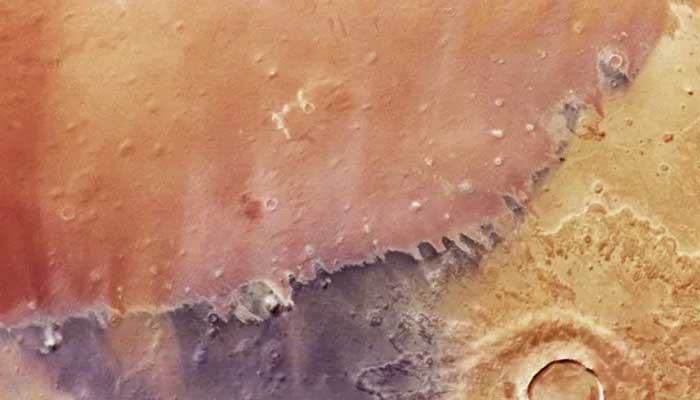
While often dubbed the “Red Planet,” a striking new satellite image from the European Space Agency (ESA) offers a different perspective of Mars, revealing a vibrant tapestry of swirling yellows, oranges, and browns. This colorful landscape, captured by the high-resolution camera aboard ESA’s Mars Express orbiter, also showcases a prominent impact crater and four dust devils sweeping across the surface.
The image focuses on Arcadia Planitia, a region that is crucial for understanding Mars’ geological history and its potential to support future human exploration, as reported by Space.com.
Arcadia Planitia: A Key Region for Martian Exploration
Located northwest of the solar system’s tallest volcanoes, Arcadia Planitia is particularly significant due to its ancient solidified lava flows, estimated to be up to 3 billion years old. Scientists also believe this area harbors water ice just beneath the surface, making it a prime target for upcoming Mars missions, according to ESA. This potential subsurface ice is a key factor in assessing the region’s habitability and resource availability for future human endeavors.
The region is also a frequent host to “dust devils,” which are short-lived, whirlwind-like phenomena formed when warm surface air rises and lifts dust. In the newly released image, four distinct dust devils are visible as faint white streaks, traversing from the darker to lighter areas of the plain.
Impact Crater Offers Clues to Martian Past
In the lower right corner of the photograph, a large impact crater, approximately 9 miles (15 kilometers) wide, stands out. The distinctive layered patterns surrounding the crater suggest that the ground in this area contained a significant amount of water ice at the time of the impact. The crater’s relatively intact appearance further indicates its formation was geologically recent, providing valuable insights into the planet’s more recent past and the presence of water.
This new image from Mars Express continues to unveil the diverse and dynamic nature of Mars, providing scientists with critical data for future research and mission planning.
