

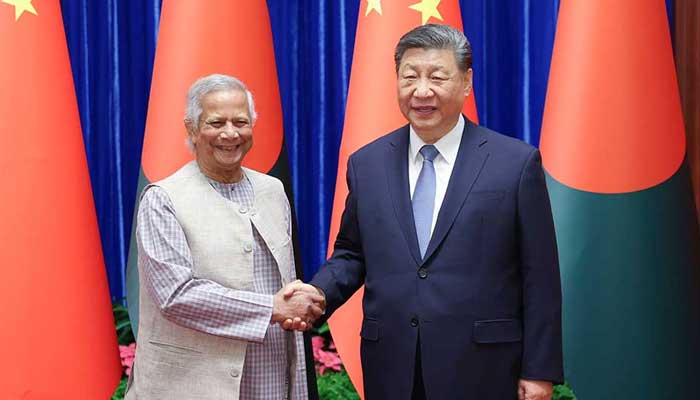
Protests in Bangladesh that led to the government’s collapse last year have triggered a significant diplomatic realignment. Dhaka is now strengthening its ties with China, a move that has seemingly angered neighboring India, which lost its long-standing ally, Sheikh Hasina. A year on, this shift risks intensifying political polarization and raising concerns about external interference as Bangladeshi parties vie for influence ahead of next year’s elections. For the caretaker government, which aims to achieve domestic consensus on overhauling democratic institutions in the nation of 170 million people, this presents another complex challenge.
“India-Bangladesh relations have probably never experienced such intense strain before,” said Praveen Donthi, a New Delhi-based analyst from the International Crisis Group. Deep resentment persists in Dhaka over the fate of former prime minister Hasina, who escaped a student-led uprising by helicopter in August 2024 and fled to New Delhi as thousands of protesters stormed her palace. Interim leader Muhammad Yunus stated that popular anger in Muslim-majority Bangladesh had been “transferred over to India” because New Delhi’s Hindu nationalist government offered sanctuary to Hasina. Hasina, 77, has defied extradition orders to attend her crimes against humanity trial and has already been convicted in absentia for contempt of court, receiving a six-month sentence.
“Readjustment” and China’s Growing Influence
Md Touhid Hossain, who heads Bangladesh’s foreign ministry, described the relationship as being in a “readjustment stage.” Nobel Peace Prize winner Yunus’s first state visit was to China in March, a trip that secured $2.1 billion in investments, loans, and grants. Beijing has also engaged directly with leading Bangladeshi politicians. Mirza Fakhrul Islam Alamgir, a senior leader of the Bangladesh Nationalist Party (BNP)—the anticipated frontrunner in the upcoming elections—stated that China is “keen” to work with the next elected government with “sincerity, steadfastness, love, and affection.”
India has long been wary of China’s expanding regional influence. The world’s two most populous countries compete for sway in South Asia, despite a recent diplomatic thaw. Bangladesh has also moved closer to Pakistan, India’s traditional rival. In May, over 70 people were killed in four days of missile, drone, and artillery fire between New Delhi and Islamabad, sparked by a deadly militant attack on civilians in India Illegally Occupied Kashmir. The following month, officials from Dhaka and Islamabad met their Chinese counterparts in China. Chinese foreign ministry spokesperson Guo Jiakun confirmed that the three nations agreed on “cooperation programmes” in various sectors, including trade, industry, education, and agriculture.
Obaidul Haque, who teaches international relations at the University of Dhaka, noted that talks with Beijing had “borne fruit,” including alternative healthcare options after once-popular medical tourism to India became restricted. “For example, China designated three hospitals for Bangladeshi patients when India made access difficult,” he explained.
Treading Carefully Amidst Regional Tensions
The warming ties between Bangladesh and Pakistan—nations that split in 1971 after Dhaka’s independence war—have also commenced, with sea trade starting last year and direct flights slated for the future. This development has caused concern in New Delhi. Donthi remarked, “The current Indian political leadership, owing to its ideological foundations… are unwilling to accept Dhaka under a government they perceive as Islamist and hostile towards India.” He added, “The visible engagement between Dhaka, Islamabad, and Beijing enhances this perception further.” Both New Delhi and Bangladesh have imposed trade restrictions on each other. India, which largely encircles Bangladesh by land, has tightened rules on Indian imports of jute fibers, ready-made garments, plastic products, and food from Bangladesh.
Despite these restrictions, trade between the neighboring nations remains high, according to Md Humayun Kabir, a former Bangladeshi ambassador to Washington who has also served in India. However, Kabir urged caution, advising Dhaka to “tread carefully forming alliances” and to seek to strengthen “multilateral relations” for balance. He summarized the current state, saying, “Cooperation still exists between the countries, but the warmth is gone.”
Global Shakeup and Future Outlook
Bangladesh, the world’s second-largest garment exporter, has also been impacted by the global economic shifts caused by US President Donald Trump’s tariffs. Dhaka is proposing to buy Boeing planes and increase imports of US wheat, cotton, and oil in an effort to reduce its trade deficit. In June, Yunus conveyed to US Secretary of State Marco Rubio his “commitment to strengthening” ties with the United States.
However, analysts believe that regional tensions are unlikely to abate soon and warn of potential escalation. “Things might change only if New Delhi is satisfied with the electoral process and sees somebody amenable to it come to power in Dhaka,” Donthi from the Crisis Group added. He concluded, “It is very unlikely that their position will change towards the current government in Dhaka. There may be attempts to undermine it rather than to collaborate.”
