

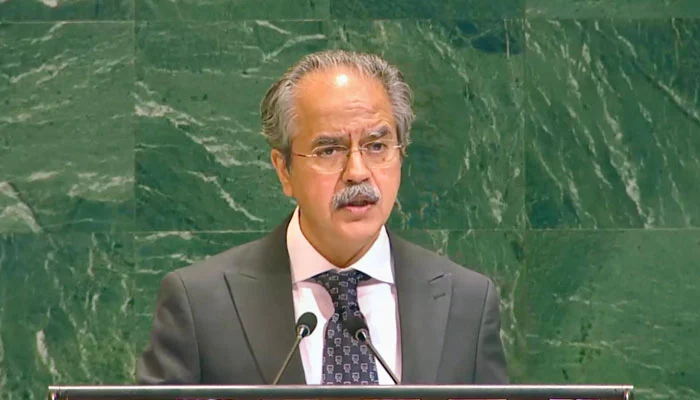
In response to recent attacks by terrorists operating from Afghanistan, Pakistan has made a strong appeal to the United Nations, urging the international body to prevent the war-torn nation from becoming a breeding ground for terrorism. Pakistan has specifically labeled the Tehreek-e-Taliban Pakistan (TTP) as a significant global and regional threat. Addressing a plenary session of the UN General Assembly on the situation in Afghanistan, Pakistan’s Permanent Ambassador to the UN, Asim Iftikhar Ahmad, stated, “We must ensure that Afghanistan does not become a breeding ground for terrorists that threatens not only its neighbours, but the region and beyond.”
The ambassador’s remarks underscore Pakistan’s consistent demand for Afghanistan not to be used as a staging ground by terror outfits for launching attacks. Just last week, Pakistani security forces successfully neutralized at least 30 Indian-backed terrorists who were attempting to infiltrate through the Pakistan-Afghanistan border in Khyber-Pakhtunkhwa’s North Waziristan district. Since the Taliban’s return to power in Afghanistan in 2021, Pakistan has experienced a noticeable increase in cross-border terror incidents, particularly impacting its bordering provinces of Khyber Pakhtunkhwa and Balochistan. May 2025 saw a slight rise in militant attacks within the country, though heightened military tensions with India did not result in a significant escalation of violence from extremist groups.
A day prior, Pakistan and Afghanistan held their inaugural additional secretary-level mechanism meeting between their foreign ministries in Islamabad. Key areas of bilateral interest, including trade, transit cooperation, security, and connectivity, were discussed. Both nations acknowledged terrorism as a serious threat to regional peace and security. During the discussions, the Pakistani delegation emphasized the need for concrete actions against terrorist groups operating from Afghan soil, highlighting how such groups undermine Pakistan’s security and impede regional development.
Ambassador Iftikhar further elaborated on the terror threat emanating from Afghanistan, stressing that it poses a serious danger to neighboring countries, especially Pakistan. “Daesh continues to target the de facto authorities while other terrorist entities including Al-Qaeda, the TTP, and the Baloch militant groups, continue to operate from ungoverned spaces in Afghanistan.” The envoy reiterated that “Afghanistan must not become a safe haven for terrorism against any other country,” and specifically noted that the TTP, with an estimated 6,000 fighters, remains the largest UN-designated terrorist group operating from Afghan soil.
“With cross-recruitment between various terrorist groups, including the TTP and Daesh, the TTP poses a threat not only to our national security but the region and the world,” the diplomat warned. The ambassador also lamented ongoing attempts to breach the Pak-Afghan borders and highlighted the use of modern weaponry, ammunition, and sophisticated equipment by terrorists “to launch increasingly sophisticated attacks against Pakistan, including in the last two weeks.” He emphasized, “These incidents underscore the scale and seriousness of the threat we face. Pakistan will continue to take all possible action to ensure the safety and security of its people.”
Furthermore, Ambassador Iftikhar stated, “We also have credible evidence of collaboration between the TTP and other groups, such as the Balochistan Liberation Army (BLA) and Majeed Brigade, aimed at disrupting strategic infrastructure and economic development projects in Pakistan.” He added, “Regrettably, Afghan soil also continues to be used by terrorists, often proxies, against other countries, particularly Pakistan.”
The Direct Impact of Afghanistan’s Challenges on Pakistan
Highlighting the direct impact of Afghanistan’s problems on Pakistan, the ambassador noted that Pakistan has hosted millions of Afghans for decades and continues to protect vulnerable Afghans despite its own limitations. “Since August 2021, an additional one million undocumented individuals crossed into Pakistan, creating among other issues, law-and-order concerns. The international community in our view must share this burden more equitably,” he stated. He also stressed the urgent need for the revival of the Afghan economy and banking system, including the unfreezing of financial assets, to enable trade and investment.
Pakistan remains committed to expanding trade and pursuing regional connectivity initiatives such as TAPI, CASA-1000, the Uzbekistan-Afghanistan-Pakistan railway, and the extension of the CPEC to Afghanistan. These initiatives, he asserted, can significantly contribute to development and peace in Afghanistan and the wider region. Concluding his address, Ambassador Iftikhar remarked, “For the first time in more than four decades, we have seen an end to fighting in Afghanistan. It has been nearly four years since the Taliban takeover. There is renewed hope for a better future for an Afghanistan at peace with itself, its neighbours and the international community.” He envisioned “An Afghanistan which respects and nurtures all Afghans, regardless of considerations of gender, ethnicity, political affiliation or religion and a prosperous Afghanistan free from terrorism; fully integrated into the international community,” stressing that Afghanistan must not be abandoned and that practical and pragmatic engagement through dialogue and diplomacy is the only way forward.
