

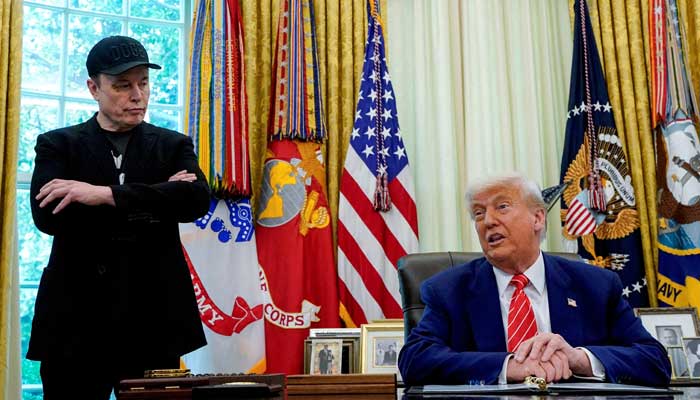
Billionaire Elon Musk has intensified his criticism of U.S. President Donald Trump’s sweeping tax-cut and spending bill, vowing to unseat lawmakers who supported it despite campaigning on limiting government expenditure. After weeks of relative silence following a feud with Trump over the legislation, Musk re-entered the debate on Saturday, July 1, 2025, as the Senate took up the package, calling it “utterly insane and destructive” in a post on his social media platform X.
On Monday, June 30, 2025, he ramped up his criticism, stating that lawmakers who had campaigned on cutting spending but backed the bill “should hang their heads in shame!” Musk posted on X: “Every member of Congress who campaigned on reducing government spending and then immediately voted for the biggest debt increase in history should hang their head in shame!!” He further declared, “And they will lose their primary next year if it is the last thing I do on this Earth.”
The Tesla and SpaceX CEO reiterated his call for a new political party, asserting that the bill’s massive spending indicated “that we live in a one-party country – the PORKY PIG PARTY!!” He wrote, “Time for a new political party that actually cares about the people.”
Musk’s vocal opposition to the bill has created a significant rift in his relationship with Trump. This marks a dramatic shift, especially given that the tech billionaire spent nearly $300 million on Trump’s re-election campaign in 2024 and led the administration’s controversial Department of Government Efficiency (DOGE), a federal cost-cutting initiative. Musk, the world’s richest person, has argued that the legislation would substantially increase the national debt and negate any savings he claims to have achieved through DOGE.
It remains uncertain how much influence Musk holds over Congress or the precise impact his opinions might have on the bill’s passage. However, Republicans have voiced concerns that his on-again, off-again feud with Trump could jeopardize their chances of protecting their majority in the 2026 midterm congressional elections.
Trump’s Retaliation
In response to Musk’s criticism, Trump suggested on Tuesday, July 1, 2025, that the Department of Government Efficiency should scrutinize the subsidies received by the Tesla CEO’s companies in an effort to save money. On his Truth Social platform, Trump posted, “Elon may get more subsidy than any human being in history, by far, and without subsidies, Elon would probably have to close up shop and head back home to South Africa. No more Rocket launches, Satellites, or Electric Car Production, and our Country would save a FORTUNE. Perhaps we should have DOGE take a good, hard, look at this? BIG MONEY TO BE SAVED!!!”
Musk swiftly responded on X, his own social media platform, stating, “I am literally saying CUT IT ALL. Now.” Trump had previously threatened to cut Musk’s government subsidies and contracts in early June when their relationship devolved into an all-out social media brawl over the bill. Non-partisan analysts have estimated that this bill would add approximately $3 trillion to the U.S. national debt.
Musk’s business empire includes SpaceX, a rocket company and government contractor, which holds about $22 billion in federal contracts, along with its satellite unit, Starlink. His dispute with Trump also caused volatility for Tesla; shares of the electric car company lost approximately $150 billion of their market value on June 5, 2025, marking the largest single-day decline in the company’s history, although it has since recovered some ground. Tesla shares trading in Frankfurt tumbled 5% on Tuesday.
Senate’s “Vote-a-rama” Battle
U.S. Senate Republicans on Monday evening were still attempting to pass Trump’s sweeping tax-cut and spending bill, despite internal party divisions over its projected $3.3 trillion impact on the nation’s debt pile. Senators were engaged in a marathon session known as a “vote-a-rama,” featuring a series of amendments proposed by both Republicans and the minority Democrats. This arcane process is being utilized by Republicans to bypass Senate rules that typically require 60 of the chamber’s 100 members to agree on legislation.
After roughly 12 hours, it remained unclear how long the voting would continue. Lawmakers indicated that the process was partly delayed by the need to determine whether amendments complied with specific budgetary rules. When asked about his confidence in the measure’s passage, Republican Senate Majority Leader John Thune of South Dakota earlier told reporters, “Never until we vote.” Republicans can afford to lose no more than three votes in either chamber to pass a bill that Democrats are united in opposing.
The nonpartisan Congressional Budget Office (CBO) released its assessment on Sunday, June 29, 2025, regarding the bill’s impact on the current U.S. national debt, which stands at over $36.2 trillion. The Senate version of the bill is estimated to cost $3.3 trillion, $800 billion more than the version passed last month in the House of Representatives. Many Republicans dispute this claim, arguing that extending existing policy will not add to the debt. Nevertheless, international bond investors are reportedly seeking incentives to diversify away from the U.S. Treasury market.
Democrats, meanwhile, hope that the latest, eye-widening figure could generate enough anxiety among fiscally minded conservatives to encourage them to break ranks with their party, which controls both chambers of Congress. Democratic Senate Minority Leader Chuck Schumer stated in a Senate speech, “This bill, as we have said for months, steals people’s healthcare, jacks up their electricity bill to pay for tax breaks for billionaires.” Thune countered, asserting that the tax cuts would benefit families and small businesses, while defending spending reductions to social safety net programs. He claimed that Medicaid was growing at an unsustainable rate and that improvements and reforms were needed to make it more efficient.
The Senate narrowly advanced the tax-cut, immigration, border, and military spending bill in a procedural vote late on Saturday, voting 51-49 to open debate on the 940-page megabill. Trump desires the bill to be passed before the July 4 Independence Day holiday. Republican Senator Thom Tillis, who opposes the bill, told reporters when asked about the timing of a Senate vote, “I’m still holding out the hope that I’m headed to North Carolina tomorrow.”
Bill Politics and Concerns
Many of the amendments are from Democrats, with Senator Lisa Blunt Rochester from Delaware proposing limits on Medicaid cuts, Senator Patty Murray from Washington pushing to strike funding restrictions for reproductive health clinics that provide abortions, and Senator Elizabeth Warren from Massachusetts attempting to reinstate funding for the Consumer Financial Protection Bureau. These and other Democratic amendments have so far been rejected by the Republican majority.
Embedded within the Senate Republicans’ bill are several politically contentious issues, such as a prohibition of Medicaid funding for a list of almost 30 medical procedures related to gender transition. It also includes an increase in immigration-related funding for criminal and gang checks for unaccompanied migrant children, which would involve examinations of “gang-related tattoos” for children as young as 12 years old.
The U.S. Chamber of Commerce, which states that the majority of its members are small businesses, supports the bill. However, John Arensmeyer, representing over 85,000 small enterprises at the Small Business Majority, cautioned that the business tax relief is currently skewed towards the wealthiest, top 5% of small businesses.
Debt Ceiling Deadline Looms
The Republican measure includes a $5 trillion debt ceiling increase—$1 trillion more than the House’s bill. Failure to pass some version of the bill would present lawmakers with a serious deadline later this summer, when the Treasury Department could near the exhaustion of its borrowing authority, risking a devastating default. The debt limit increase has led Senator Rand Paul of Kentucky to oppose the bill, joining fellow Republican Tillis, who has decried its cuts to Medicaid and clean energy initiatives.
According to the Congressional Budget Office, the Senate bill would result in about 11.8 million additional uninsured people, surpassing estimates for the House’s version. If the Senate successfully passes the bill, it will then move to the House, where members are also divided, with some expressing anger over its cost and others concerned about cuts to the Medicaid program.
The megabill aims to extend the 2017 tax cuts, which were Trump’s main legislative achievement during his first term as president, while also cutting other taxes and boosting spending on the military and border security. Senate Republicans, who dispute the CBO’s estimates on the legislation’s cost, are determined to use an alternative calculation method that does not factor in costs from extending the 2017 tax cuts. Outside tax experts, such as Andrew Lautz from the nonpartisan think tank Bipartisan Policy Center, describe this as a “magic trick.” Using this calculation method, the Senate Republicans’ budget bill appears to cost substantially less and seems to save $500 billion, according to the BPC analysis.
