

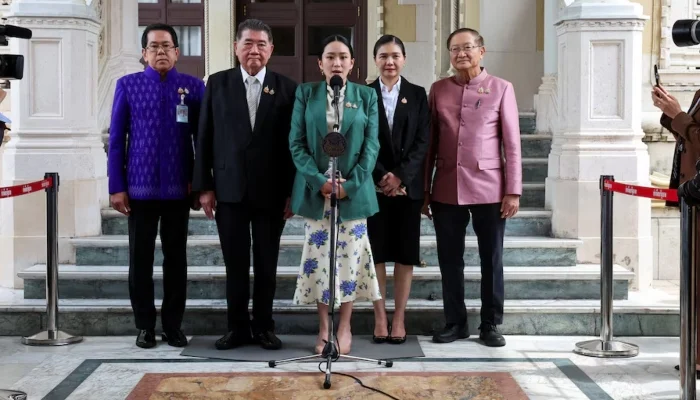
On Tuesday, Thai Prime Minister Paetongtarn Shinawatra was suspended by the country’s Constitutional Court, as it initiated an investigation into her conduct during a diplomatic dispute with Cambodia. For years, the kingdom’s politics have been characterized by a struggle between the conservative, pro-military, pro-royalist elite and the Shinawatra clan, whom they view as a threat to Thailand’s traditional social order.
This setback for 38-year-old Paetongtarn occurred on the same day her father, former premier Thaksin Shinawatra, faced a criminal court over allegations of royal defamation. Paetongtarn, who assumed power less than a year ago, will remain suspended while the Constitutional Court deliberates whether she breached ministerial ethics during a recent border row. A long-standing territorial dispute with Cambodia escalated into cross-border clashes in May, resulting in the death of one Cambodian soldier.
During a phone call to discuss the tensions, Paetongtarn referred to Cambodian ex-leader Hun Sen as “uncle” and a Thai military commander as her “opponent,” according to a leaked recording that triggered widespread backlash. Conservative lawmakers accused her of kowtowing to Cambodia and undermining the military, alleging she violated constitutional provisions requiring “evident integrity” and “ethical standards” among ministers. A statement from the court read, “The Constitutional Court with a majority of 7-2 suspends the respondent from Prime Ministerial duty from July 1 until the Constitutional Court has made its ruling.”
‘Critical Dilution’
The scandal has already led to Paetongtarn’s Pheu Thai party being abandoned by a key conservative coalition partner, and thousands protested against her leadership in Bangkok over the weekend. On Tuesday, Thailand’s King approved Paetongtarn’s cabinet reshuffle after her allies resigned. She assigned herself the culture minister position and is scheduled to take up the role on Thursday, though it remains unclear if she can assume that position while under investigation by the Constitutional Court.
Separately on Tuesday, her father, Thaksin, arrived at a Bangkok criminal court to face accusations of breaching strict lese-majesty laws, which are used to shield Thailand’s King from criticism. The allegations stem from a 2015 interview he gave to South Korean media, and he faces up to 15 years in jail if convicted. The trial is expected to last for weeks, with a verdict not anticipated for at least a month thereafter. A court official confirmed to AFP that the trial commenced on Tuesday morning with Thaksin in attendance, but media access was not permitted. His lawyer, Winyat Chatmontri, told AFP outside court, “I can’t speak on his behalf about how he feels, but I think he seems chill.”
Thai political analyst Thitinan Pongsudhirak told AFP that “there is a direct undeniable linkage between the two cases,” indicating that the brand of the Shinawatra family faces “a critical dilution.”
