

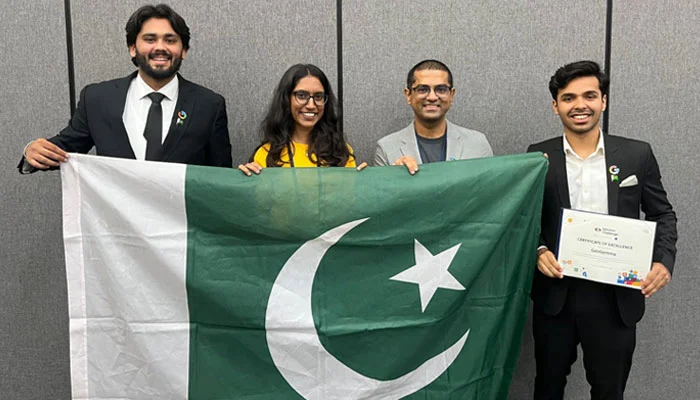
Two driven students from Islamabad’s Institute of Space Technology (IST), Ahmed Iqbal and Hanzila Bin Younas, have transformed their final-year academic project into an award-winning innovation. Their project, GeoGemma—an open-source Large Language Model (LLM) integrated with the powerful Google Earth Engine—recently secured the ‘Best AI Use Case’ award at the prestigious Asia-Pacific (APAC) Solution Challenge, an event jointly organized by Google and the Asian Development Bank in Manila.
The duo’s groundbreaking project, GeoGemma, is an open-source Geo Large Language Model (GeoLLM) designed for planetary-scale satellite imagery and analysis. This initiative was born from their ambition to make complex geospatial data and satellite imagery easily accessible, an idea that also captured the attention of Google DeepMind, Alphabet’s subsidiary focused on AI development. They were awarded a $10,000 grant which significantly accelerated GeoGemma’s development.
Speaking to Geo.tv from Manila, Philippines, on Monday, Iqbal shared that the motivation to turn his final-year project into something impactful arose from observing the rapid rise of generative AI and ChatGPT over the past three years. “Initially, with both Hanzila and I having a background in Space Science, and our specialization in Geographic Information Systems (GIS) and Remote Sensing, which is based on Satellite Imaging, it was very apparent, it was very straightforward for us that we need to find cross-sections in Geospatial Artificial Intelligence or Geo AI,” Iqbal explained.
He added, “This is a relatively new field and we have seen very few cross-sections in geospatial technologies or GIS and text-based Large Language Models (LLM) like ChatGPT.” Iqbal, the team lead for GeoGemma, emphasized that a key tool “every person uses in this particular field” is the Google Earth Engine.
Ahmed Iqbal (left) and Abdullah Asif pose with Pakistan’s national flag after winning the ‘Best AI Use Case’ award at the APAC Solution Challenge in Manila, Philippines, on June 26, 2025. — Reporter
“We may have seen the roofs of our houses on Google Earth and whatnot, but Google Earth Engine is a step ahead from that, it is a bigger brother, so to speak,” Iqbal said. “There you find more than 80 petabytes worth of Satellite Imaging and its related and associated data sets. So, we thought okay, Google Earth Engine is an open source platform, why not fuse it with a free-to-use, ChatGPT-like model?” the young innovator elaborated.
While highlighting the vast applications of Google Earth Engine, Iqbal also pointed out that its utility has traditionally been restricted to users with extensive programming and coding expertise. Iqbal and Younas aimed to dismantle this barrier, envisioning a tool that would enable anyone to analyze this immense data simply by writing natural language prompts.
A Crucial Summer of Development
A pivotal phase in GeoGemma’s development occurred during the summer of 2024 at the National Center of GIS and Space Application (NCGSA). Iqbal underscored the significance of this internship: “We were doing an internship there, and they gave us a free hand to experiment on this particular research that eventually became GeoGemma.” He also expressed gratitude to key figures at NCGSA, stating, “They gave us pro versions of ChatGPT tools and Cloud Sonnet tools in the early pre-ideation stage.”
It was during this NCGSA internship that the team actively began pursuing research grants. Iqbal reflected on the mindset that led them to Google DeepMind: “Why not have our project sponsored by one of the biggest tech companies in the world? It could be Google, it could be Amazon, it could be Meta, it could be NVIDIA.”
IST’s GeoGemma Team can be seen manifesting their future win via ChatGPT in this image taken on April 22, 2025. — Reporter
He lamented a common oversight in academic circles, remarking, “Somehow, within our academia circles or our students, this thought doesn’t come to us; it isn’t ingrained within our workflows, as it were. If you have a fantastic idea, why not just openly say it to these companies? You would never know how many doors open if you don’t knock.”
Around June 2024, Iqbal discovered a research grant opportunity through the Gemma Academic Programme. He, Younus, and their supervisor, Dr. Sajid Ghuffar, formed a GeoAI team and successfully pitched their idea of fusing Google Earth Engine with the open-source Gemma model. This led to a substantial $10,000 research grant from Google DeepMind in September 2024, providing crucial funding for their development.
“We eventually got flown out to Google offices in Manila, which was an incredible experience,” Iqbal recounted. “Being honored and given a research grant by Google DeepMind is a massive achievement in itself, especially considering the broader landscape of AI research.” He emphasized their clear initial vision: “Our ideation was very clear that we wanted to fuse generative AI models with the Google Earth Engine or its similar products. But the Google Earth Engine was a product that we had an eye on.”
GeoGemma rapidly gained recognition, being selected as one of the top 10 projects from a pool of 750 entries across over 200 universities. To further strengthen their project for the final stage of the competition, Iqbal and Younus expanded their team, bringing in Abdullah Asif as a Front-end Web Developer and Khalil Ur Rehman as a tech lead and AI engineer, both undergraduates from IST’s Computer Science program.
Addressing the “Biggest Limitation”
Beyond celebrating their success, Iqbal also highlighted a critical hurdle in advancing AI research in Pakistan—the scarcity of powerful computing infrastructure. “The biggest limitation of any AI research project is that you need lots and lots of graphics processing unit (GPU), which Pakistan certainly lacks,” the co-creator of the award-winning GeoGemma explained. “We need AI infrastructure to fine-tune these models, to train these models. We need lots and lots of GPUs, which cost thousands of dollars, if not hundreds of thousands of dollars.”
The $10,000 research grant from Google DeepMind was not a direct cash infusion but rather a strategic allocation of resources. Iqbal elaborated, “The research grant is basically, we have received credits on Google Cloud of $10,000 to fine-tune our models, to experiment on our models and to also contribute overall, which is our understanding with them: making Gemma learn more about Earth GIS.”
(From left to right) IST’s GeoGemma Team’s Khalil Ur Rehman, Hanzila Bin Younas, Ahmed Iqbal, and Abdullah Asif can be seen in this undated image. — Reporter
This access to robust cloud computing resources proved invaluable for the Pakistani team.
Immense Potential
GeoGemma functions as a simplified spatial analysis tool, capable of fetching and interpreting satellite data by understanding natural language commands. Remarkably, the model itself is less than 2GB in size, allowing it to be loaded and run on any standard laptop without the need for external servers.
The team believes GeoGemma holds immense potential across a multitude of industries where satellite imagery and remote sensing are crucial, including sustainability, oil and gas exploration, real estate development, and supply chain management, among others. With their recent award and recognition, the team is now focused on releasing their software before the end of this year. They envision future partnerships and the development of custom, proprietary modules to further expand GeoGemma’s reach and impact.
