

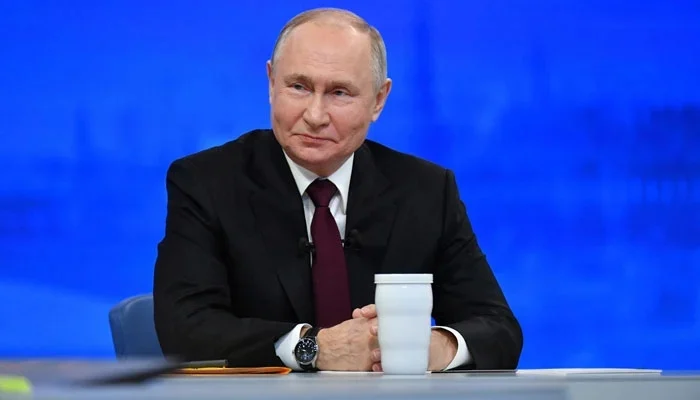
Russian President Vladimir Putin has stated that relations between Russia and the United States are beginning to stabilize, attributing this improvement to the efforts of US President Donald Trump. Putin reiterated his “great respect” for Trump and expressed willingness to meet him, noting that such a meeting would require careful preparation but was “quite possible.”
“In general, thanks to President Trump, relations between Russia and the United States are beginning to level out in some ways,” Putin told a press conference in Minsk. He added, “Not everything has been decided in the sphere of diplomatic relations, but the first steps have been taken and we are moving forward.”
Unexpected Shift on Military Expenditure In a surprising announcement, Putin also indicated that Russia intends to reduce its military expenditure starting next year, a stark contrast to NATO’s plan to increase defense spending over the next decade.
NATO allies recently agreed to raise their collective spending target to 5% of their gross domestic product over the next 10 years, citing the long-term threat posed by Russia and the need for stronger civil and military resilience. Responding to this, Putin suggested that NATO’s increased spending would be directed towards “purchases from the USA and on supporting their military-industrial complex,” deeming it NATO’s internal affair, not Russia’s.
“But now here is the most important thing. We are planning to reduce defense spending. For us, next year and the year after, over the next three-year period, we are planning for this,” Putin stated. He acknowledged that while a final agreement among defense, finance, and economy ministries is pending, “overall, everyone is thinking in this direction.” He then posed a rhetorical question: “And Europe is thinking about how to increase its spending, on the contrary. So who is preparing for some kind of aggressive actions? Us or them?”
These comments are likely to be met with skepticism in the West, given Russia’s significant increase in defense spending since the start of the Ukraine war. The conflict continues to intensify with no visible progress towards a ceasefire or permanent settlement.
Ukraine War and Trump’s Involvement Putin acknowledged and appreciated Trump’s efforts to end the war, noting Trump’s recent statement that the conflict “turned out to be more difficult than it seemed from the outside.” This week, Trump had expressed his belief that Putin seeks a way to resolve the conflict, though Ukraine and many European allies suspect the Kremlin leader has no genuine interest in a peace deal and aims to capture more territory.
Putin confirmed that Russian and Ukrainian negotiators remain in constant contact and that Moscow is prepared to return the bodies of 3,000 more Ukrainian soldiers.
Separately, President Trump stated on Friday that he believes “something will happen” in Russia’s war in Ukraine to get it “settled,” referencing his recent call with Putin but offering no further details. “We’re working on that one. President Putin called up and he said, I’d love to help you with Iran. I said, do me a favor: I’ll handle Iran. Help me with Russia. We got to get that one settled. And I think something’s going to happen there,” Trump told reporters at the White House. He also praised Putin’s remarks, describing them as “very nice statements.”
Economic Pressures and Budgetary Shifts Russia is currently experiencing a sharp slowdown in economic growth, primarily due to pressure on the budget from falling energy revenues, with the central bank actively working to curb inflation.
In 2025, Russia significantly increased its state spending on national defense by a quarter, reaching 6.3% of gross domestic product (GDP), the highest level since the Cold War. Defense spending accounts for 32% of the total 2025 federal budget expenditure. Defense plants have been operating round-the-clock for several years, and the state has invested heavily in bonuses to attract soldiers and compensation for fallen personnel’s families. Putin acknowledged that the increase in military spending has contributed to higher inflation.
The finance ministry raised the 2025 budget deficit estimate to 1.7% of GDP in April from 0.5%, following a 24% reduction in its energy revenues forecast. The ministry plans to utilize fiscal reserves this year to balance the budget. The next draft budget is anticipated in the autumn.
