

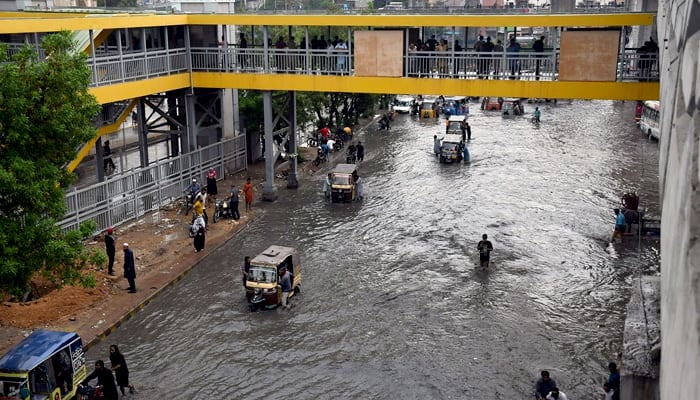
For the third consecutive day on Saturday, monsoon rains continued to lash Karachi, leading to significant water accumulation in low-lying areas and disrupting the daily routines of residents.
Affected Areas and Rainfall Data: Localities reporting moderate to heavy rainfall included II Chundrigar Road, Saddar, Lyari, Gulistan-e-Jauhar, Gulshan-e-Iqbal, DHA, Clifton, Tariq Road, and North Nazimabad. According to the Pakistan Meteorological Department (PMD), the highest rainfall recorded was 23mm in Gulshan-e-Maymar, followed by 22mm in Surjani Town, 17mm in Saadi Town, 11mm along University Road, 8.2mm in Nazimabad, and 6mm at Jinnah Terminal. The widespread water accumulation in various neighborhoods has raised concerns and questions regarding the Sindh government’s earlier claims of thorough monsoon preparedness.
Mayor’s Response and Public Advisory: Karachi Mayor Murtaza Wahab visited several rain-affected areas on Saturday evening, including Soldier Bazaar, Guru Mandir, Patel Para, and Jahangir Road. He urged citizens to prioritize their safety and avoid unnecessary movement during the intermittent showers.
Weather Forecast and Warnings: The Met Office has predicted continued light to moderate showers with occasional heavy downpours across the city throughout Saturday. Winds are currently blowing from the northeast at a speed of 10 kilometers per hour. For Sunday, intermittent rain is forecast for Karachi, with the possibility of moderate to isolated heavy falls in some areas. Monday is expected to bring cloudy conditions with chances of light rain or drizzle.
In other parts of Sindh, thunderstorms are expected to continue until tomorrow, with occasional breaks, in areas such as Hyderabad, Dadu, Badin, Ghotki, Kashmore, Jacobabad, Tharparkar, Mirpurkhas, Umerkot, Khairpur, Sukkur, Larkana, Qambar Shahdadkot, Shaheed Benazirabad, and their surrounding regions.
National Disaster Management Authority (NDMA) has issued a warning that heavy rainfall in the port city could disrupt daily activities, cause urban flooding and waterlogging in low-lying areas, and potentially damage vulnerable structures. This includes roofs and walls of temporary houses, electric poles, billboards, vehicles, and solar panels during the forecast period.
