

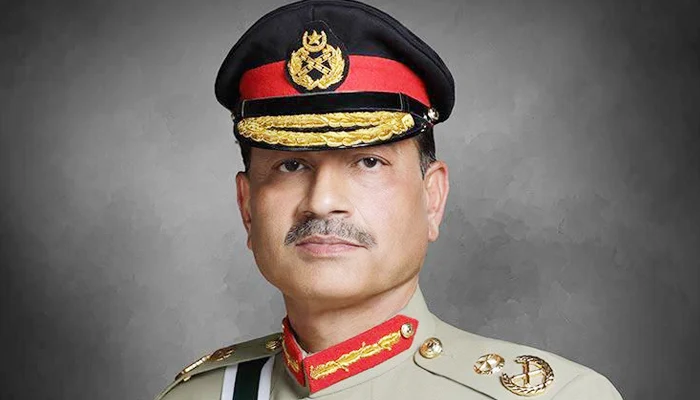
Field Marshal Syed Asim Munir, Chief of Army Staff, has identified India as the largest state sponsor of terrorism in the region, urging neighboring countries to remain vigilant against Indian proxy networks.
Addressing officers of the 52nd Common Training Programme on Friday, COAS Munir underscored Pakistan’s desire for friendly relations with Afghanistan, a brotherly Islamic nation, but expects it to deny sanctuary to India’s terror proxies, specifically naming Fitna al-Hindustan and Fitna al-Khawarij.
“India is the largest sponsor of terrorism in the region,” he declared, warning that Pakistan would never tolerate Indian hegemony. “We have never bowed before India, nor will we ever do so.”
The army chief asserted that terrorism is primarily an internal Indian issue, stemming from its discriminatory and violent treatment of its minorities, particularly Muslims.
Regarding Pakistan’s defense readiness, Field Marshal Munir stated that the armed forces remain fully prepared to meet the demands of modern warfare.
Chief of Army Staff, Field Marshal Syed Asim Munir, addresses 52nd CTP of the Civil Services Academy at the Army Auditorium, in a video released on June 27, 2025. — ISPR
He credited Pakistan’s robust response during Ma’rakah-e-Haq — from the Line of Control to the country’s shores — as a decisive reply to India’s unwarranted aggression.
Last month, Pakistan and India experienced the most intense fighting in decades, which was triggered by an April 22 attack in Indian Occupied Jammu and Kashmir that resulted in 26 fatalities. New Delhi attributed the attack to “terrorists” backed by Pakistan, a charge Islamabad denies. India launched unprovoked attacks on Pakistan, leading to the martyrdom of over 50 individuals, including security personnel. In retaliation, Pakistan successfully downed multiple Indian jets and attacked military installations. Following Pakistan’s response, the United States intervened through mediation, successfully de-escalating the conflict.
Field Marshal Munir highlighted that divine support was with Pakistan during the confrontation because the country stood on the side of truth.
He also emphasized the importance of unity among all state institutions, stating that the administration and civil bureaucracy form the bedrock of harmony and bear crucial responsibilities.
Underscoring the value of history and national identity, COAS Munir urged the officers to embrace the identity of Pakistaniyat over individual or regional affiliations. “Nations that forget their history lose their future.”
Calling on officers to cultivate courage, competence, and character, he stressed that if a choice must be made among the three, character should always be prioritized.
“Every system has flaws,” the army chief acknowledged, “but your job is to ensure that weaknesses and negative forces do not overpower the system.”
He further added that national progress hinges on strong ties between the public, government, and the armed forces, and that love and loyalty to the country must remain the foremost principle.
