

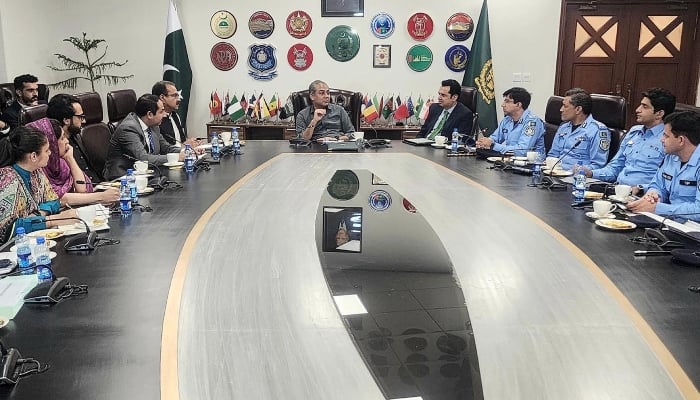
The decision regarding the suspension of mobile phone or internet services during Muharram-ul-Haram will be made in consultation with the provinces. This was resolved in a meeting chaired by Interior Minister Mohsin Naqvi, which focused on reviewing the national security plan.
The meeting thoroughly examined security preparations for Muharram across all provinces, including Azad Jammu and Kashmir (AJK), Gilgit-Baltistan (GB), and the federal capital, Islamabad. Officials collectively agreed that strict action would be taken against individuals spreading religious hatred on social media platforms.
Naqvi stated that all necessary measures and decisions related to Muharram security would be undertaken through mutual consultation. He affirmed that the federal government would provide full support to maintain peace during the religious month. He further emphasized that no individual would be allowed to provoke unrest or engage in subversive activities. Naqvi confirmed that the enforcement of the code of conduct during Muharram would be ensured, and processions and gatherings would be monitored using modern technology.
Attendees at the meeting included inspectors general of police and interior secretaries from the provinces, AJK, GB, and Islamabad. Minister of State for Interior Talal Chaudhry, the Interior Secretary, and the Acting Chairman of the Capital Development Authority (CDA) were also present. The Commandant of the Frontier Constabulary, Deputy Commissioner Islamabad, and DIG Islamabad Police were also in attendance. DG Rangers Sindh and senior officials from law enforcement agencies participated via video link, along with IGs of police, interior secretaries, and DGs Rangers from all provinces, AJK, and GB.
State Authority to Counter Hate Speech: Ulema-Mashaykh Peace Conference Declaration
In a separate development, the Ulema-Mashaykh Peace Conference was held in Islamabad under the auspices of the Council of Islamic Ideology (CII). The event was chaired by Dr. Raghib Naeemi and attended by religious scholars from all schools of thought.
A joint declaration issued after the conference stated that all citizens must uphold their oath of loyalty to the Constitution and the State of Pakistan. It affirmed that the Constitution grants every citizen the right to assembly, belief, and worship. It also recognized the right of citizens to peacefully strive for the implementation of Shariah.
The declaration further asserted that armed action, violence, and chaos against the State constitute forms of rebellion. It called on citizens to fully support Pakistan’s armed forces and urged avoidance of movements based on linguistic, regional, or sectarian biases.
The declaration stated that the State has the right to take strict action against those who spread hatred, and that imposing one’s beliefs on others through coercion is a clear violation of Shariah. It also warned that any public or private educational institution found imparting military training would face action.
Additionally, the declaration called for measures against extremism and sectarianism. It stressed that no person shall insult Khatam-un-Nabiyyin (the Seal of the Prophets), the Companions, or the Ahl al-Bayt. It further emphasized that no individual should declare another a disbeliever (takfir).
