

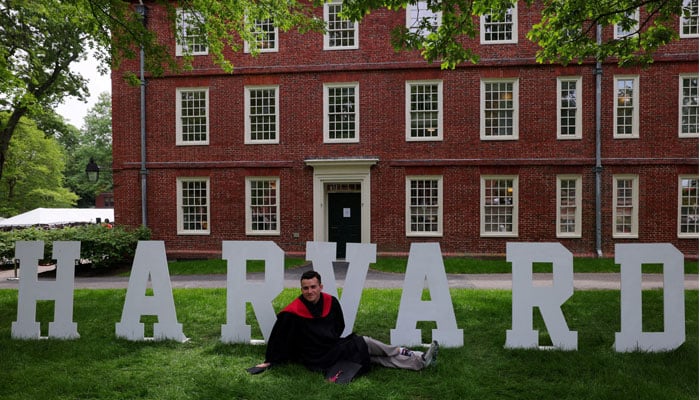
On Monday, a federal judge blocked President Donald Trump’s administration from moving forward with its plan to prohibit foreign nationals from entering the United States to pursue studies at Harvard University.
US District Judge Allison Burroughs in Boston issued an injunction, effectively barring the Trump administration from implementing its latest effort to curb Harvard’s capacity to host international students. This decision comes amidst an escalating conflict between the Republican president and the renowned Ivy League institution.
This preliminary injunction extends a temporary order Judge Burroughs had initially issued on June 5. That earlier order had prevented the administration from enforcing a proclamation Trump signed a day prior, which cited national security concerns as justification for no longer trusting Harvard to host international students.
The proclamation specifically barred foreign nationals from entering the US to study at Harvard or participate in exchange visitor programs for an initial period of six months. It also directed Secretary of State Marco Rubio to assess whether to revoke the visas of international students already enrolled at Harvard.
Judge Burroughs, in her written decision, stated that “at its root, this case is about core constitutional rights that must be safeguarded: freedom of thought, freedom of expression, and freedom of speech, each of which is a pillar of a functioning democracy and an essential hedge against authoritarianism.”
She further elaborated, “Here, the government’s misplaced efforts to control a reputable academic institution and squelch diverse viewpoints seemingly because they are, in some instances, opposed to this Administration’s own views, threaten these rights.” She added, “To make matters worse, the government attempts to accomplish this, at least in part, on the backs of international students, with little thought to the consequences to them or, ultimately, to our own citizens.”
During its most recent academic year, nearly 6,800 international students attended Harvard, constituting approximately 27% of the student body at the prestigious Cambridge, Massachusetts-based institution.
Broader Conflict Between Trump Administration and Harvard
Trump signed the aforementioned proclamation after his administration had already taken several punitive actions against Harvard. These included freezing billions of dollars in funding to the oldest and wealthiest US university, threatening Harvard’s tax-exempt status, and initiating multiple investigations into the school.
On Friday, Trump indicated that his administration might announce a deal with Harvard “over the next week or so” to resolve the White House’s campaign against the university, which has been engaged in a legal battle against the administration’s actions.
Harvard alleges that Trump is retaliating against it, in violation of its free speech rights under the US Constitution’s First Amendment. The university claims this retaliation stems from its refusal to accede to the administration’s demands to control the school’s governance, curriculum, and the ideology of its faculty and students.
The university has filed two separate lawsuits before Judge Burroughs. One seeks to unfreeze approximately $2.5 billion in funding, and the other aims to prevent the administration from blocking the ability of international students to attend the university.
The latter lawsuit was filed after Homeland Security Secretary Kristi Noem announced on May 22 that her department was immediately revoking Harvard’s Student and Exchange Visitor Program certification, which is essential for enrolling foreign students. Noem, without providing specific evidence, accused the university of “fostering violence, antisemitism, and coordinating with the Chinese Communist Party.”
Her action was swiftly blocked temporarily by Judge Burroughs. While the Department of Homeland Security has since shifted its approach to challenging Harvard’s certification through a months-long administrative process, Judge Burroughs stated at a May 29 hearing that she intended to issue an injunction to maintain the status quo, which she officially did on Friday.
A week after that hearing, Trump signed his proclamation. This proclamation cited concerns about Harvard’s acceptance of foreign money, including from China, and what it described as the school’s inadequate response to his administration’s demands for information on foreign students.
His administration has also accused Harvard of creating an unsafe environment for Jewish students and allowing antisemitism to persist on its campus. Protests over US ally Israel’s treatment of Palestinians during its war in Gaza have disrupted numerous university campuses, including Harvard’s. Rights advocates have pointed to a rise in antisemitism and Islamophobia in the US due to the conflict. The Trump administration has yet to announce any action regarding anti-Arab and anti-Muslim hate. Harvard’s own antisemitism and Islamophobia task forces, in reports released in late April, found widespread fear and bigotry within the university community.
