

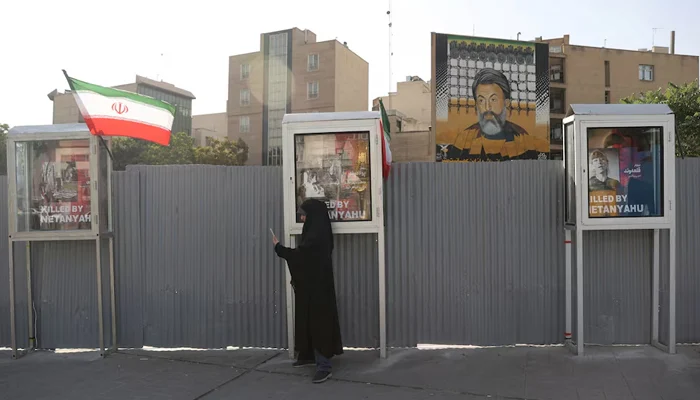
US President Donald Trump announced on Monday a comprehensive ceasefire between Israel and Iran, potentially bringing an end to the 12-day conflict that forced millions to flee Tehran and sparked fears of further escalation in the war-torn region.
However, there was no immediate confirmation from Israel. The Israeli military stated it had detected missiles launched from Iran toward Israel in the early hours of Tuesday.
“Defensive systems are operating to intercept the threat,” the Israel Defense Forces declared in a statement.
Israel, joined by the United States over the weekend, has been carrying out attacks on Iran’s nuclear facilities, alleging that Tehran was nearing the acquisition of a nuclear weapon.
“On the assumption that everything works as it should, which it will, I would like to congratulate both Countries, Israel and Iran, on having the Stamina, Courage, and Intelligence to end, what should be called, ‘THE 12 DAY WAR’,” Trump posted on his Truth Social site.
While an Iranian official had earlier confirmed that Tehran agreed to a ceasefire, the country’s foreign minister stated that hostilities would only cease if Israel halted its attacks. Abbas Araqchi said early on Tuesday that if Israel ceased its “illegal aggression” against the Iranian people no later than 4 AM Tehran time (0030 GMT) on Tuesday, Iran had no intention of continuing its response.
There have been no reported Israeli attacks on Iran since that time. “The final decision on the cessation of our military operations will be made later,” Araqchi added in a post on X.
A senior White House official indicated that Trump brokered the deal in a call with Israeli Prime Minister Benjamin Netanyahu, and Israel agreed on the condition that Iran would not launch further attacks. Trump appeared to suggest that both Israel and Iran would have a period to complete any ongoing missions, after which the ceasefire would commence in a staged process.
Iran denies ever having a nuclear weapons program, but Supreme Leader Ali Khamenei has asserted that if Iran desired nuclear weapons, world leaders “wouldn’t be able to stop us.” Israel, which is not a signatory to the international Non-Proliferation Treaty, is widely believed to be the only country in the Middle East possessing nuclear weapons, a fact it neither confirms nor denies.
Qatar’s Prime Minister Sheikh Mohammed bin Abdulrahman Al Thani secured Tehran’s agreement during a call with Iranian officials, an official briefed on the negotiations told Reuters on Tuesday. US Vice President JD Vance, Secretary of State Marco Rubio, and US special envoy Steve Witkoff were in direct and indirect contact with the Iranians, according to the White House official.
Neither Iran’s UN mission nor the Israeli embassy in Washington responded to separate requests for comment from Reuters. Hours earlier, three Israeli officials had signaled Israel’s intention to conclude its campaign in Iran soon and had conveyed this message to the United States. Israel’s Channel 12 television reported that Netanyahu had instructed government ministers, whose discussions concluded early on Tuesday, not to speak publicly about the situation.
Markets reacted positively to the news. S&P 500 futures rose 0.4% late on Monday, suggesting traders anticipate gains in the US stock market on Tuesday. US crude futures fell in early Asian trading hours on Tuesday to their lowest level in over a week after Trump’s ceasefire announcement, easing concerns about supply disruptions in the region.
Unresolved Tensions and Strategic Objectives
Despite the ceasefire announcement, calm did not appear to have fully returned to the region. The Israeli military issued two evacuation warnings in less than two hours to residents of areas in the Iranian capital Tehran, one late on Monday and another early on Tuesday. Israeli Army radio also reported early on Tuesday that alarms were activated in the southern Golan Heights area due to fears of hostile aircraft intrusion.
Earlier on Monday, Trump stated he would encourage Israel to pursue peace after dismissing Iran’s attack on an American air base, which caused no injuries, and thanking Tehran for providing early notice of the strikes. He claimed Iran fired 14 missiles at the US air base, characterizing it as “a very weak response, which we expected, and have very effectively countered.”
Iran’s handling of the attack mirrored previous clashes with the United States and Israel, as Tehran sought to balance saving face with a military response without provoking an unaffordable cycle of escalation. Tehran appears to have achieved that objective.
Iran’s attack followed US bombers dropping 30,000-pound bunker-buster bombs on Iranian underground nuclear facilities over the weekend, joining Israel’s air campaign. Much of Tehran’s population of 10 million had fled after days of bombing.
The Trump administration maintains that its sole aim was to destroy Iran’s nuclear program, not to initiate a wider war. “Iran was very close to having a nuclear weapon,” Vice President JD Vance said in an interview on Fox News’ “Special Report with Bret Baier.” “Now Iran is incapable of building a nuclear weapon with the equipment they have because we destroyed it,” Vance asserted.
Trump has cited intelligence reports suggesting Iran was close to building a nuclear weapon, without providing specifics. However, US intelligence agencies earlier this year assessed that Iran was not building a nuclear weapon, and a source with access to US intelligence reports told Reuters last week that this assessment had not changed.
Yet, in a social media post on Sunday, Trump spoke of toppling the hardline clerical rulers who have been Washington’s principal adversaries in the Middle East since Iran’s 1979 Islamic Revolution. Israel, however, had made clear that its strikes on Evin prison—a notorious facility for political prisoners—and other targets in Tehran were intended to broadly target the Iranian ruling apparatus and its capacity to maintain power.
