

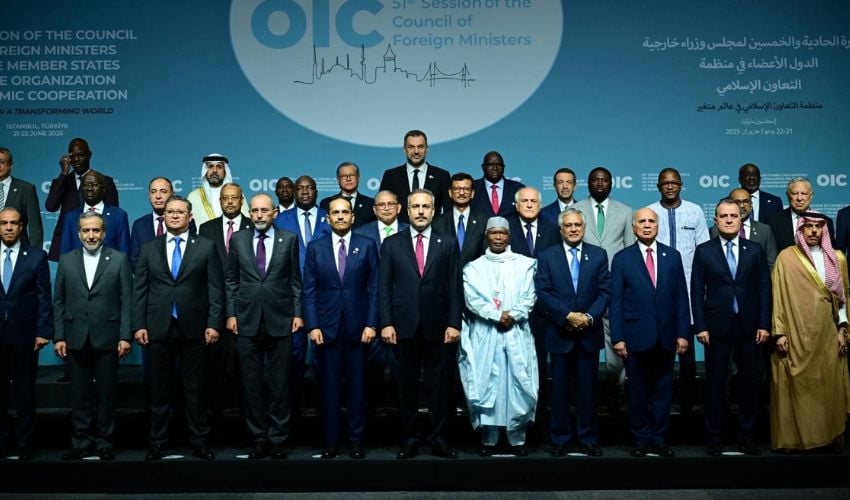
The 51st Session of the Council of Foreign Ministers of the Organization of Islamic Cooperation (OIC) has concluded in Istanbul, Türkiye. The session saw the adoption of the Istanbul Declaration, a comprehensive document addressing a wide array of political, humanitarian, and regional challenges confronting the Muslim world. OIC member states reaffirmed their unity and called for enhanced collective action amidst increasing international instability and evolving global power dynamics. The ministers underscored the necessity for the OIC to assume a more prominent role in fostering regional and global peace.
Palestinian Cause Remains at the Forefront
The OIC reiterated its unwavering support for the Palestinian people, advocating for the establishment of an independent Palestinian state along the 1967 borders, with East Jerusalem as its capital. The ministers condemned Israel’s 19-month-long military campaign in Gaza, unequivocally describing it as genocide and a systematic effort to undermine the Palestinian cause.
Call for Ceasefire and Gaza Reconstruction
The declaration urged the implementation of a permanent ceasefire in Gaza in accordance with UN Security Council Resolution 2735. It also expressed support for the Arab-Islamic plan for the rapid recovery and reconstruction of the Gaza Strip. The OIC called for the protection of Palestinian civilians and the immediate opening of all crossings to facilitate unrestricted humanitarian aid access.
Condemnation of Israeli Aggression Against Iran and Neighbors
The OIC strongly condemned recent Israeli attacks on Iran, Syria, and Lebanon, labeling them grave violations of international law. The declaration emphasized the urgent need to de-escalate tensions and announced the formation of a Ministerial Contact Group dedicated to pursuing peaceful resolutions.
Solidarity with Pakistan and Kashmir
Expressing concern over recent escalations in South Asia, the OIC condemned strikes on Pakistan and Azad Jammu and Kashmir. It called for restraint and adherence to bilateral agreements, including the Indus Waters Treaty. The ministers also reiterated their support for the Kashmiri people’s right to self-determination.
Advocacy for Muslim Communities Globally
The OIC condemned Islamophobia, the rise of hate speech, and systematic discrimination against Muslim minorities worldwide, including the Rohingya in Myanmar, Turkish Cypriots, and the Muslim population in Bosnia and Herzegovina. The declaration expressed solidarity with oppressed Muslim communities and stressed the importance of international accountability.
Regional Developments and Protection of Religious Heritage
The ministers welcomed the progress in the peace process between Azerbaijan and Armenia, emphasizing support for Azerbaijan’s territorial integrity. They also acknowledged efforts by Syria’s interim government to reintegrate the country into the international system. The OIC commended Jordan’s custodianship of Islamic and Christian holy sites in Al-Quds (Jerusalem) and reaffirmed the significance of preserving the status quo at Al-Aqsa Mosque.
Future Engagement: Azerbaijan to Host Next Islamic Summit
The declaration highlighted the importance of the upcoming Islamic Summit Conference, slated to be hosted by Azerbaijan in 2026. This summit is viewed as a crucial opportunity to further strengthen unity and cooperation within the Islamic world.
