

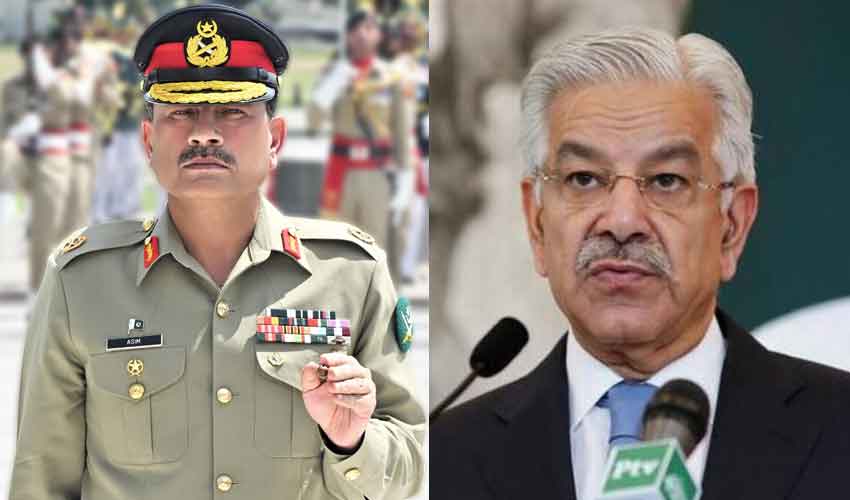
Defence Minister Khawaja Asif has offered a rare and frank assessment of Pakistan’s governance structure, describing it as a “hybrid model” where civilian and military leadership share power. He asserts that this model is yielding “excellent results” and could remain a permanent fixture until Pakistan overcomes its “economic and governance problems.”
Speaking to Arab News, Asif acknowledged the effectiveness of this model in navigating Pakistan through challenging periods. “This is a hybrid model. It’s not an ideal democratic government… So, this arrangement, the hybrid arrangement, I think [it] is doing wonders,” the minister stated. He added, “If this sort of [hybrid] model was adopted way back in the 90s, things would have been much, much better…. because the confrontation between [military] establishment and the political government, it actually retarded the progress of our democracy.”
‘Shehbaz Sharif Exercises Independent Authority’
Asif emphasized that Prime Minister Shehbaz Sharif makes decisions independently while maintaining continuous consultation with the military establishment. He claimed that power has been divided mutually, not imposed, and is functioning smoothly.
“We have common platforms, like SIFC and other platforms, where military leadership and civilian leadership, they sit together and decide about the business,” Asif said, labeling it a “de facto arrangement, and it’s working very well.”
Military’s Enhanced Image Post-India Conflict
The defence minister also referenced the recent escalation with India, noting that the military’s role in the conflict significantly boosted its national image.
“The military’s prestige has skyrocketed after the conflict with India,” Asif remarked, adding, “It’s a blessing in disguise, but it doesn’t worry me. It will not lead to unchecked military control.”
Army Chief’s Unprecedented White House Reception
Asif’s comments coincide with Army Chief Field Marshal Asim Munir’s high-profile solo visit to the United States, which included an unprecedented meeting with President Donald Trump at the White House—a rare occurrence for a Pakistani military leader unaccompanied by civilian leadership.
Munir was joined by Lt Gen Asim Malik, who now serves in the unique dual role of both national security adviser and director general of the ISI, a development analysts see as a further blurring of civil-military lines in policymaking.
The warm reception in Washington, encompassing meetings at the Pentagon, State Department, and US Central Command, signals what many analysts interpret as a recalibration of US-Pakistan ties, with the military playing a prominent role.
On June 18, US President Donald Trump confirmed discussing Iran-Israel tensions during his meeting with Army Chief Field Marshal Syed Asim Munir at the White House, stating that Pakistan “knows Iran better than we do.”
Speaking to reporters after the high-level interaction, Trump underscored Pakistan’s strategic importance in the region, particularly concerning Tehran. “We spoke about the Iran-Israel issue. Pakistan understands Iran better than us — they’re a key player in regional peace,” he stated.
The rare one-on-one meeting, held in the Cabinet Room, was followed by a luncheon hosted by Trump in the army chief’s honor. A White House spokesperson confirmed that the luncheon aimed to appreciate Pakistan’s role in regional stability and to acknowledge General Munir’s efforts in de-escalating tensions between nuclear-armed neighbors, Pakistan and India.
“It’s an honor to meet Field Marshal Asim Munir. I thanked him for not letting things spiral into war,” Trump said, referring to recent cross-border tensions that were diplomatically defused. The two also discussed potential areas of economic cooperation, with Trump confirming that a trade agreement with Pakistan and India is currently under negotiation.
“We’re in early talks on trade — Pakistan’s concerns are being heard,” he said.
According to diplomatic sources, General Munir is also scheduled to meet US Secretary of State Marco Rubio and Defence Secretary Pat Hegseth in the coming days. These engagements are viewed in Islamabad as a significant diplomatic success, signaling a revival in US-Pakistan strategic dialogue after a period of relative quiet.
When asked about possible diplomatic outcomes of the meeting, Trump said, “General Asim has played a strong role in lowering Pak-India tensions. We appreciate his leadership.”
Earlier, in a brief interaction with reporters, President Trump praised the Pakistani Army Chief, describing him as “an influential figure who played a critical role in de-escalating tensions between Pakistan and India.” The former US president also reiterated his admiration for Pakistan, calling it “an important nuclear country” and lauding the “good people of Pakistan.”
“This man [Field Marshal Munir] has been extremely effective in preventing war from Pakistan’s side,” Mr. Trump concluded.
