

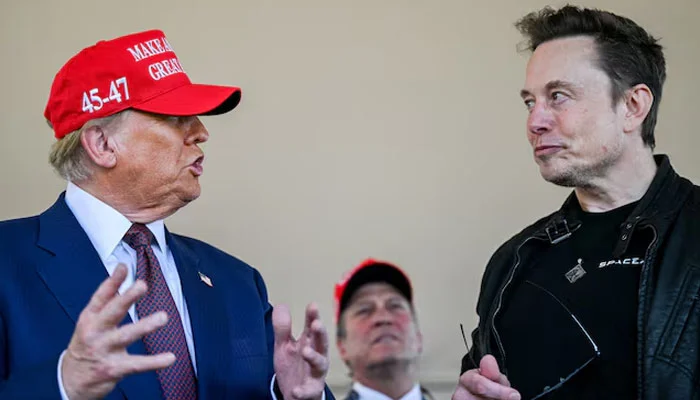
Elon Musk has sent shockwaves through the political world by publicly calling for the impeachment of President Donald Trump. The billionaire tech magnate’s demand follows a fierce public dispute with Trump over government spending and electric vehicle subsidies.
Once close allies, the two powerful figures have now become rivals, with Musk declaring that Trump is no longer fit to lead. The escalating feud unfolded in real-time on social media, dominating headlines and sending tremors through financial markets.
The hostilities ignited when Trump criticized Tesla CEO Musk in the Oval Office. Within hours, their once-cordial relationship had dramatically unraveled in full public view, as the world’s most powerful man and its richest exchanged personal insults on Trump’s Truth Social and Musk’s X platforms.
“The easiest way to save money in our Budget — billions and billions of dollars — is to terminate Elon’s governmental subsidies and contracts,” Trump posted on Truth Social.
Wall Street traders reacted by dumping shares in Musk’s electric vehicle maker, resulting in Tesla closing down 14.3%, and losing approximately $150 billion in market value—its largest single-day decline ever. Minutes after the closing bell, Musk responded with a simple “Yes” to a post on X suggesting Trump should be impeached. Given that Trump’s Republican Party currently controls both chambers of Congress, an impeachment remains highly unlikely.
The rift had been simmering for several days, beginning when Musk publicly denounced Trump’s sweeping tax-cut and spending bill. Initially, Trump remained silent as Musk campaigned to oppose the bill, arguing it would exacerbate the nation’s $36.2 trillion debt. Trump finally broke his silence on Thursday, telling reporters in the Oval Office that he was “very disappointed” in Musk.
“Look, Elon and I had a great relationship. I don’t know if we will anymore,” Trump commented.
As Trump spoke, Musk unleashed an increasingly sharp volley of posts on X.
“Without me, Trump would have lost the election,” wrote Musk, who had contributed nearly $300 million to support Trump and other Republicans in last year’s election. “Such ingratitude.”
In another post, Musk warned that Trump’s signature tariffs could potentially push the US into a recession later this year.
Alongside Tesla, Musk’s diverse business empire includes the rocket firm and government contractor SpaceX, and its satellite unit Starlink. Musk, whose space company plays a critical role in the US government’s space program, stated he would begin decommissioning SpaceX’s Dragon spacecraft—currently the only US spacecraft capable of transporting astronauts to the International Space Station—in response to Trump’s threats.
Pugilistic Pair
The escalation was not entirely unforeseen. Both Trump and Musk are known as political pugilists, possessing significant egos and a penchant for utilizing social media to retaliate against critics. Many observers had, therefore, predicted a eventual falling-out. Even before Musk’s departure from the administration last week, his influence had been diminishing following repeated clashes with cabinet members over his aggressive cost-cutting strategies.
For Trump, this marks the first major rupture with a top adviser since the commencement of his second term, though his first term was characterized by numerous dramatic exits. Trump parted ways with multiple chiefs of staff, national security advisers, and political strategists between 2017 and 2021. While a few, like Steve Bannon, remained allies, many others, such as Ambassador John Bolton, became outspoken critics.
Musk became one of Trump’s most visible advisers after serving as the largest Republican donor in the 2024 campaign. As head of the Department of Government Efficiency, Musk spearheaded a sweeping and controversial initiative to shrink the federal workforce and drastically cut spending. He was a frequent presence at the White House and on Capitol Hill, often accompanied by his young son.
Just six days prior to Thursday’s public bust-up, Trump and Musk made a joint appearance in the Oval Office, publicly praising each other’s work and pledging to continue their collaboration. However, this escalating feud now threatens Republican unity ahead of next year’s midterm elections. Musk’s massive online following and extensive fundraising connections within Silicon Valley could pose significant challenges.
Musk has already indicated his intention to reduce his political spending moving forward. Soon after Trump’s remarks, Musk posted a poll to his 220 million followers on X asking: “Is it time to create a new political party in America that actually represents the 80% in the middle?”
‘Kill the Bill’
Musk fiercely criticized Trump’s “big, beautiful bill” this week, labeling it a “disgusting abomination” that he warned would severely balloon the federal deficit. His criticism has exacerbated existing divisions within the Republican Party, potentially jeopardizing the bill’s passage in the Senate. Nonpartisan analysts project that the bill could add an additional $2.4 trillion to $5 trillion to the nation’s existing $36.2 trillion debt.
Trump accused Musk of opposing the bill because it includes cuts to electric vehicle tax credits. He also claimed that Musk missed working in the White House.
“He’s not the first,” Trump said. “People leave my administration… then at some point they miss it so badly. Some embrace it. Some become hostile.”
Musk retorted on X: “KILL the BILL,” adding that he would accept losing EV credits if Republicans removed the “mountain of disgusting pork” embedded in the bill. He also recirculated Trump’s past comments condemning government overspending, questioning: “Where is this guy today?”
Musk entered government promising to slash $2 trillion from the budget. He ultimately left having cut just half a percent—while leaving a trail of chaos in his wake. His recent political shift has triggered protests at Tesla facilities in both the US and Europe, contributing to declining sales and unsettling investors who are concerned about Musk’s apparent distraction.
