

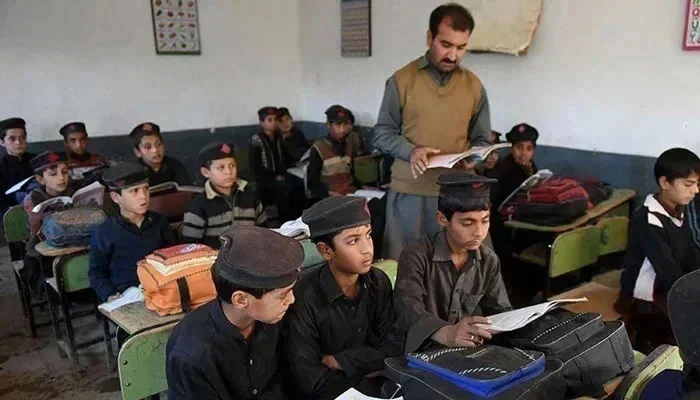
Thousands of children attending over 10,000 government schools across 28 established districts of Khyber Pakhtunkhwa continue to lack fundamental facilities such as boundary walls, electricity, washrooms, and safe drinking water, according to a recent report by the provincial Education Department.
The compiled data highlights substantial infrastructural deficiencies within the public education sector of the province. More than 5,000 schools are without electricity, over 2,000 lack the provision of clean drinking water, and a similar number are deprived of proper washroom facilities and secure boundary walls.
The report specifies that 2,211 primary schools are without electricity, with the highest concentrations found in Mansehra (344) and Upper Kohistan (252). In Upper Kohistan, 208 schools are reported to be without clean drinking water, and 1,253 primary schools do not have washroom facilities.
Among the 160 middle schools in the province, 136 lack boundary walls, 71 do not have clean drinking water, and 57 are without washrooms. In the provincial capital, Peshawar, 21 schools are without electricity, 15 lack clean drinking water, 17 have no washrooms, and 8 are without boundary walls.
Khyber Pakhtunkhwa’s Information Advisor, Barrister Muhammad Ali Saif, affirmed that the provincial government is actively working to address the scarcity of basic amenities in government schools. He emphasized that education remains a paramount priority, and Chief Minister Ali Amin Gandapur has acknowledged the issue and issued appropriate directives.
He further added that increased resources would be allocated in the forthcoming budget to ensure that no government school remains without adequate washroom and drinking water facilities.
Saif also indicated that educational emergencies would be declared in districts where over 50% of children are out of school. In areas with an urgent need for school facilities, the government intends to establish schools in rented buildings to bridge the existing gap.
These governmental efforts are being made against the backdrop of alarming statistics recently released by the provincial education department, which reveal that 37% of children in KP remain out of school.
The earlier report presents a worrying scenario, indicating that 4.92 million boys and girls across the province are currently deprived of formal education.
The problem is most severe in Kolai-Palas Kohistan, where 80,333 children are out of school. The neighboring districts of Lower and Upper Kohistan also report alarmingly high rates, with 79% of children not enrolled in any educational institution.
In contrast, Upper Chitral emerges as the province’s top-performing district, with only 10% of children out of school.
The provincial capital, Peshawar, accounts for more than 500,000 out-of-school children, including 319,000 girls, thereby underscoring a significant gender disparity in educational access.
