

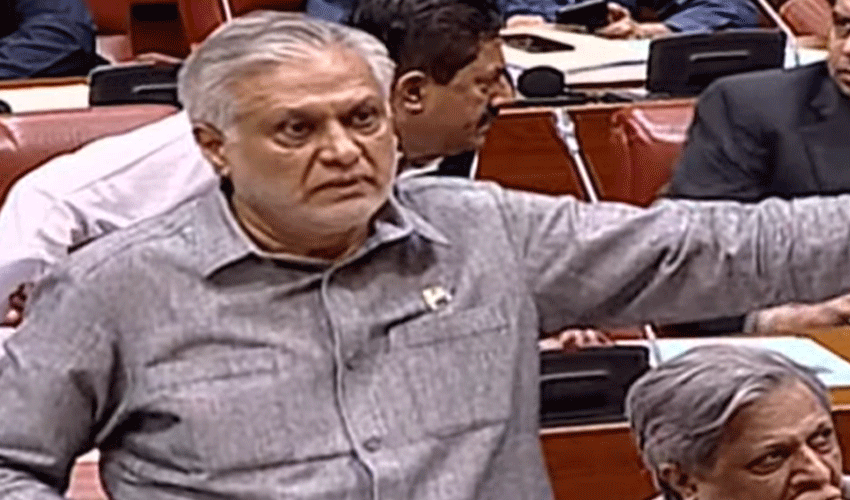
Deputy Prime Minister Ishaq Dar stated on Thursday that Pakistan did not request a ceasefire at any point during the recent conflict.
Addressing the upper house, he provided a detailed timeline and rationale behind Pakistan’s actions during escalating tensions with India. Dar said that on May 10 at 8:15 am, US Senator Marco Rubio made the initial call, indicating India’s willingness to observe a ceasefire. “I informed him that if India is prepared, we are also prepared for a ceasefire. Following discussions, the ceasefire was extended initially until May 12, then to May 14, and now further to May 18,” he maintained.
“We achieved victory through the bravery and valor of our armed forces,” Dar stated. He confirmed that six Indian aircraft and one UAV were downed. “The Pakistan Air Force has become the uncontested ruler of the skies.”
He revealed that certain countries had cautioned against India’s potential retaliation. “My clear response was – if India punches, we will punch back as well.” Dar reported that India had incurred an estimated loss of $3 billion, including the destruction of three Rafales, two MiGs, and one Su-30.
– Timeline of Escalation and Response –
Dar recounted that on the nights of April 29–30, approximately 75 Indian aircraft, including Rafales, violated Pakistani airspace. Attacks were carried out in Punjab and Azad Kashmir, with two mosques being targeted under the false pretense of striking militant hideouts.
“The PAF was instructed to target any aircraft violating our airspace. Our response was immediate and decisive,” he said.
He accused India of falsely claiming that Pakistan had attacked 15 Indian military installations on the night of May 7. “India even attempted to provoke the Sikh community by launching missiles towards Amritsar.”
In response, Pakistan conducted a measured counter-attack on the mornings of May 7 and 10, remaining within its territory and acting under Article 51 of the UN Charter, which permits self-defense.
– No Civilian Targets Hit by Pakistan –
“Pakistan deliberately avoided civilian areas,” Dar emphasized. While 11 Pakistani soldiers and 40 civilians were martyred, Indian civilian zones were not targeted. Instead, Pakistan precisely struck military installations.
He confirmed that Indian attacks targeted Nur Khan Airbase, Sukkur, and Rahim Yar Khan, prompting Pakistan to launch full retaliatory strikes.
– Diplomatic Engagements and International Outreach –
Dar shared that contacts were made with over 60 foreign ministers and deputy PMs to explain Pakistan’s restraint and position. “We assured global leaders that we would not escalate unless India initiated further action.”
Following Rubio’s call, Saudi Prince Faisal also contacted Dar and subsequently informed Indian Foreign Minister Jaishankar about Pakistan’s stance. The ceasefire terms were communicated to the armed forces immediately after these discussions.
Pakistan also responded to Indian provocations at international forums. While the UN Security Council did not condemn the Pahalgam incident, Pakistan successfully ensured the inclusion of Jammu and Kashmir in the resolution text while removing references to TRF, safeguarding its national narrative.
– Strategic Balance and Ceasefire Monitoring –
Dar noted that Pakistan has restored strategic balance in the region and dismantled India’s one-sided narrative. “The world now recognizes the professional competence of our forces,” he added.
Despite the ceasefire, Indian shelling continued late at night on the LoC, to which Pakistan responded forcefully. The ceasefire timing was recorded at 4:30 PM, and Pakistan remains prepared for both peace and war.
– Senate Resolutions and National Consensus –
The Senate unanimously passed multiple resolutions, including commending the success of Operation Bunyan-um Marsoos and the armed forces. The resolution affirmed that Pakistan will defend its share of water resources under the Indus Waters Treaty and reiterated Pakistan’s commitment to regional and global peace.
Furthermore, it called for the resolution of the Kashmir dispute in accordance with UN Security Council resolutions.
The resolution rejected India’s attempts to annex Kashmir, stating that the treaty cannot be suspended or altered.
