

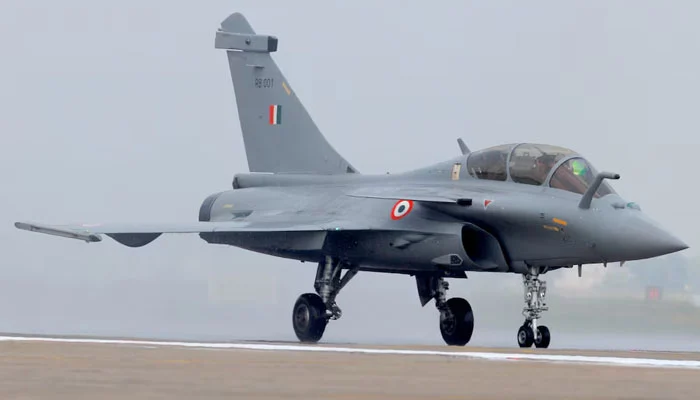
Since the Pahalgam incident, India has been attempting to provoke Pakistan with its warmongering and aggressive actions near the border. However, Pakistan has displayed restraint and, through timely defensive measures, has prevented India from any form of aggression.
Thanks to effective defensive measures, the Pakistan Air Force (PAF) once again promptly thwarted India’s attempt to advance towards Pakistan a few days ago, compelling India’s modern Rafale aircraft to retreat.
The PAF countered India’s advance on the night between April 29 and April 30. According to relevant sources, the PAF took this action on the same night that Federal Information Minister Attaullah Tarar voiced concerns about a potential Indian attack on Pakistan within the following 24 to 36 hours.
Sources indicated that four Indian Rafale aircraft took off from the Ambala air base in the Indian state of Haryana and moved towards Pakistan at a ground speed of 1,200 kilometers per hour. The Indian aircraft came very close to Pakistani airspace but did not cross it at any point.
Nevertheless, as these aircraft were equipped with advanced Spice 2000 air-to-ground missiles, which have a range of 200 kilometers, this action by the Indian Air Force (IAF) was a hostile act because the Indian aircraft could have conducted ground operations within Pakistan while remaining in their own airspace.
These planes were flying at an altitude of 40,000 feet when Pakistan’s Air Defence System, utilizing its Electronic Warfare Assets, jammed the Rafale aircraft’s onboard sensors, communication, and radar systems. This resulted in the planes losing contact with each other and with the ground.
According to sources, simultaneously, PAF’s J-10C aircraft were also airborne to confront the Indian planes and deter any aggression. This situation forced the Indian planes to make an emergency landing in Srinagar instead of returning to Ambala.
It is important to note that the Rafale planes were equipped with missiles having a 200km range that night, but the Pakistan Air Force’s J-10C planes were equipped with PL-15 missiles with a beyond visual range of 230km. This meant that the Pakistani aircraft were also in a position to target the Indian aircraft while staying within their own territory.
Relevant sources state that if our air defense system had not jammed the communication and radar systems of the Rafale aircraft that night, the Indian aircraft could have taken some action within Pakistani territory.
Another noteworthy point is that the Pakistan Air Force dealt with the four Rafale aircraft on the night between April 29 and 30 in the same manner that blocked the radar and communication systems of Indian pilot Abhinandan in 2019. However, at that time, the Indian pilot was flying an older aircraft, but this time the Pakistan Air Force faced the modern 4.5 generation Rafale aircraft.
According to relevant sources, after facing failure on the night between April 29 and April 30, the IAF planned to take action in Pakistan on Friday.
However, as soon as intelligence regarding this matter was received, Pakistan immediately had 40 to 50 aircraft airborne, including F16, J-10C, and JF-17. This action by Pakistan compelled the IAF to abandon its plan.
This signifies that India has once again faced a setback similar to 2019.
According to relevant sources, the multi-domain capabilities of the armed forces, particularly the PAF, play a crucial role in thwarting Indian ambitions. Relevant sources indicate that the PAF is consistently a step ahead of India in the domains of electronic, cyber, and space warfare. And in the last four to five days, Pakistan fully leveraged these modern capabilities and took such proactive measures.
Pakistan has successfully countered India’s most advanced Rafale aircraft. India had placed significant hopes on the Rafale aircraft in 2019. Following the 2019 setback, Indian Prime Minister Narendra Modi himself acknowledged his defeat, stating that if India had possessed Rafale at that time, the outcome would have been different.
Now, India does possess Rafale aircraft, but due to the effective operations and modern technology of the PAF, India was unable to achieve its objectives.
