

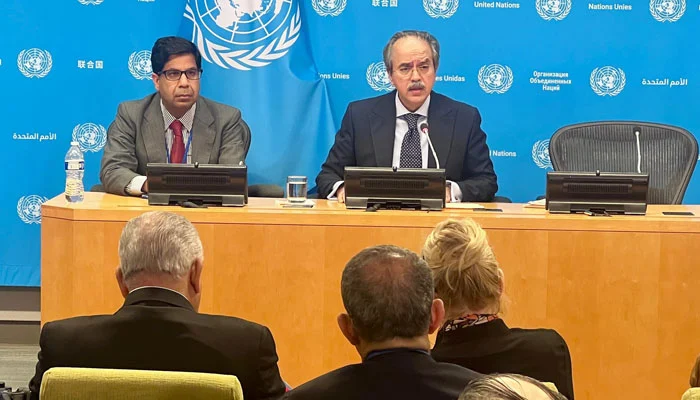
Pakistan is closely monitoring the situation arising from India’s aggressive actions following last week’s attack in Indian-occupied Kashmir and will seek a UN Security Council meeting when it is deemed “appropriate,” Ambassador Asim Iftikhar Ahmad stated on Friday.
“It is evident that there was an incident, but now what has evolved in terms of the situation, which is a real threat to regional and international peace and security, and we believe that the Security Council, in fact, has the mandate, it would be very legitimate for any member of the Council, including Pakistan, to request a meeting,” he told a press conference at UN Headquarters in New York.
The press conference was among several steps Ambassador Asim, Pakistan’s permanent representative to the UN, has taken to update the international community on this developing situation and Pakistan’s perspective.
“We have discussed that with the previous — last month’s Council’s presidency (France) — and this month’s presidency (Greece) — we are observing the situation very closely, and we have the right to convene a meeting when we feel appropriate,” he said.
Ambassador Asim was responding to a question about Pakistan’s plans to request a Security Council meeting in the wake of escalating tensions between India and Pakistan after the attack in Pahalgam on April 22, which resulted in 26 fatalities.
On Thursday, Greece, the current President of the UN Security Council for May, indicated that the Security Council was expected to convene “sooner rather than later” to discuss the situation between India and Pakistan. This meeting would provide an opportunity to express views and potentially help de-escalate tensions, as Greece voiced concern over the heightened tensions between the nuclear-armed South Asian neighbors.
“Of course, if a request comes for a meeting then… I think this meeting should take place because, as we said, maybe it’s also an opportunity to have views expressed and this might help to diffuse a bit of tension. We will see,” said Ambassador Evangelos Sekeris, Permanent Representative of Greece to the UN and President of the Security Council for May.
“We are in close contact. But this is something which might happen, I would say, sooner rather than later. We will see, we are preparing. It’s the first day of our (UNSC) presidency,” Sekeris added.
Sekeris briefed UN reporters on Thursday regarding the Council’s program of work under Greece’s month-long presidency of the 15-nation body.
Asked about UN Secretary-General António Guterres’s offer of good offices to both India and Pakistan to de-escalate tensions, Ambassador Asim stated that Pakistan has welcomed the UN chief’s initiative.
In fact, Pakistan has consistently offered its cooperation to any peace efforts undertaken by the UN Secretaries-General, he noted.
Guterres’s offer was contingent upon acceptance by both parties. However, India has not yet responded to the Secretary-General’s proposal.
When an Indian journalist referred to Defence Minister Khawaja Asif’s remarks suggesting Pakistani involvement in terrorism, Ambassador Asim clarified that the comments had been “twisted” and taken out of context. He asserted that it was India, in fact, that was involved in acts of terrorism not only against Pakistan but also as far as North America, a fact that has been documented. Pakistan, he added, is a victim of terrorism.
“India’s conduct, marked by a disregard for international law and regional stability, is incendiary and dangerous, with the potential for far-reaching and disastrous consequences,” Ambassador Asim emphasized.
Pakistan, he reiterated, does not seek escalation, a stance made clear by its political leadership and at all levels.
“At the same time,” he warned, “we are fully prepared to defend our sovereignty and territorial integrity. Should India resort to aggression, Pakistan will exercise its inherent and legitimate right to self-defence, as enshrined in the UN Charter.”
Pakistan, he added, categorically rejects any attempt to link it with the Pahalgam incident in Indian Illegally Occupied Jammu and Kashmir (IIOJK).
“Pakistan condemns terrorism in all its forms and manifestations. Nothing justifies the targeting of innocent civilians,” the Pakistani envoy stated.
“We are concerned over the loss of lives in the Pahalgam attack, and we extended our condolences. As a victim of terrorism itself, no one can feel the pain of those impacted by this scourge like Pakistan.”
In response to India’s provocative and unilateral actions, he said that Pakistan’s National Security Committee (NSC), chaired by the Prime Minister, convened on April 24 and was compelled to undertake certain proportionate counter-measures.
“Of grave and particular concern is India’s irresponsible decision to hold in abeyance the historic Indus Waters Treaty of 1960 – a landmark, legally binding agreement brokered and guaranteed by the World Bank,” the Pakistani envoy highlighted.
“Holding of IWT in abeyance is unilateral and illegal. There are no such provisions in the Treaty. India’s unilateral and unlawful actions are bound to undermine regional peace and stability with catastrophic implications,” he noted.
Pakistan’s envoy to the UN further stated, “Pakistan’s National Security Committee has made it categorically clear that any attempt to stop or divert the natural flow of water that rightfully belongs to Pakistan in accordance with the provisions of the Treaty, and the usurpation of the rights of the lower riparian, will be considered as an ‘act of war’.”
Such a move poses an existential threat to the people of Pakistan and will not be tolerated, he stressed.
“If left unchecked by the international community, such actions risk setting a dangerous precedent that could undermine the legal rights for lower riparian states, potentially triggering new global conflicts over shared water resources,” Ambassador Asim added.
“We are deeply concerned by reports of widespread human rights violations in the IIOJK, including arbitrary detentions, home demolitions, and collective punishment imposed on the innocent Kashmiri people,” he pointed out.
“Pakistan desires good neighborly, peaceful and cooperative relations with all its neighbors, including India. We advocate for a relationship grounded in mutual respect, sovereign equality, peaceful co-existence and peaceful resolution of all outstanding disputes,” he remarked.
But this aspiration must be reciprocated – it cannot be a one-sided affair, he concluded.
