

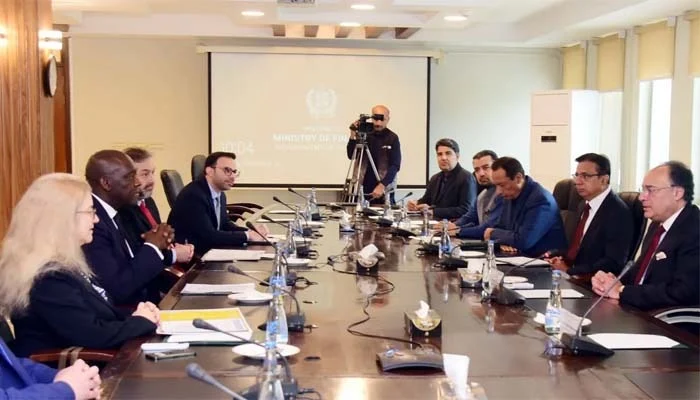
An International Finance Corporation (IFC) delegation and Finance Division officials discussed policies on Thursday aimed at driving industry-led economic growth, with a focus on export-based expansion. The meeting was part of Pakistan’s ongoing efforts to secure financing under the $20 billion private sector investment programme.
The visit followed a landmark agreement with the World Bank, which will focus $20 billion in lending over the next decade on addressing development issues such as climate change impacts and private-sector growth.
This IFC commitment is in addition to the $20 billion already pledged by the World Bank through IDA (the concessional finance window) and IBRD, taking the total World Bank Group investment in Pakistan to $40 billion over the next ten years.
“IFC is committed to working closely with Pakistan and providing support in key areas such as green energy, data centres, agricultural supply chain improvements, the telecom sector, and digitisation,” said IFC Managing Director and Executive Vice President Makhtar Diop in a high-level meeting at the Finance Division.
Leading the IFC delegation, Diop met Finance Minister Mohammad Aurangzeb and his team, commending Pakistan’s Country Partnership Framework (CPF) with the World Bank as a “global best practice.”
Diop was accompanied by Hela Cheikh Rouhou (Regional Vice President, MCT Region), Khawaja Aftab Ahmed (Regional Director, Middle East, Pakistan, and Afghanistan), Najy Benhassine (Country Director, World Bank Pakistan), and Zeeshan Sheikh (Country Manager, IFC Pakistan & Afghanistan).
He noted that private-sector stakeholders in Pakistan had expressed confidence in the government’s economic policies and appreciated the progress being made.
Aurangzeb was joined by Dr. Syed Tauqeer Hussain Shah, Executive Director (Pakistan) at the World Bank Group, Finance Secretary Imdad Ullah Bosal, and senior Finance Division officials.
The finance minister highlighted recent government initiatives, including declaring warehousing an industry and reaffirming its commitment to public-private partnerships (PPPs) in infrastructure, IT, data centres, and AgTech.
Speaking a day earlier, World Bank Pakistan’s Dr. Shah stated that the recently approved $40 billion country partnership framework is a strong vote of confidence in Pakistan’s economic reforms and financial consolidation over the past two years.
He further said that while IFC has a robust investment pipeline for Pakistan, its implementation depends on continued economic and political stability.
During the meeting, Aurangzeb briefed the IFC delegation on Pakistan’s macroeconomic stability, citing his recent meeting in Dubai with IMF Managing Director Kristalina Georgieva.
The finance minister outlined key structural reforms, including the introduction of agricultural income tax, pension reforms, and the rightsizing of 43 ministries and 400 attached departments, many of which have been merged or abolished.
Last month, the World Bank, which has currently committed around $17 billion to Pakistan for 106 projects, emphasized that policy and institutional reforms are critical to boosting private sector growth and expanding fiscal space for government investment.
Since 1950, the World Bank has provided over $60 billion in financing to Pakistan. However, the new programme represents a longer-term strategy than previous agreements, which typically lasted four to six years.
Pakistan has been on the brink of economic crisis for several years, with economists and international financial institutions calling for major economic reforms.
Currently, Pakistan is under a $7 billion International Monetary Fund bailout, requiring it to increase government revenues and secure external financing, much of which comes from loans provided by China and Gulf nations.
