

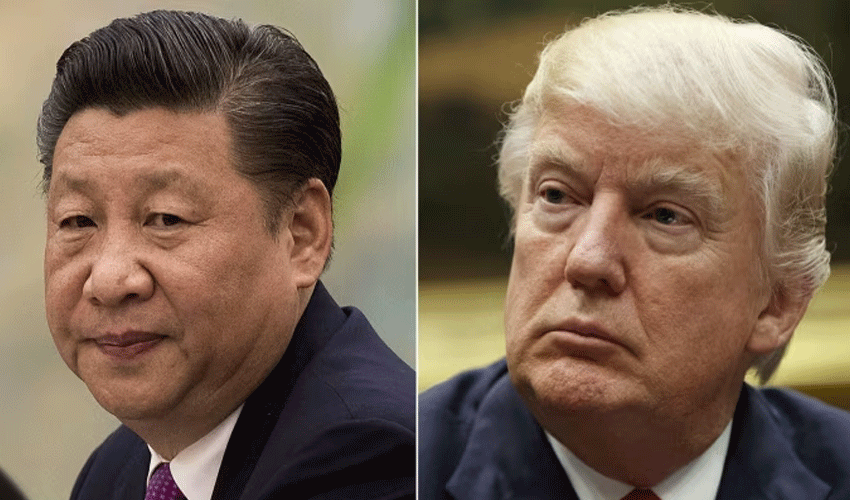
In response to new US tariffs on Chinese goods, China has announced retaliatory measures, reigniting a trade war between the world’s two largest economies.
On Tuesday, China’s Ministry of Finance revealed that the country would impose tariffs on a range of US products following the United States’ decision to implement a 10% duty on all Chinese imports.
The US tariff, which took effect at 12:01 a.m. ET on Tuesday (0501 GMT), is part of former President Donald Trump’s strategy to pressure China into curbing the flow of illicit drugs into the US.
In retaliation, China announced a 15% tariff on US coal and liquefied natural gas (LNG) imports, along with a 10% tariff on crude oil, agricultural equipment, and some automobiles. These new tariffs are set to take effect on February 10, according to the Chinese Ministry of Finance.
Additionally, China launched an anti-trust investigation into Google, posing a direct challenge to one of America’s largest technology giants. Furthermore, two major US firms—PVH Corp. (the parent company of brands like Calvin Klein) and biotechnology firm Illumina—were added to China’s “unreliable entities list.”
China’s Ministry of Commerce and Customs Administration also announced new export controls on critical rare earth materials, including tungsten, tellurium, and molybdenum, which are essential for the global clean energy transition. These materials play a crucial role in high-tech industries, and China dominates the world’s supply.
Trade War and Its Impact on Global Economy
The conflict has escalated at a time when negotiations between the two nations remain strained. In 2018, Trump initiated a trade war against China over its massive trade surplus with the US. Despite a 2020 agreement in which China pledged to increase purchases of US goods, the deal was disrupted by the COVID-19 pandemic, and China’s trade deficit has since widened to $361 billion.
The White House has stated that former President Trump would not engage in talks with Chinese President Xi Jinping until later in the week, further deepening the impasse between the two global powers.
“If China doesn’t stop sending fentanyl, the tariffs are going to go substantially higher,” Trump warned during a press conference.
China has denied responsibility for the US opioid crisis, calling it an “American problem.” Beijing has vowed to challenge the tariffs at the World Trade Organization (WTO) and warned of additional countermeasures but has also expressed willingness to negotiate.
China’s Countermeasures and Global Market Reactions
The escalation of the trade war led to a drop in the offshore yuan, which declined by 0.3% to 7.3340 against the US dollar after the announcement of the new tariffs.
Other currencies, including the Australian and New Zealand dollars, also fell by at least 0.8% as markets reacted to the developments.
In Hong Kong, stock market gains were pared back as investors responded to China’s retaliatory measures. Gary Ng, senior economist at Natixis, emphasized that unlike Canada and Mexico, the US and China have deep-rooted economic and political differences. “Even if the two countries agree on some issues, tariffs could still be used as a recurring tool, contributing to market volatility,” Ng noted.
