

The death toll from the devastating floods soared to 1,162 on Wednesday as flood waters which came from the north began to breach banks and affected more than a million people in Sindh’s Dadu district.
According to the daily report by the National Disaster Management Authority (NDMA), more than 3,500 people have been injured so far since June 14.
Around 1,941 people were injured while 36 were killed during the past 24 hours.
Today’s key developments:
- NDMA data shows death toll reaching 1,162, over 3,500 hurt since June 14
- 36 die, 1,941 injured in previous 24 hours
- Water level rising in Sindh’s Khairpur Nathan Shah and Johi talukas
- Dadu city facing flood threat
- Standing crops on 11,000 acres destroyed in Charsadda
- Shortage of petroleum goods and wheat in GB
- PM Shehbaz visits flood-affected areas of KP, Maryam visits Punjab
Dadu Deputy Commissioner Syed Murtaza Ali told Dawn.com that 1.2 million people had been affected and displaced in the district.
The water level is rising in the Main Nara Valley (MNV) drain in Khairpur Nathan Shah and Johi talukas which are located at a distance of 8km from Dadu city, he said.
It is feared if the water level continues to rise in the MNV drain, Dadu city will be severely impacted, he said.
MPA Pir Mujeebul Haq, who was elected from Dadu, told Dawn.com that the city was facing the threat of flood, adding that machinery had been employed to prevent flood waters from entering the city.
Unprecedented rains
Pakistan has received nearly 190 per cent more rain than the 30-year average in the quarter through August this year, totalling 390.7 millimetres (15.38 inches). Sindh was hardest hit, getting 466pc more rain than the 30-year average.

Flash floods surging out of northern mountains have swept away homes, businesses, infrastructure and crops. The government says 33 million people, or 15pc of the 220 million-strong nation, have been affected.
Colossal volumes of water are pouring into the Indus river, which flows down the middle of the country from its northern peaks to southern plains, bringing flooding along its length.
Villager Fayyaz Ali, 27, in hard-hit Shikarpur district, has managed to get his family to safety but has little hope of saving his small home surrounded by flood waters.
“The house is going to fall at any moment. It’s inundated,” Ali told Reuters.
Like many villagers, Ali said he had yet to receive any help.
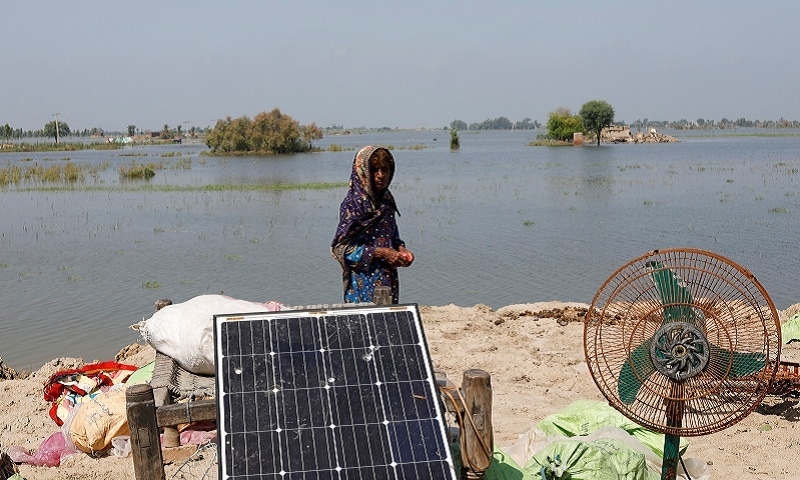
Huge tracts of land on both sides of the Indus are submerged.
Main roads raised above the fields have become a refuge where people with their bundles of belongings try to shelter from the sun and rain under plastic. Farm animals seek safety with their owners.
PM Shehbaz visits KP, announces Rs10bn assistance
Separately, PM Shehbaz embarked on a visit to the flood-affected districts of Khyber Pakhtunkhwa.

Speaking to the media in Swat’s Kanju area, the prime minister assured the nation that the army and local administration were working day and night to help the affected areas.
“Millions have been displaced and hundreds have died,” he said, adding that the government was providing monetary assistance to the victims. He noted that while the financial assistance could not make up for the loss of life, the damages incurred were “colossal”.
“We have announced Rs10 billion for Balochistan and Rs 15bn for Sindh. I am announcing a Rs10bn grant for KP. The NDMA and provincial government will collaborate on how to utilise this amount,” he said, vowing to keep visiting flood-affected areas until the last family was settled.
He added that several countries had offered financial assistance during this difficult time, such as Turkey, Iran and the United Arab Emirates. “I assured them the money will be spent in a transparent manner.”
PML-N Vice President Maryam Nawaz, who also embarked on a visit to flood-hit areas in Punjab on Wednesday, said her party will undertake rehabilitation and rebuilding works in all affected areas to bring back life to normalcy.
Speaking to flood victims in Jampur of Rajanpur district, Maryam said her party was aware of the sufferings of the masses, adding the PML-N “will try to compensate for all losses inflicted on the people”.
“I have brought relief goods which will be distributed in Jampur while the government will despatch more items among people in the village and other affected areas,” she said.
Standing crops on 11,000 acres destroyed in Charsadda
The floods have affected over 200,000 people and destroyed standing crops on over 11,000 acres and 160 houses in Charsadda district.
According to the initial report of the district administration, five people died and over 180 were injured in flood-related incidents in Charsadda. Likewise, more than 120 water channels were destroyed and over 800 livestock were swept away by the gushing water.
The floods also affected Munda Headworks besides inflicting huge losses to gardens and livestock sectors. To provide relief to flood victims, large medical camps in 17 different places have been established and relief activities accelerated.
Flour shortages in GB
Flash floods also damaged the Karakoram Highway and bridge at Kohistan on Wednesday, blocking the passage of large vehicles and causing a shortage of petroleum goods and wheat in Gilgit-Baltistan, officials said.
The closure of the Karakoram Highway affected the transfer of wheat to the region, Secretary Food Safdar Khan told Dawn.com.
Separately, Kashif Husain, a member of the Petroleum Dealers’ Association Gilgit-Baltistan, said the closure of the Karakoram Highway has stopped large oil tankers from entering the region, which has led to a shortage of fuel at some petrol stations.
However, small oil tankers continue to arrive but they were still not enough to fulfil demand, Husain added.
In Gilgit, many petrol pumps have been closed due to the inadequate supply of petrol and diesel, creating difficulties for the citizens.
Meanwhile, residents bemoaned the unavailability of wheat flour.
A resident of the city working at a private company, Mumtaz Ahmed, told Dawn.com that he could not find flour at any shop and had to get it from relatives.
He added that the finer variety of flour currently available in the market “causes stomach-related issues for the elderly” which is why he does not use it. He added that he could not find any flour at any local mill.
According to him, he had even tried using personal contacts to procure some flour but failed to obtain it.
Abdur Rehman, a Gilgit local, told Dawn.com that he did not have flour at his home for the past four days, adding that the shop he procured it from did not have milled flour due to its shortage.
More aid pours in
Meanwhile, the United States announced $30 million in humanitarian aid to Pakistan.
“We stand with Pakistan during this difficult time, and the US is proud to be the single largest humanitarian donor to Pakistan,” Vedant Patel, principal deputy spokesperson for the State Department, told a daily news briefing on Tuesday.
“We are deeply saddened by the devastating loss of life and livelihoods throughout Pakistan,” he added.
USAID (United States Agency for International Development) partners will use this fund to prioritise urgently needed support for food, nutrition, multi-purpose cash, safe water, improved sanitation and hygiene, and shelter assistance, he said.
PM Shehbaz thanked the US government for the financial assistance.
“The tragedy is massive with millions of people gravely affected and we need our friends around the globe to help the suffering humanity,” he said.
