The Islamabad Talks: The War Did Not End — It Only Changed Its Face
By: Raja Zahid Akhtar Khanzada
Islamabad’s long night ended, finally, on a single sentence. But that sentence was not a conclusion. It was the opening of a wound that had not yet been named.
J.D. Vance placed his hands on the table, tapped it twice — softly, almost gently, the way a man taps a casket before they close the lid — and said: “This is our last and best offer. Now we’ll see whether the Iranians accept it or not.” Then the silence came down like a curtain. The camera lights dimmed. And a conversation ended that had not, in any honest sense, ended at all.
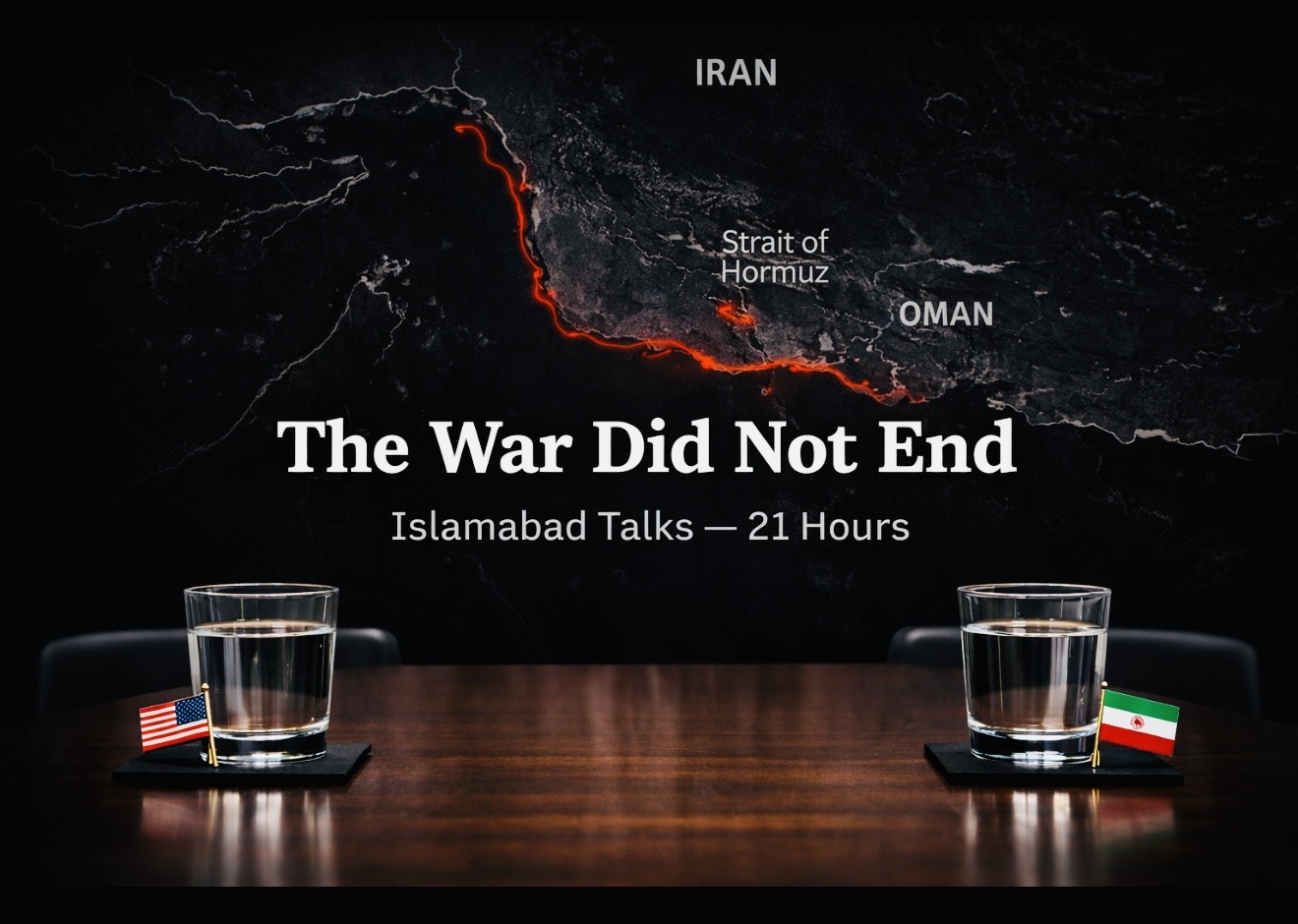
Twenty-one hours. That is how long it lasted. Twenty-one hours that, measured in clocks, seem almost manageable — a long shift, a restless night, a transatlantic flight with nowhere to go. But there are hours that carry the weight of decades inside them, and these were such hours. Inside the sealed rooms of Islamabad’s Serena Hotel, something older and heavier than diplomacy was at work. Two worlds were examining each other across a table — measuring intentions, weighing silences, reading the spaces between words — and at the end, they gave each other the answer that both had perhaps already known, but that history required them to speak aloud.
America’s demand was, on its surface, simple. Or at least America wished it to be simple, because simplicity is the language of power, and power does not like to explain itself. Iran must not build a nuclear weapon. Must not acquire that capability. Must not come anywhere near it. This was the line, and the line, Washington insisted, was non-negotiable.
But I have lived long enough — and watched this world long enough — to know that no demand is ever as simple as it sounds. Behind every ultimatum is a history. Behind every history is a wound. And behind this particular wound are four questions that no press conference has managed to answer, because press conferences are not designed for honest answers: the question of nuclear sovereignty, the question of regional power, the question of sanctions and economic suffocation, and the question of who controls the Strait of Hormuz.
It is that last question — the one about water, about passage, about the forty percent of the world’s seaborne oil that moves through a narrow throat of the Persian Gulf — that contains the truest terror of this moment. Because once you understand Hormuz, you understand that this is no longer merely a confrontation between two nations. It is a confrontation between two visions of the world, and the rest of us — Europe, Asia, the Global South, every ordinary human being who has ever paid a heating bill or filled a gas tank — are caught in the middle of it, with no vote and no voice.
Donald Trump, standing before the cameras with that particular brand of American confidence that has never learned to distinguish itself from arrogance, said it plainly: “We are clearing the Strait of Hormuz. Deal or no deal, it doesn’t matter to us. We have already won.”
I want to sit with those words for a moment. We have already won. There is something in that sentence that goes beyond policy, beyond strategy, beyond even the ordinary theater of geopolitics. There is a coldness in it — the coldness of a man who has decided that the other person’s suffering is no longer his problem. And that coldness, I have come to believe, is not strength. It is the disguise that fear wears when it has grown too proud to show itself.
Iran, for its part, speaks a different language — but it is describing the same fear from the other side of the mirror. Iranian officials will tell you that much was agreed upon in Islamabad. That two or three crucial points remained, and that those points were not stubbornness but survival. For Iran, the nuclear program is not merely a collection of centrifuges and enriched uranium. It is identity. It is the right of a nation to exist on its own terms, without permission, without apology, without the constant surveillance of a world order it did not design and was not consulted about.
History does not forgive us for dismissing that kind of claim. It does not matter whether we agree with it. What matters is that it is real — as real as the hunger that sanctions have produced, as real as the isolation that has shaped a generation of young Iranians who have never known their country to be treated as fully human by the West.
There is a third voice in this story. It does not belong to Washington or Tehran. It belongs to the cities and the markets and the ordinary people for whom this drama is not an abstraction but a daily, lived reality.
Reuters calls what happened in Islamabad an “incomplete pause” — negotiations not concluded but suspended, like a sentence left hanging in the air. The Guardian sees a world that has stepped back from the edge of catastrophe, but has not yet found solid ground beneath its feet. Axios and the American press corps, with their characteristic loyalty to the logic of pressure, frame the non-agreement as itself a kind of message: see what we are willing to do.
In Europe, the newspapers read this story through the lens of economics — energy, inflation, the fragility of a global order that was always more precarious than its architects admitted. For European editors, the Strait of Hormuz is not a geography lesson. It is the thread upon which everything else hangs.
And in Iran’s own press, the story is something else entirely. There, America is the aggressor. The demands were excessive. The flexibility was demanded of one side only. I am not in a position to tell you which narrative is true, because the honest answer is that they are all true and none of them is complete. That is the nature of the stories nations tell about themselves. They are not lies, exactly. They are partial truths elevated into monuments.
In the middle of all this — between the competing narratives, between the superpower and the sanctioned nation, between the table where Vance tapped his fingers and the room where the silence fell — stood a city that did not belong to any of the principal actors, and a country that had everything to lose by getting this wrong.
Islamabad. Pakistan.
Under the leadership of Shehbaz Sharif and Asim Munir, Pakistan attempted something that is rarer in this world than it should be: it tried to be a bridge. Not a side. Not an ally in the conventional sense. A bridge — something that connects two banks without belonging to either. It is a difficult posture to maintain, especially when the river beneath you is moving fast and the waters are rising. But there is a dignity in the attempt that history ought to record, even if the attempt falls short.
Vance, upon leaving, acknowledged what those in the room already knew: the shortcoming was not Pakistan’s. Ishaq Dar said the process would continue. Perhaps that is the most important sentence of this entire episode. Not the ultimatum, not the silence, not the tapped table. But the simple, stubborn insistence that the door has not been closed.
And yet. And yet we must speak about Hormuz, because Hormuz is where all the abstractions become concrete.
The oil that moves through that narrow passage is not simply fuel. It is the circulatory system of a global economy that has organized itself, over decades, around the assumption that the passage will remain open. Iran understands this. That is precisely why the strait is, for Tehran, not merely a geographic feature but a form of leverage — the one card that a heavily sanctioned, diplomatically isolated nation holds that cannot be easily dismissed. When Iran gestures toward Hormuz, it is reminding the world that it exists, that it has power, that its existence cannot be wished away by executive order or economic pressure.
America understands this too. Which is why “clearing” Hormuz is not simply a military objective. It is a statement about who controls the grammar of the international order — who decides what is open, what is closed, who may pass and who may not.
Two nations. One narrow strait. And the rest of us watching, because we have no other choice.
No agreement was reached in Islamabad. But something was clarified that press releases will not say plainly, so I will say it here: this war — and let us be honest, it is a war, even if the bombs have temporarily stopped falling — is no longer, if it ever was, primarily a war about weapons.
It is a war about narrative. About who gets to tell the story of what happened, and why, and who bears the blame. It is a war about dignity — Iran’s insistence that it will not be diminished, America’s insistence that its red lines are real. It is a war about fear, which is the most honest thing I can say about it, because fear is what drives nations to build weapons in the first place, and fear is what makes them unable to put those weapons down.
The international press, to its credit, has largely refused to call Islamabad a failure. They call it a phase — a moment in a longer process that may yet produce something better than what we have now. I want to believe that. I have spent enough time in this world to know that hope is not naivety; it is a discipline, a practice, the daily refusal to accept that things cannot be otherwise.
Now the question is not what happened. The question is what comes next.
In the near term, we are likely to see an effort to preserve the ceasefire — fragile, contested, but holding. Back-channel conversations will continue, as they always do, in the language that diplomacy prefers to its public face. Limited tensions will persist along the Strait. In the months ahead, we may see either a partial agreement or a return to limited confrontation, depending on which pressures prove stronger. And in the long arc of it — the long, difficult, uncertain arc — this conflict will move toward one of three destinations: a controlled peace with some measure of agreement and oversight; a prolonged diplomatic stalemate in which the talking never stops and the resolution never comes; or a new military confrontation, particularly if Hormuz or Lebanon ignites again.
The deepest question — the one that sits beneath all the others like bedrock — is whether this war can actually end. For Iran, it is a question of dignity. For America, a question of security. For the world, a question of economic survival. And I have noticed, in my time watching history, that when dignity and security and survival are all in the room together, wars do not end. They transform. They find new shapes. They migrate from the battlefield to the negotiating table to the sanctions list to the propaganda channel, and back again.
Perhaps that is what Islamabad was, finally. Not an ending. Not a failure. But a transformation — the war changing its face, as wars always do, while the rest of us stand and watch and try to find the words for what we are seeing.
The night in Islamabad is over. But its echo has not faded.
Vance has returned to Washington. The cameras have been packed away. The Serena Hotel has resumed its ordinary life. And somewhere, in rooms we will never enter, the conversations that matter most are continuing — in whispers, in coded messages, in the silences between sentences, in the long pauses that diplomats learn to read the way the rest of us read words.
Shehbaz Sharif’s government opened a door. Whether anyone walks through it will depend on decisions made in capitals far from Islamabad, by men and women who carry the weight of their nations’ fears on their shoulders and call that weight principle.
Maybe the answer is not yet available to anyone. But one thing is clear.
Sometimes history writes fewer verdicts than it does ellipses. Sometimes the most honest thing a nation — or a writer, or a witness — can do is stand in the wreckage of what almost happened and say: the door is not yet closed. The conversation is not yet over. The morning has not yet decided what it will become.
The echo of that Islamabad night is still in the air.
And some echoes, if we are willing to listen, become the opening notes of something we did not expect.