

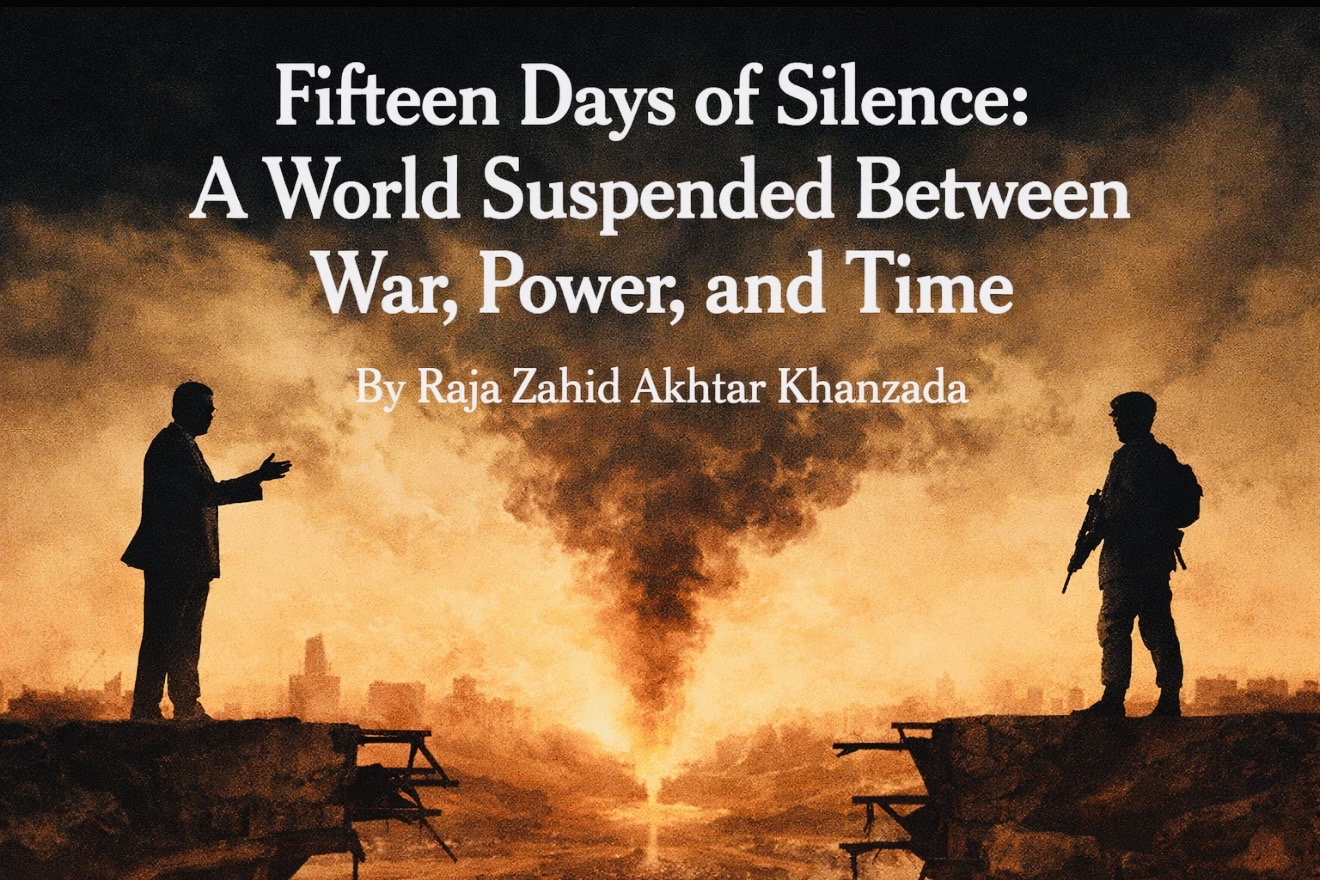
Fifteen Days of Silence: A World Suspended Between War, Power, and Time
By Raja Zahid Akhtar Khanzada
This was not merely a war of fire and steel. It was a war of nerves. And perhaps, more truthfully, it was a war over a question that has begun to haunt the modern world: what power really means anymore.
When smoke rises, truth tends to disappear into it. But when the smoke settles, the questions return, sharper, more unforgiving. On that April night, the world did not simply watch the clock, it listened to it, as though each passing second carried the weight of a possible catastrophe. Time itself felt weaponized, stretched thin between decision and destruction. And just as the world braced for what seemed inevitable, something unexpected occurred. Words interrupted the machinery of war.
When Donald Trump turned a threat into a pause, and Shehbaz Sharif, alongside Asim Munir, placed diplomacy at the very edge of escalation, it felt as though a fragile but deliberate line had been drawn across a burning landscape. Not a line between war and peace, but between arrogance and restraint. And in that moment, the world was forced to confront a difficult truth: power does not reside only in missiles. Sometimes, it resides in the decision not to use them.
These fifteen days are not merely time. They are a test. A suspended interval in which each actor examines its wounds, rewrites its narrative, and struggles to translate compromise into victory. The question is not whether the war has paused. The question is who bent, who endured, and who managed, if only briefly, to purchase time.
The United States declared that it had achieved its military objectives. Great powers have always written their own stories, and they tend to write them in the language of triumph, even when the ink is mixed with uncertainty. Washington sought to remind the world that it remains the center of gravity, that it still controls the tempo of conflict, that escalation and restraint alike are its prerogatives. And yet, reality is rarely as obedient as official statements suggest. The war did not advance to the point of irreversible dominance. Domestic unease grew. Political voices questioned not only the strategy, but the tone. The rhetoric itself began to echo back, exposing its own excess. It was, perhaps, a rare moment when power glimpsed its own limits. A partial victory, then, but one shadowed by a deeper unease.
Iran, viewed from another angle, tells a different story. It did not accept this pause in surrender, but in calculation. It opened the Strait of Hormuz, yet did so in a manner that reminded the world that the gate, even when open, remains within its reach. That is the essence of this moment. Iran reduced pressure, but preserved leverage. It stepped into negotiations not as a defeated actor, but as one still capable of shaping the terms of engagement. Its message is unmistakable: we did not yield, we endured, and in enduring, we bought time.
Here lies the paradox. Iran is both weakened and strengthened. Weakened, because it absorbed damage, because its structures were shaken, because the cost was real. Strengthened, because it remained intact, because it compelled engagement, because it could not be erased. There are nations that collapse under pressure, and there are nations that become more central because of it. Iran, at this moment, appears to belong to the latter.
For Israel, this phase is not a final victory, but a strategic gain. It inflicted damage, constrained its adversary, reinforced its doctrine of preemption. And yet, the fundamental truth persists: Iran was not eliminated. Israel can strike, it can deter, it can disrupt. But it cannot erase the idea that sustains Iran’s presence in the region. This, perhaps, is the enduring reality of this conflict. No actor has reached its ultimate objective.
And then there is Pakistan. An unexpected presence in a familiar storm. The Government of Pakistan did not merely issue statements. It intervened, however briefly, in the space between escalation and catastrophe. It offered a bridge where none seemed possible, and proposed Islamabad as a place where the language of war might give way, even temporarily, to the language of negotiation. This is not merely diplomacy as performance. It is diplomacy as interruption. A moment in which a middle power does not simply observe history, but nudges it.
So who, then, has won?
The United States will say it achieved its aims. Iran will say it did not surrender. Israel will say it imposed costs. Pakistan will say it halted the slide. And all of them, in their own ways, will be telling a version of the truth.
But the deeper truth resists such clarity.
No one has fully won. Each has gained something, and each has lost something. This is the tragedy of modern war, that victory no longer arrives cleanly. It comes blurred, partial, contested. It lives in the space between perception and reality.
What this moment reveals is not simply the outcome of a conflict, but the transformation of power itself. Power is no longer defined solely by the ability to destroy. It is also defined by the capacity to stop, to recalibrate, to choose the moment of restraint. The strongest actor is no longer just the one who can escalate, but the one who knows when escalation must yield.
The coming days will decide whether these fifteen days are the foundation of a fragile peace, or merely the silence before a greater storm. If negotiations hold, the Middle East may edge toward a new equilibrium, uneasy but necessary. If they fail, this pause will be remembered not as a turning point, but as a prelude. And the next confrontation, shaped by wounded pride and unresolved narratives, may be even more unforgiving.
For now, the war has not ended. It has only stepped aside.
And history has taught us that some of its most dangerous moments are not those filled with noise, but those marked by silence. Because silence has a way of deceiving us. It tempts us to believe that the danger has passed, that the outcome has been decided, that we have, somehow, prevailed.
But not all silences are peace.
Some are simply the breath before the next fire.
Conocido por su periodismo directo y su análisis perspicaz, Khanzada ha escrito extensamente sobre geopolítica, diplomacia, derechos humanos y los desafíos que enfrentan los pakistaníes en el exterior. Este artículo ha sido traducido especialmente al español a partir de su columna original en urdu.
