

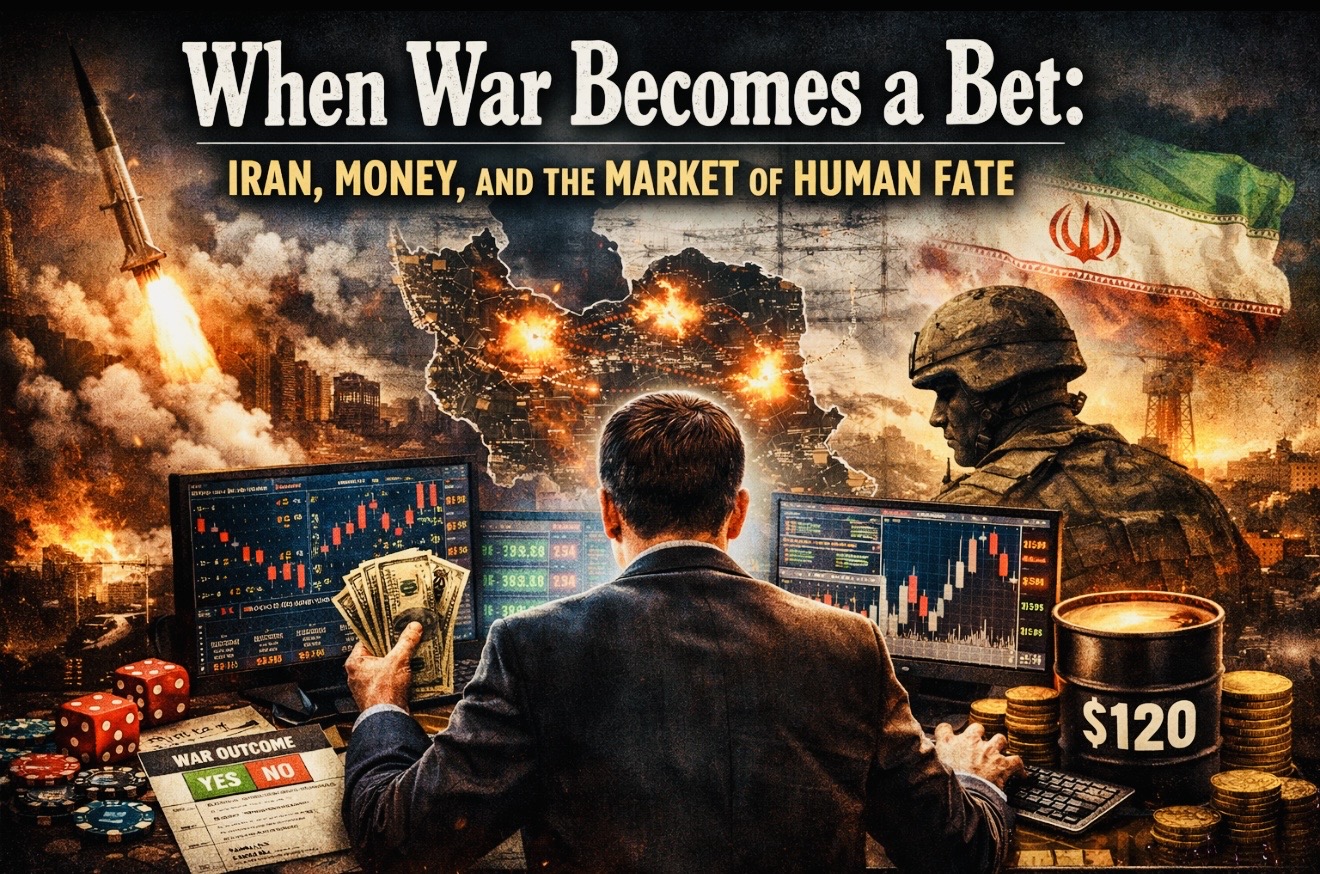
When War Becomes a Bet: Iran, Money, and the Market of Human Fate
By: Raja Zahid Akhtar Khanzada
As I write these lines, twenty hours remain in the forty-eight-hour ultimatum issued by the American president to Iran. But time, in moments like these, does not move on a clock alone. It travels through nerves, through markets, through the quiet anxieties of a watching world. Military experts lean over their maps. Journalists shape their analyses. International media calls this a decisive moment. And yet, there is no certainty. Only conjecture. Only possibilities. Only roads not yet built, but already debated.
Some say the war will expand. Others insist it will remain contained. A few hold on to the fragile hope that diplomacy might still find a way through the smoke. But nearly all agree on one truth: ultimatums are rarely about immediate outcomes. They are instruments of pressure, performances of power, sentences placed deliberately on the table so that the man across from you sits a little straighter in his chair.
But this time, the story does not end there.
There was a time, in our childhood, when we watched cricket and heard whispers, half-believed and half-understood, that betting lurked behind the game. That somewhere beyond the stadium, another contest unfolded, one where runs did not matter, only money did. That even players, it was said, sometimes became part of that invisible game. It felt distant then. Shadowy. Like a side stage hidden from the ordinary eye, a world that existed, yet remained unseen.
But the world has changed.
Now, the world is not only watching war. It is pricing it.
This is the moment that alters everything. Once, news arrived and was followed by analysis. Now, news arrives and is followed by wagers. Bets are placed. Gambles are made. And it is all given a more respectable name: markets, shares, trading. But the truth remains, standing quietly but firmly in place: it is betting. It is gambling. Only the costume has changed.
On digital platforms today, the betting around Iran, the United States, and global conflict has reached extraordinary levels. Hundreds of millions of dollars are in motion. Between $250 million and $500 million alone are circulating on questions related to Iran. These are not singular questions. They are dozens, each circling the same unease: Will there be war? Will it escalate? Will it end? Or will it spread?
And here lies the strangest transformation of all. It is no longer diplomats who answer these questions. It is those who risk their own money. A marketplace has emerged where the question is not how peace will come, but when it will come, and how much profit can be made from its arrival. More than $100 million may sit on the possibility of a ceasefire. Elsewhere, traders speculate whether fourteen consecutive days of calm are even possible. And in one of the more chilling formulations, the question is posed plainly: will the war end first, or will oil reach $120 a barrel?
It is here that one must pause and ask: where have we arrived?
To understand this world, one must understand the machinery behind it. Digital platforms known as prediction markets, including names like Polymarket and Kalshi, have turned global events into tradable outcomes. Users buy “Yes” or “No” shares on whether something will happen. If a “Yes” share trades at sixty cents, the market is effectively saying there is a sixty percent chance of that event occurring. If the event happens, the share pays out one dollar. If it does not, it becomes worthless.
Thus, every headline becomes a financial instrument. Every war becomes an opportunity.
Despite regulatory restrictions in the United States, access persists. Through VPNs and cryptocurrency, users from around the world participate in these markets. And within this ecosystem, even political proximity finds its place. Donald Trump Jr. is not the founder of such a platform, nor its day-to-day operator, yet his association with its advisory structures and financial interest underscores something deeper: politics, capital, and technology are no longer separate spheres. They are converging into one.
War, once an unambiguous tragedy, has become something else entirely. For some, it remains a threat. For others, it is an opportunity.
Look closer, and the pattern sharpens. Tens of millions of dollars are placed on whether the United States will directly strike Iran. In some markets, up to $50 million rides on the question of who will launch the next attack. But perhaps the most unsettling truth is this: people are betting less on the beginning of war and more on its end, as if watching a game, as if awaiting a final score.
And this phenomenon is not confined to one region. During the Gaza-Israel conflict, during the war between Russia and Ukraine, the same pattern emerged. With every strike, the odds shifted. With every statement, prices rose and fell. It was as if the war itself was not breathing, but its price was.
This is the architecture of a new digital world. A world in which events are not merely lived, but measured, bought, and sold. A world where probability becomes currency.
And yet, beneath this innovation lies a deeper unease. Global media has not treated this trend as mere technological evolution, but as an ethical rupture. There have been instances where bets were placed on the fate of pilots shot down in conflict. Human lives, reduced to positions on a ledger. Some have called it a “death market,” a place where mortality itself becomes a commodity. Reports have surfaced suggesting that individuals have profited by placing bets ahead of major events, raising questions that are as troubling as they are difficult to prove: is there, somewhere within this system, a shadow of insider knowledge?
When politics, capital, and technology converge, complexity is inevitable. But so is danger.
There are figures who do not operate these platforms, yet stand close enough to influence their gravity. Their presence lends legitimacy, visibility, and trust. And in such a system, price is no longer just a number. It becomes a signal.
And so, we arrive at a different set of questions.
No longer: where is the war being fought?
But: where is the war being priced?
Are decisions being shaped in the battlefield, where soldiers stand, or on screens, where strangers wager on the fate of others?
This is not a scene from fiction. It is our world.
We are living in an era where war is no longer only reported, but performed. Where it becomes spectacle. And in this spectacle, we are all, to some degree, participants.
There was a time when history was written in blood. In sacrifice. On the ground. Today, it is increasingly written in dollars. And the pen is no longer held by the soldier, but by the trader, seated before a screen, pressing a button, attempting to predict tomorrow.
And perhaps that is the most unsettling truth of all.
Power is no longer shaped only by weapons. It is shaped by money. And perhaps even more by belief, by the collective wager on what comes next.
And when the future itself becomes something to be bought and sold, when war becomes a form of gambling, the question is no longer who will win.
The question is: where is humanity losing?
Perhaps this is the moment to pause and ask, quietly but honestly, if everything can be priced, can anything still be valued? Or have we entered a world where everything has a price, and nothing has meaning?
Known for his forthright journalism and incisive analysis, Khanzada has written extensively on geopolitics, diplomacy, human rights, and the concerns of overseas Pakistanis. This article has been specially translated into Spanish from his original Urdu column.
