

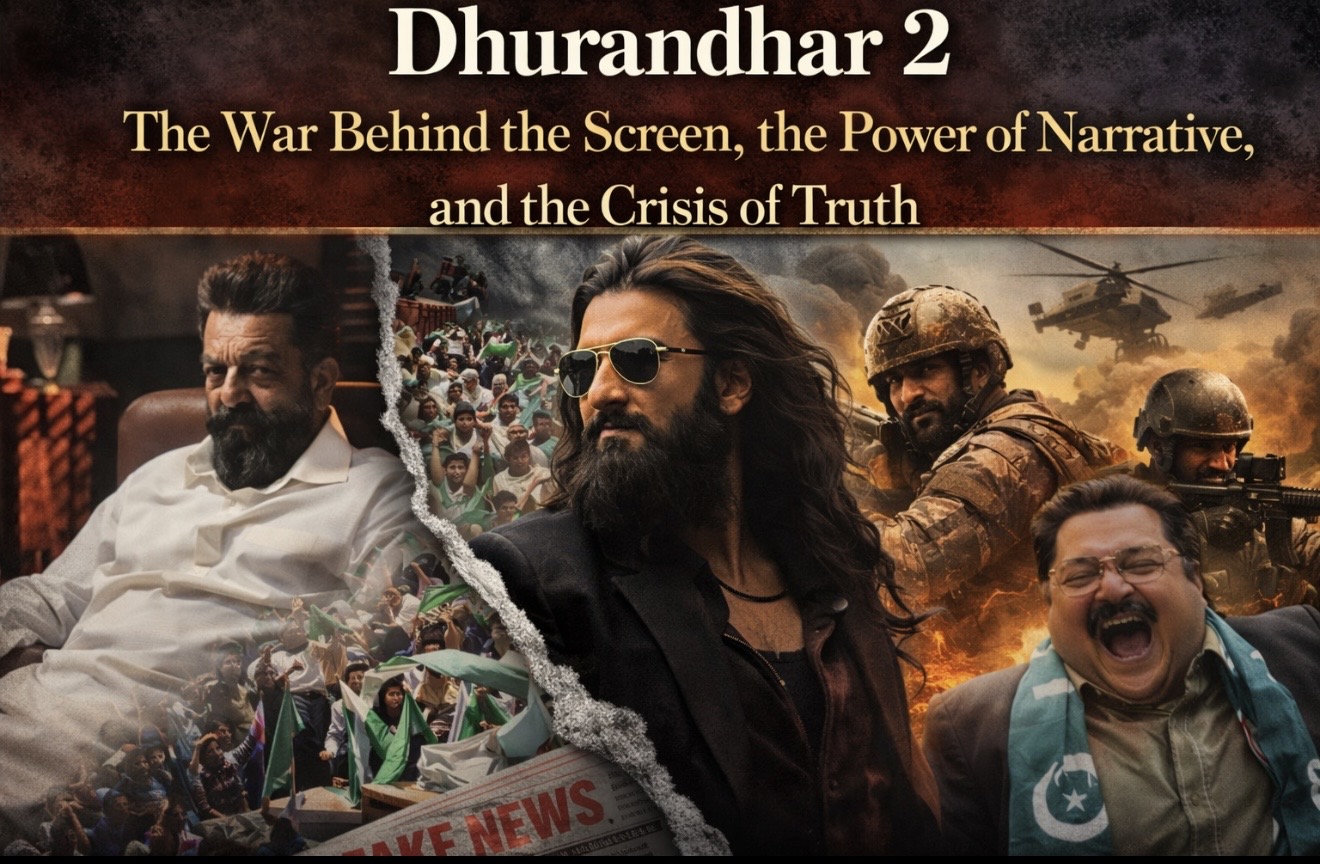
Dhurandhar 2: The War Behind the Screen, the Power of Narrative, and the Crisis of Truth
By Raja Zahid Akhtar Khanzada
Several days have passed since Eid, and I found myself hesitating to write this review. Not because I lacked words, but because what I had witnessed did not feel like a film alone. It felt like an experience, an observation, something that demanded reflection before it could be translated into language. Today, I finally attempt to put it into words.
Sometimes, cinema is not merely entertainment. It is persuasion. It is architecture for the mind. It is a quiet weapon that does not fire bullets, yet leaves wounds in the way people think.
On the second day of Eid, sitting in a cinema hall in the United States, watching Dhurandhar 2, I realized I was not simply watching a story unfold on screen. I was watching a narrative being constructed. And more importantly, I was watching it as a Pakistani viewer trying to read what lay beneath the surface.
Before entering the theater, an Indian friend remarked, “This film is against Pakistan.” I smiled and replied, “That is precisely why I want to watch it.” In that moment, both the journalist and the reader within me were fully awake. Because some stories are not meant to be watched, they are meant to be examined, questioned, and understood for what they reveal and what they conceal.
The film begins with a familiar disclaimer: that it is a work of fiction. Yet, almost immediately, it anchors itself in reality. The Kandahar hijacking, the 2001 Indian Parliament attack, and the 2008 Mumbai attacks are invoked to give the narrative a sense of authenticity. But this is not reality in its full complexity. It is a curated reality, shaped, selected, and arranged to serve a particular perspective.
At that point, the film ceases to be just cinema. It becomes a political document.
Pakistan, in this narrative, is not portrayed as a country but as an idea—an idea consistently painted in dark, singular tones. Characters are not given depth; they are assigned blame as identity. A sitting member of Pakistan’s National Assembly from Karachi, someone I personally know and whose brother is a close friend of mine, is depicted as an Indian agent, seemingly for no reason other than his association with a Baloch identity. The issue here is not character, but identity itself. This is not storytelling; it is construction of perception.
The protagonist, played by Ranveer Singh, is less a human being and more a symbol. Bullets pierce him, yet he does not stop. Blades cut into him, yet he does not bend. Blood flows, yet he does not fall. This is not realism. It is fantasy. It resembles a video game universe where the hero does not die but evolves with every attack.
Watching this, I was reminded of the era of Pakistani Punjabi cinema, particularly the films of Sultan Rahi, where heroes could survive impossible odds, where emotion triumphed over reality. The difference is that the past was simpler, and today is digital. But the illusion remains the same: the dream of the invincible hero.
The Pakistan depicted in the film is flattened into a single dimension. Karachi’s Lyari is portrayed as if it represents the entire nation, as if its complexities define the whole. Political structures are reduced to caricatures, and terrorism is framed within a narrative that allows no room for nuance. Yet reality, as we know, is layered, human, and far more complicated.
Even the music raises questions. Echoes of “Hawa Hawa” recall the voice of Hassan Jahangir, while certain compositions seem to carry the stylistic imprint of Sajjad Ali. With elements resembling tracks like “Basbousa,” one begins to wonder: where does inspiration end, and imitation begin?
Inside the cinema hall, applause erupted at moments of action, particularly from segments of the Indian audience who appeared fully immersed in the narrative. Yet, sitting beside me, a friend of Bangladeshi origin shared a similar discomfort. By the time the interval arrived, it felt as though the film was not only consuming time, but testing patience. Its grip began to loosen, and what might have been a serious narrative drifted toward spectacle.
And yet, here lies the paradox.
The film has achieved significant commercial success, generating immense box office revenue and public excitement. At the same time, it has drawn sharp criticism in more reflective circles. This contradiction raises an essential question: is this success, or is it the triumph of a narrative? Is this cinema, or another front in a different kind of war?
In many ways, Dhurandhar 2 is both noise and silence. Noise in its scale, its action, its spectacle. Silence in the questions it leaves behind, in the narratives it embeds, in the impact it quietly carries.
As I walked out of the theater, the night of Eid remained unchanged—bright, festive, alive. But within me, a question lingered: what are we really watching in cinema today? A story, or a narrative? Entertainment, or conditioning?
Perhaps the problem is not the film itself. Perhaps the problem lies in the widening distance between reality and cinema. Because when cinema begins to win not by truth, but by perception, it ceases to be just film. It becomes a psychological battleground.
And in that battleground, no bullets are fired. Only stories. Yet their wounds run far deeper.

Conocido por su periodismo directo y su análisis perspicaz, Khanzada ha escrito extensamente sobre geopolítica, diplomacia, derechos humanos y los desafíos que enfrentan los pakistaníes en el exterior. Este artículo ha sido traducido especialmente al español a partir de su columna original en urdu.
