

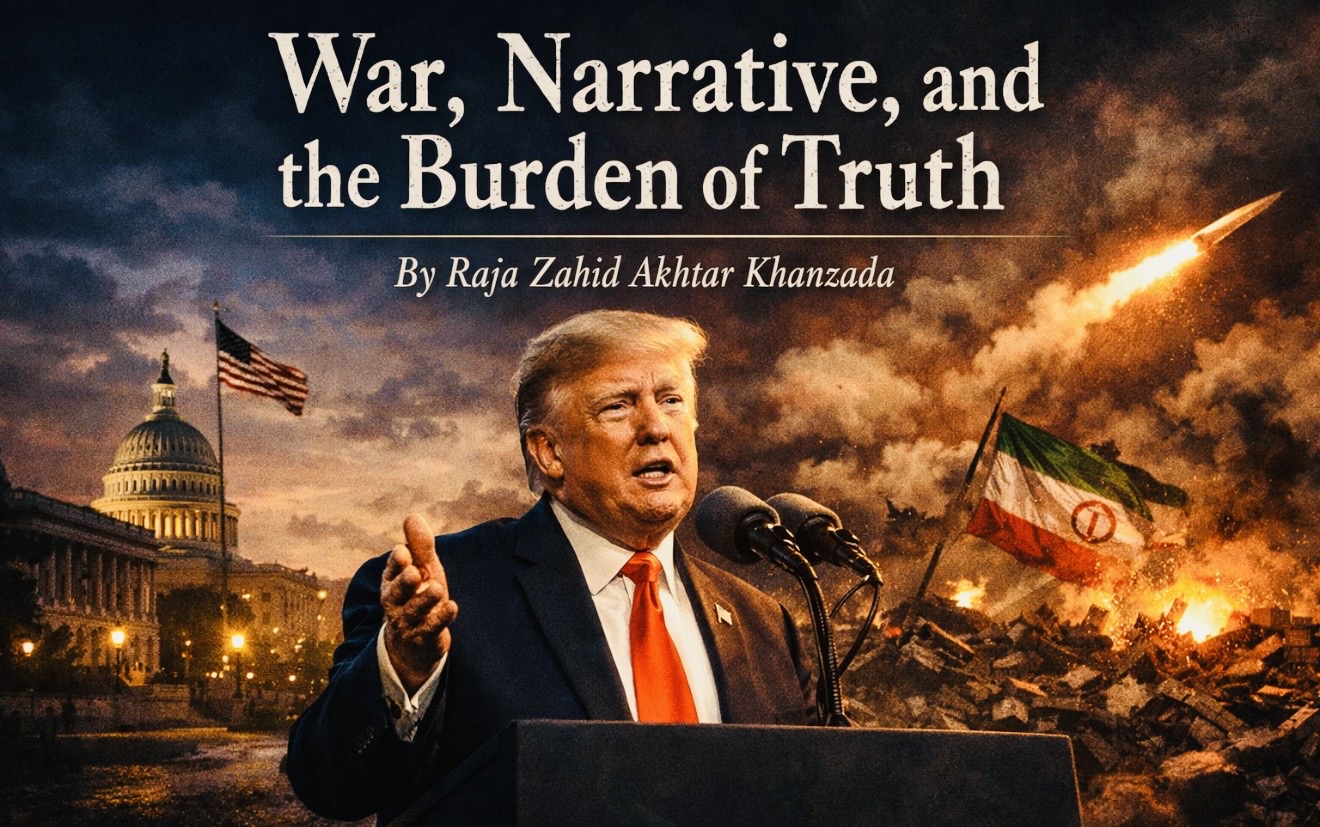
War, Narrative, and the Burden of Truth
By Raja Zahid Akhtar Khanzada
WASHINGTON:There is a silence in this city that does not belong to peace. It is the silence of power thinking about itself. The buildings glow, the flags move in a rehearsed wind, and somewhere behind those marble walls, words are chosen carefully, because words, in a place like this, do not merely describe reality. They attempt to create it.
On the night of April 1, 2026, Donald Trump stood before the American people and spoke of victory. He spoke of a war that, in his telling, had already bent history in America’s favor. Iran’s navy, he said, was gone. Its air force was in ruins. Its command broken. Its future, implied if not declared, already decided.
But there is something one must understand about power: it does not speak to inform. It speaks to persuade. And sometimes, it speaks because it is afraid of what silence might reveal.
The president’s words carried the weight of certainty. He promised that Iran would never possess nuclear weapons, invoking old vows like sacred scripture. He reached back into time, to his campaign in 2015, to the killing of Qasem Soleimani, to the unraveling of an agreement once brokered under Barack Obama. Each reference was meant to build a line, straight and unbroken, from past to present, from promise to action, from action to righteousness.
But history is rarely so obedient.
Because if this war is already won, as he suggests, then why does it continue? If the enemy is broken, why must it still be struck? If the threat is neutralized, why does the future remain so uncertain? These are not questions the speech answered. These are questions it tried, quietly, to move past.
There is always a moment in war when language begins to betray itself. When victory is declared too soon, or too often, it begins to sound less like truth and more like hope disguised as fact. And hope, when wielded by power, can be a dangerous thing.
The president spoke of sacrifice, of thirteen American lives lost, and in that moment the speech became something else. It became not only a justification, but a demand. To honor the dead, he suggested, the living must see the mission through. But this is the oldest argument in war: that the cost already paid must justify whatever cost remains. It is an argument that turns grief into obligation, and memory into momentum.
Meanwhile, beyond the reach of the podium, reality moves in its own direction. Oil prices rise. Markets tremble. Families feel the war not in distant headlines, but in the arithmetic of daily life. The cost of gasoline, the price of food, the quiet anxiety that settles in when the future feels less certain than it did yesterday. War, in the end, always comes home.
The American press, institutions like Associated Press and Reuters, listened carefully, not only to what was said, but to what was missing. They heard the declarations of success, but not the map of an ending. They saw the confidence, but not the clarity. And in that absence, they recognized something familiar: a nation speaking loudly because it is unsure of what comes next.
And then there was the remark, almost casual, that the United States could simply take Iran’s oil. It passed quickly, as such remarks often do, but it lingered in the air. Because it revealed something that no policy paper ever fully admits: that beneath the language of security and morality, there is often a quieter language, one of resources, of control, of who owns what, and who decides.
The Strait of Hormuz, that narrow artery through which the world’s energy flows, hovered over the speech like a question no one wanted to answer directly. The president suggested others should secure it, others should bear the burden. It was a subtle shift, but an important one. Power, it seemed, was beginning to renegotiate its responsibilities even as it asserted its dominance.
Across the ocean, Iran responded not with surrender, but with defiance. Abbas Araghchi rejected the language of threats. Masoud Pezeshkian addressed the American people, asking a question that cut deeper than any missile: whose war is this, really?
It is a question worth asking, not only in Tehran, but in Washington, and in every place where the consequences of this conflict will eventually be felt.
Because there is another truth, quieter but more persistent than any speech. The American people are not entirely convinced. They see the rising costs, the shifting explanations, the distance between promise and outcome. They hear the words, but they also feel the weight of uncertainty. And in a democracy, that feeling matters.
The president, of course, understands this. That is why the speech was not only about Iran. It was about America. About control. About reassurance. About the fragile contract between a government and its people, a contract that war always strains.
But contracts, like narratives, cannot survive on language alone. They require trust. And trust is not built through declarations of victory. It is built through clarity, through honesty, through an end that people can see, not just imagine.
For now, that end remains out of reach.
And so we are left with a speech that is both powerful and incomplete. A declaration that sounds like an ending, but feels like a continuation. A moment that reveals, perhaps more than it intends, the central paradox of our time: that in modern war, the greatest battle is not always fought on the ground, but in the story we tell ourselves about what is happening, and why.
And sometimes, it is in that story that the first cracks begin to appear.
Conocido por su periodismo directo y su análisis perspicaz, Khanzada ha escrito extensamente sobre geopolítica, diplomacia, derechos humanos y los desafíos que enfrentan los pakistaníes en el exterior. Este artículo ha sido traducido especialmente al español a partir de su columna original en urdu.
